
RedKalion
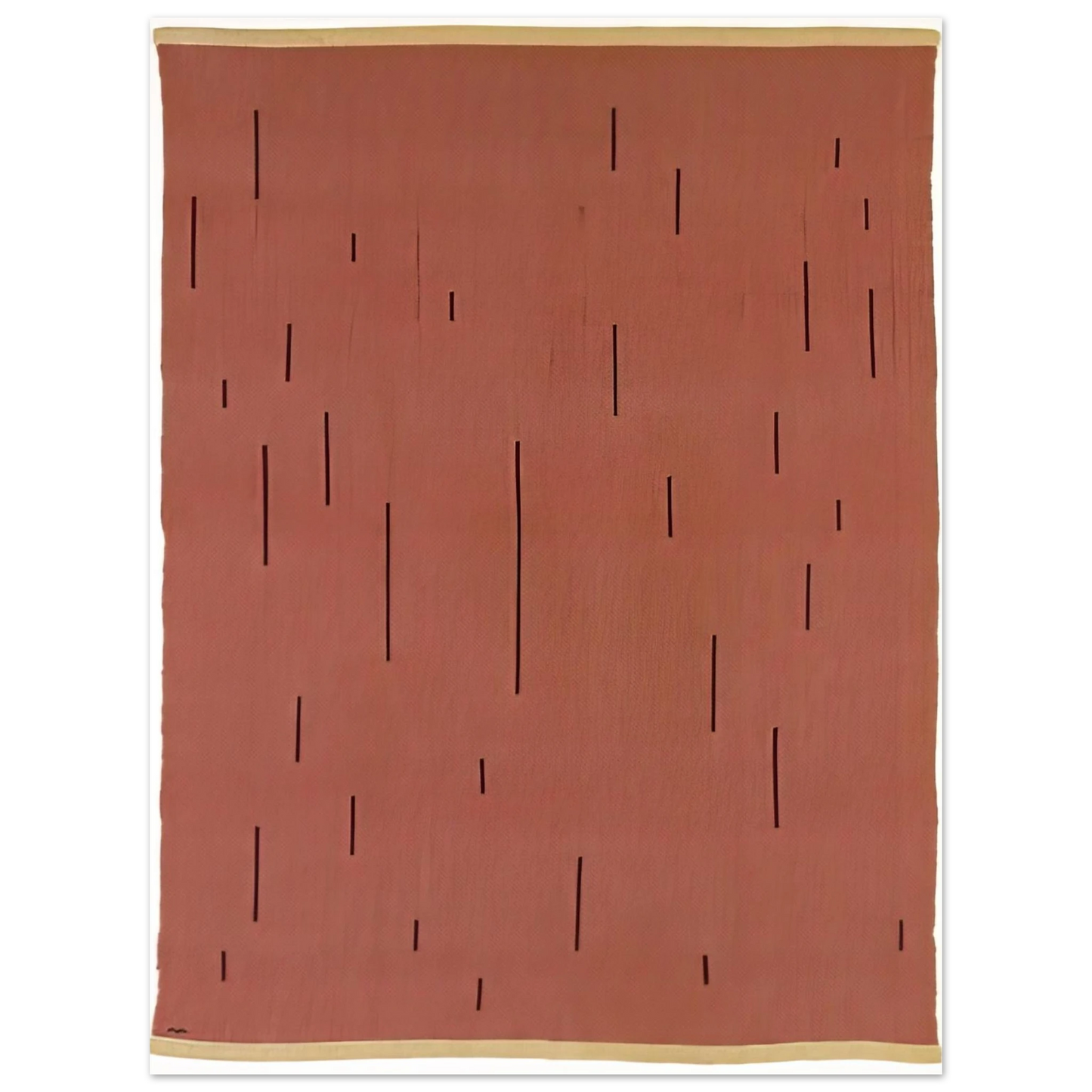
Anni Albers - WITH VERTICALS 1946 75x100 cm / 30x40inches Fine Art Poster
Anni Albers - WITH VERTICALS 1946 75x100 cm / 30x40inches Fine Art Poster
Couldn't load pickup availability
The Structural Elegance of Anni Albers: 'With Verticals' 1946
Elevate your environment with the rhythmic precision of Anni Albers and her seminal 1946 work, 'With Verticals'. As a central figure of the Bauhaus movement, Albers revolutionized the relationship between craft and fine art. This piece exemplifies her ability to translate the structural logic of weaving into a sophisticated graphic language, where vertical intervals create a visual cadence that is both rigorous and lyrical. It is a masterclass in mid-century abstraction that remains strikingly contemporary.
Museum-Quality Craftsmanship by RedKalion
At RedKalion, we honor the legacy of Anni Albers by utilizing Master's Edition archival paper for this reproduction. This 250 gsm (110 lb) natural white paper offers an uncoated, matte finish that mirrors the tactile honesty of the original era. With a thickness of 0.29 mm (11.4 mils), the print possesses a substantial, gallery-grade weight that demands respect in any setting. Our archival process ensures that the print is acid-free (pH above 7), protecting it against yellowing and degradation for generations to come.
A Sustainable Choice for Fine Art
This 75x100 cm (30x40 inches) fine art print is not only a tribute to aesthetic excellence but also to environmental responsibility. We utilize FSC-certified paper, ensuring that your acquisition supports sustainable forestry. Each piece is printed and shipped on demand with no minimum order requirements, reflecting RedKalion’s commitment to modern, efficient, and ethical curation. Transform your space with a work that bridges the gap between historical significance and archival durability.
Discover Unlimited Art Possibilities
At RedKalion, you can find virtually any artwork from any artist, available in a wide range of sizes to perfectly match your space.
If you didn’t find what you’re looking for, contact us at support@redkalion.com . We will source any artwork and produce it in any size and format you need, including art prints, posters, canvas, framed pieces, framed canvas, and more.
For dedicated art enthusiasts, we also offer handcrafted replicas of any artwork, carefully painted by highly skilled artists using traditional techniques.
For custom requests, contact us at support@redkalion.com .
What is the quality of the paper used for this Anni Albers print?
We use Master's Edition archival paper, a 250 gsm (110 lb) medium that offers a premium, museum-quality feel. Its natural white, matte finish provides a luxurious texture perfect for high-end fine art reproductions.
How does RedKalion ensure the longevity of the artwork?
Our prints are acid-free with a pH value above 7, meaning they are chemically stable. This archival standard prevents the paper from yellowing or becoming brittle, preserving the artwork's integrity for decades.
Is the paper used for 'With Verticals' sustainably sourced?
Yes, all our prints utilize FSC-certified paper. This certification guarantees that the materials come from responsibly managed forests that provide environmental, social, and economic benefits.
What are the shipping and fulfillment details for this poster?
RedKalion prints and ships each order on demand, ensuring a fresh, pristine product. There are no minimum order requirements, and we utilize secure, protective packaging for global delivery.
Does this reproduction capture the true texture of the original work?
While it is a flat print, the 0.29 mm thick, uncoated matte paper provides a depth and organic texture that beautifully reflects the structural, textile-inspired nuances of Albers' original 1946 design.
What is the historical significance of 'With Verticals' in Albers' career?
Created in 1946, this work marks Albers' transition from the loom to graphic arts. It applies the 'woven' logic of vertical and horizontal intersection to paper, a core Bauhaus principle.
Why is Anni Albers considered a pioneer of geometric abstraction?
Albers broke the boundaries between traditional weaving and modern art, using the grid as a foundation for complex, non-representational compositions that influenced generations of abstract artists and designers.