RedKalion
Ascending I - 1958 - Alfred Jensen Acrylic Print - 70x100 cm / 28x40″ inches | Alfred Jensen Wall Art | Alfred Jensen Prints
Ascending I - 1958 - Alfred Jensen Acrylic Print - 70x100 cm / 28x40″ inches | Alfred Jensen Wall Art | Alfred Jensen Prints
Couldn't load pickup availability
Elevate Your Space with Alfred Jensen’s Mathematical Masterpiece
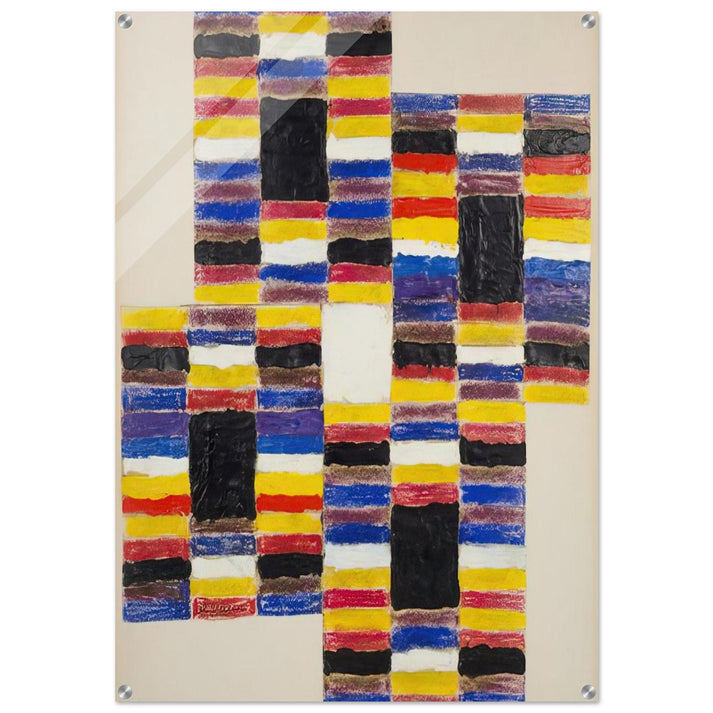
Experience the cerebral intensity of Alfred Jensen’s Ascending I (1958), a seminal work that bridges the gap between mid-century abstraction and ancient numerical systems. As a centerpiece of our curated collection at RedKalion, this museum-quality reproduction captures the rhythmic precision and vibrant color theory that defined Jensen’s unique contribution to the American avant-garde. This 70x100 cm (28x40″) acrylic print offers a sophisticated window into the artist's fascination with the Pythagorean theorem and Mayan calendrics, translated into a modern visual language.
Artistic Significance and Historical Context
By 1958, Alfred Jensen had moved away from traditional Abstract Expressionism to embrace a structured, grid-based approach. Ascending I represents a pivotal moment where the artist utilized high-impasto concepts and complex color sequences to map metaphysical ideas. His work is celebrated for its 'thick' intellectualism—where every color choice and directional stroke is governed by mathematical logic. At RedKalion, we preserve this intensity through high-definition printing that respects the original’s textural complexity.
The RedKalion Acrylic Standard
This Alfred Jensen wall art is rendered on premium 4mm (0.15") acrylic, a medium chosen specifically for its ability to enhance the luminosity of Jensen’s palette. The sleek, vibrant finish provides a sense of depth that traditional paper cannot replicate, making it an ideal choice for modern interiors seeking a statement piece of fine art prints. Features include:
- Precision Design: Straight-cut corners for a clean, contemporary silhouette.
- Visual Clarity: Optimized white backgrounds for any transparent elements, ensuring the colors remain true to the artist's vision.
- Durability: A resilient, archival-grade surface that protects the artwork from environmental factors while maintaining clarity.
Installation and Presentation
Every Alfred Jensen print arrives ready for display. Our included hanging kit features high-quality hardware and screws. The piece is pre-drilled with 8mm (0.31") diameter holes located 14mm (0.55") from each corner, designed to accommodate the 15mm (0.6") screw heads for a secure, floating presentation. This architectural mounting style complements the mathematical rigor of Jensen’s work, turning your wall into a gallery-level installation.

Discover Unlimited Art Possibilities
At RedKalion, you can find virtually any artwork from any artist, available in a wide range of sizes to perfectly match your space.
If you didn’t find what you’re looking for, contact us at support@redkalion.com . We will source any artwork and produce it in any size and format you need, including art prints, posters, canvas, framed pieces, framed canvas, and more.
For dedicated art enthusiasts, we also offer handcrafted replicas of any artwork, carefully painted by highly skilled artists using traditional techniques.
For custom requests, contact us at support@redkalion.com .
What makes RedKalion's Alfred Jensen prints museum-quality?
Our reproductions utilize high-resolution imaging and archival-grade 4mm acrylic to capture every detail of Jensen's complex grids. This ensures color accuracy and professional-grade durability, elevating your Alfred Jensen wall art to gallery standards.
What are the specifications of the acrylic material used?
We use premium 0.15" (4mm) thick acrylic with straight-cut corners. This material provides a sleek, vibrant finish that enhances light transmission and depth, making the colors in Ascending I appear more luminous and defined.
How do I install my Ascending I acrylic print?
Each print includes a professional hanging kit with screws and hardware. The acrylic features pre-drilled 8mm holes at each corner, placed 14mm from the edge, allowing for a secure and modern floating installation.
Is this Alfred Jensen wall art archival-grade?
Yes. The combination of UV-resistant inks and high-quality acrylic ensures that your Alfred Jensen prints will not fade over time. The material is designed for archival longevity, maintaining its vibrancy for decades.
How is the artwork packaged for secure shipping?
We employ rigorous protective packaging standards. Each 70x100 cm print is layered with protective film and secured in specialized, impact-resistant crates to ensure your fine art print arrives in pristine condition.
What is the significance of the mathematical patterns in Ascending I?
Alfred Jensen used mathematical sequences to represent cosmic order. Ascending I reflects his study of ancient number systems, using color and geometry to visualize complex philosophical and scientific theories from 1958.
How did Alfred Jensen's background influence his 1958 works?
Born in Guatemala and traveling extensively, Jensen combined European color theory with ancient Mayan mathematics. By 1958, his work became a unique intersection of scientific logic and abstract expressionist heritage.