RedKalion
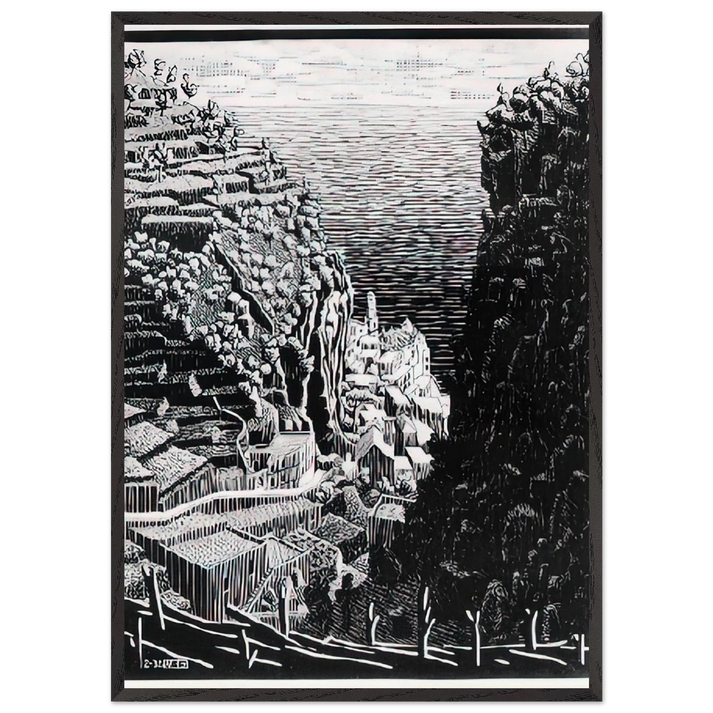
ATRANI COAST OF AMALFI 1 - MC Escher 70x100 cm / 28x40 inches Framed Art Print – Black Wooden Frame | Maurits Cornelis Escher Prints
ATRANI COAST OF AMALFI 1 - MC Escher 70x100 cm / 28x40 inches Framed Art Print – Black Wooden Frame | Maurits Cornelis Escher Prints
Couldn't load pickup availability
Elevate Your Collection with M.C. Escher’s Architectural Mastery
Step into the intricate world of Maurits Cornelis Escher with our museum-quality reproduction of ATRANI COAST OF AMALFI 1. This striking piece captures the rhythmic geometry of the Italian coastline, rendered through the eyes of a master of perspective. Created during Escher’s prolific Italian period, this composition highlights the structural harmony of the town’s ancient houses and winding staircases, foreshadowing the complex spatial illusions that would later define his career.
Archival Excellence and Sustainable Craftsmanship
At RedKalion, we believe that fine art deserves to be preserved for generations. This MC Escher fine art print is meticulously produced on 250 gsm (110 lb) archival museum-quality paper. The natural white, matte, and uncoated finish provides a sophisticated texture that eliminates glare, allowing the deep blacks and subtle highlights of Escher’s lithography to shine with authentic clarity. Our commitment to sustainability is reflected in our choice of FSC-certified materials, ensuring your acquisition supports responsible forestry.
Premium Framing for the Discerning Curator
This 70x100 cm / 28x40 inches masterpiece is presented in a premium black wooden frame, crafted from responsibly sourced oak and ash. To provide a more presence-heavy and professional aesthetic, our frames measure 20mm (0.79") in width and thickness, surpassing the standard 14mm profile. Your artwork is protected by shatterproof plexiglass, ensuring the print remains pristine and safe during transport and display. Every order includes a complete hanging kit, making this work ready-to-hang the moment it arrives at your doorstep.
- Artist: M.C. Escher
- Title: Atrani Coast of Amalfi 1
- Paper: Archival 250 gsm natural white paper
- Frame: 20mm black oak/ash wood
- Protection: Shatterproof plexiglass
- Certifications: FSC-certified paper

Discover Unlimited Art Possibilities
At RedKalion, you can find virtually any artwork from any artist, available in a wide range of sizes to perfectly match your space.
If you didn’t find what you’re looking for, contact us at support@redkalion.com . We will source any artwork and produce it in any size and format you need, including art prints, posters, canvas, framed pieces, framed canvas, and more.
For dedicated art enthusiasts, we also offer handcrafted replicas of any artwork, carefully painted by highly skilled artists using traditional techniques.
For custom requests, contact us at support@redkalion.com .
What defines the print quality of this Escher reproduction?
We use 250 gsm museum-quality, archival paper with a matte finishing. This ensures a glare-free viewing experience and long-term durability, preserving the intricate details of the ATRANI COAST OF AMALFI 1 print for decades.
What are the framing specifications for this piece?
The print is housed in a 20mm (0.79") thick and wide black frame made from responsibly sourced oak or ash. This premium profile provides superior structural integrity and a gallery-standard aesthetic compared to thinner frames.
Is the artwork ready to hang upon delivery?
Yes, your M.C. Escher framed art print includes a pre-installed hanging kit. It is designed to be ready-to-hang immediately, allowing you to elevate your space without needing extra hardware.
How do you ensure the longevity and protection of the print?
We protect each print with shatterproof, transparent plexiglass and use acid-free, natural white paper. These archival-grade materials prevent yellowing and physical damage, ensuring your investment remains an enduring centerpiece.
What is the shipping and protection process for large prints?
Our 70x100 cm prints are securely packaged with protective edges and robust materials. The use of shatterproof plexiglass instead of standard glass ensures the artwork arrives in perfect condition without risk of breakage.
What was M.C. Escher’s inspiration for the Atrani series?
During the 1920s and 30s, Escher was captivated by the structural rhythm of Italian hill towns. Atrani provided the perfect subject for his study of interlocking architecture and dramatic coastal perspectives.
Does this print represent Escher’s early style?
Yes, this piece belongs to Escher's Italian period (1931). While it precedes his "impossible" constructions, it showcases the mastery of light, shadow, and architectural layering that defined his later mathematical works.