RedKalion
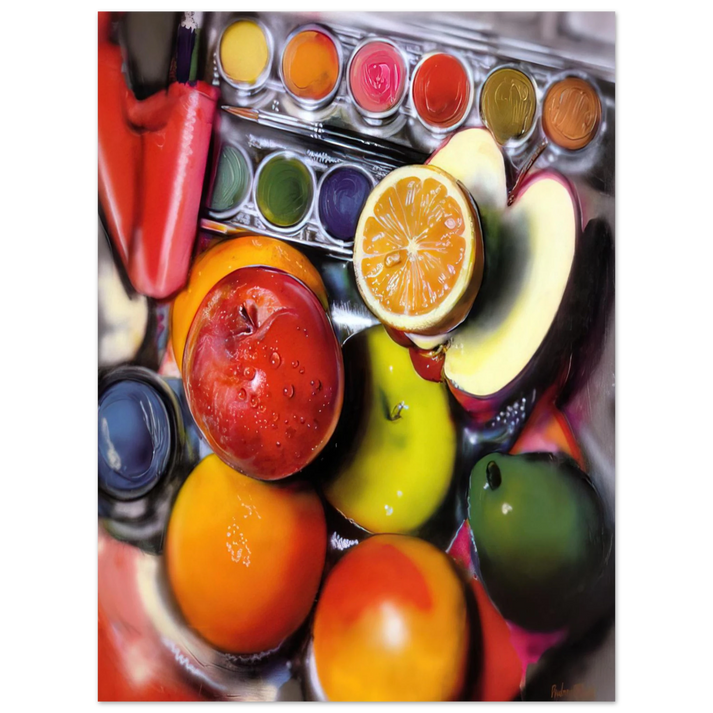
Audrey Flack - ENERGY APPLES 1980 75x100 cm / 30x40inches Fine Art Poster
Audrey Flack - ENERGY APPLES 1980 75x100 cm / 30x40inches Fine Art Poster
Couldn't load pickup availability
Elevate Your Space with Audrey Flack’s Masterpiece: Energy Apples (1980)
Experience the vibrant intersection of color theory and meticulous realism with Energy Apples (1980), a seminal work by the pioneer of Photorealism, Audrey Flack. This museum-quality fine art print captures the pulsating vitality and luminous light that defined Flack’s innovative airbrush technique during the peak of her career. As one of the few women in the Photorealist movement, Flack’s work often transcended mere documentation, infusing everyday objects with a heightened, almost spiritual resonance.
The Artistry of Photorealism
In Energy Apples, Flack challenges the viewer's perception of light and form. The composition is a masterclass in Superrealism, utilizing layers of transparent pigment to achieve a depth that traditional brushwork often misses. This reproduction honors Flack's legacy, preserving the intense saturation and intricate reflections that make this piece a cornerstone of 20th-century American art history.
Museum-Quality Technical Specifications
At RedKalion, we curate archival-grade prints that serve as enduring investments in your home or gallery. This premium reproduction is crafted using the following professional standards:
- Master’s Edition Archival Paper: A heavyweight 250 gsm (110 lb) foundation that provides a substantial, luxury feel.
- Uncoated Matte Finish: A natural white (off-white) surface that eliminates glare, allowing the vibrant reds and greens of the apples to be viewed from any angle.
- Archival Longevity: Acid-free paper with a pH above 7 ensures your print remains pristine, resisting the yellowing and degradation associated with standard posters.
- Substantial Texture: With a thickness of 0.29 mm (11.4 mils), this print offers the tactile presence of an original gallery piece.
- Sustainable Excellence: We utilize FSC-certified paper, supporting responsible forest management while delivering world-class art.
By choosing this RedKalion edition of Energy Apples, you are acquiring more than a poster; you are bringing a piece of art history into your environment, reproduced with the precision and respect the original work demands.
Discover Unlimited Art Possibilities
At RedKalion, you can find virtually any artwork from any artist, available in a wide range of sizes to perfectly match your space.
If you didn’t find what you’re looking for, contact us at support@redkalion.com . We will source any artwork and produce it in any size and format you need, including art prints, posters, canvas, framed pieces, framed canvas, and more.
For dedicated art enthusiasts, we also offer handcrafted replicas of any artwork, carefully painted by highly skilled artists using traditional techniques.
For custom requests, contact us at support@redkalion.com .
What makes the paper quality of this Audrey Flack print 'Museum-Quality'?
We use Master's Edition archival paper weighing 250 gsm. This heavyweight, acid-free (pH above 7) paper prevents yellowing and preserves the vibrant colors of 'Energy Apples' for decades, meeting the high standards required by galleries and museums.
How is the 'Energy Apples' print finished?
The print features a premium matte, uncoated finish on a natural white (off-white) base. This specific texture enhances the luxurious feel of the Photorealist details while ensuring there is no distracting light reflection.
Is the shipping process sustainable and efficient?
Yes. All prints are fulfilled on demand with no minimum order requirements, reducing waste. We use FSC-certified paper and ship in robust packaging to ensure your fine art print arrives in perfect condition.
Will the colors in this 1980 reproduction fade over time?
No. Thanks to the archival nature of our acid-free paper and high-quality inks, this reproduction is designed to resist aging and fading, maintaining its original intensity and 'energy' for a lifetime.
What are the exact dimensions and thickness of the print?
This edition measures 75x100 cm (30x40 inches). It has a thickness of 0.29 mm (11.4 mils), providing a professional rigidity and premium feel characteristic of high-end art reproductions.
Why is 'Energy Apples' significant in Audrey Flack's career?
Created in 1980, 'Energy Apples' showcases Flack's transition toward more symbolic and vibrant still lifes. It highlights her role as a pioneer of Photorealism, using airbrush techniques to create depth and luminosity.
What specific technique did Audrey Flack use for this work?
Flack utilized a sophisticated airbrushing technique, layering primary colors to create a 'super-real' effect. This allowed her to capture light reflections and color transitions with a precision that mimics high-resolution photography.