RedKalion
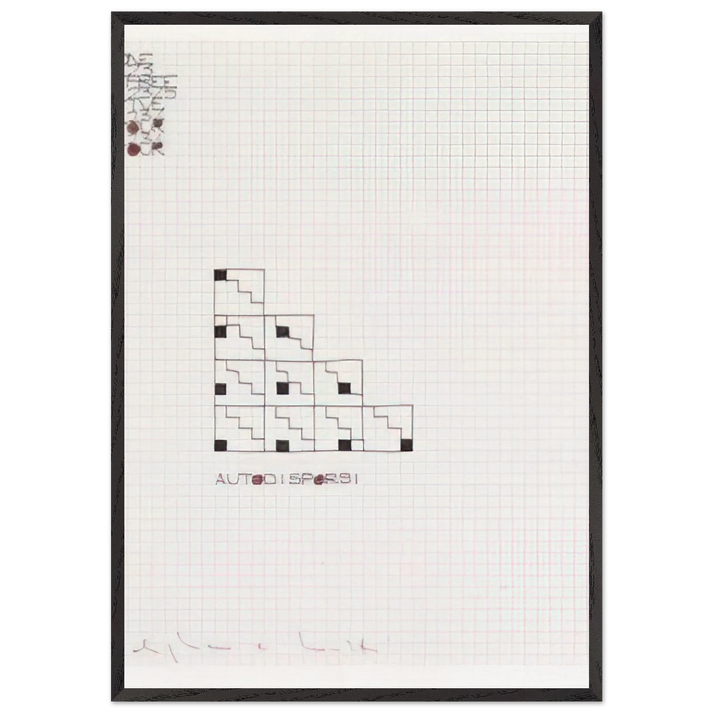
AUTODISPORSI 1975 - Alighiero Boetti 70x100 cm / 28x40 inches Framed Art Print – Black Wooden Frame
AUTODISPORSI 1975 - Alighiero Boetti 70x100 cm / 28x40 inches Framed Art Print – Black Wooden Frame
Couldn't load pickup availability
Elevate Your Space with Conceptual Mastery: Alighiero Boetti's AUTODISPORSI (1975)
Immerse yourself in the intellectual rigor of Italian conceptualism with this museum-quality reproduction of Alighiero Boetti's seminal 1975 work, AUTODISPORSI. As a leading figure of the Arte Povera movement, Boetti explored the delicate tension between order (ordine) and disorder (disordine), a philosophy perfectly encapsulated in this rhythmic, grid-based composition. This fine art print brings the avant-garde spirit of 1970s Rome into the contemporary interior.
RedKalion is proud to offer this archival-grade reproduction, meticulously crafted to preserve the nuance of Boetti's original vision. Printed on heavy 250 gsm (110 lb) natural white, matte, uncoated paper, the print offers a tactile depth that avoids the glare of standard commercial posters. The 0.29 mm thickness ensures structural integrity, making it a true investment in home curation.
Premium Framing and Material Excellence
To complement the stark, intellectual beauty of the work, this 70x100 cm (28x40 inches) piece arrives in a sophisticated black wooden frame. Constructed from responsibly sourced oak and ash wood, the frame features a contemporary profile of 20mm (0.79") in both thickness and width. This wider profile provides a more substantial and luxurious presence on your wall compared to standard 14mm frames. Every detail, from the shatterproof plexiglass to the included hanging kit, is designed for longevity and ease of installation.
- Artist: Alighiero Boetti (1940–1994)
- Paper: FSC-certified museum-quality, 250 gsm matte paper.
- Frame: Sustainably sourced wood with a premium black finish.
- Longevity: Archival materials designed to resist yellowing and fading.
By choosing a RedKalion reproduction, you are acquiring a piece that honors the legacy of 20th-century art history while adhering to the highest standards of modern sustainable craftsmanship. This is not merely a print; it is an enduring statement of aesthetic sophistication.

Discover Unlimited Art Possibilities
At RedKalion, you can find virtually any artwork from any artist, available in a wide range of sizes to perfectly match your space.
If you didn’t find what you’re looking for, contact us at support@redkalion.com . We will source any artwork and produce it in any size and format you need, including art prints, posters, canvas, framed pieces, framed canvas, and more.
For dedicated art enthusiasts, we also offer handcrafted replicas of any artwork, carefully painted by highly skilled artists using traditional techniques.
For custom requests, contact us at support@redkalion.com .
What are the specifications of the paper used for this print?
We use archival, museum-quality 250 gsm (110 lb) natural white paper. It is uncoated and matte, providing a premium feel and superior ink absorption for long-lasting fine art reproductions.
Is the frame made from real wood?
Yes, our frames are crafted from responsibly sourced, FSC-certified oak and ash wood. The 20mm thick black wooden frame provides a substantial, high-end gallery aesthetic.
Does the artwork come ready to hang?
Absolutely. Every framed print includes a complete hanging kit. The artwork is professionally assembled and ready to be displayed on your wall immediately upon delivery.
How is the print protected from damage?
We use high-quality, shatterproof plexiglass to protect the artwork. This ensures the print remains safe during shipping and is shielded from dust and UV exposure over time.
Is this product environmentally friendly?
Yes, RedKalion prioritizes sustainability. We use FSC-certified or equivalent materials for our frames and paper, ensuring that your art collection supports responsible forest management.
What is the significance of the year 1975 in Boetti's work?
1975 was a pivotal year for Boetti as he deepened his exploration of classification and mathematical patterns, moving toward the complex grids that defined his conceptual legacy.
What does 'Autodisposi' mean in the context of this piece?
'Autodisposi' refers to a self-arranging or self-ordering system, reflecting Boetti's fascination with how rules and chance interact to create visual harmony and conceptual meaning.