

RedKalion
Barn and Silo, Vermont - Edward Hopper Acrylic Print - 70x100 cm / 28x40″ inches
Barn and Silo, Vermont - Edward Hopper Acrylic Print - 70x100 cm / 28x40″ inches
Couldn't load pickup availability
Capture the Stark Beauty of Edward Hopper’s New England
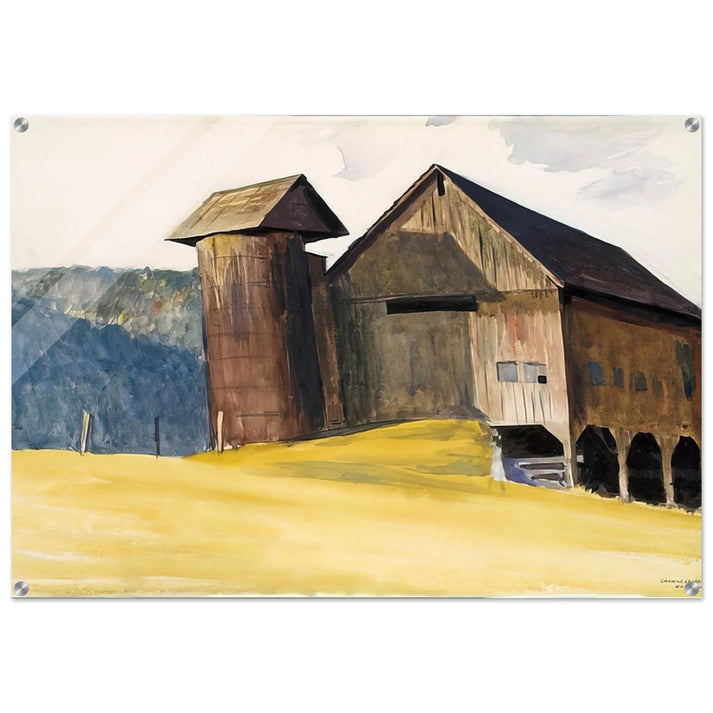
Elevate your interior with Barn and Silo, Vermont, an evocative masterpiece by the preeminent American realist, Edward Hopper. This fine art reproduction captures the profound stillness and architectural solitude that defined Hopper's Vermont period. Painted with a keen eye for the interplay of light and geometric form, the piece transforms a simple rural scene into a cinematic exploration of space and shadow.
Museum-Quality Execution on Premium Acrylic
At RedKalion, we curate archival-grade reproductions that do justice to the artist's original vision. This Barn and Silo, Vermont acrylic print is rendered on a 4mm (0.15") high-grade acrylic panel. Unlike traditional glass, our acrylic enhances the depth and vibrancy of Hopper’s palette, allowing the stark Vermont sunlight to appear almost three-dimensional. The straight-cut corners and sleek profile offer a modern, gallery-standard aesthetic that complements both contemporary and classical décor.
The RedKalion Archival Standard
Our commitment to excellence ensures that your investment endures. Each print is designed for longevity, utilizing transparent backgrounds that default to a crisp white for optimal color accuracy. The 70x100 cm (28x40″) format provides a commanding presence, while the integrated hanging kit—featuring four pre-drilled holes (14mm from the edge) and sophisticated 15mm screw heads—ensures a secure and seamless installation. Experience a museum-quality reproduction that serves as a focal point of quiet contemplation.


Discover Unlimited Art Possibilities
At RedKalion, you can find virtually any artwork from any artist, available in a wide range of sizes to perfectly match your space.
If you didn’t find what you’re looking for, contact us at support@redkalion.com . We will source any artwork and produce it in any size and format you need, including art prints, posters, canvas, framed pieces, framed canvas, and more.
For dedicated art enthusiasts, we also offer handcrafted replicas of any artwork, carefully painted by highly skilled artists using traditional techniques.
For custom requests, contact us at support@redkalion.com .
What materials are used for the Barn and Silo, Vermont print?
This print is crafted from 4mm (0.15") premium acrylic, offering a vibrant, durable, and sleek finish. It features straight-cut corners for a modern look, ensuring your Edward Hopper masterpiece remains a centerpiece for years.
How is the acrylic print mounted to the wall?
Each print includes a professional hanging kit with screws. There are pre-drilled holes at each corner, located 14mm (0.55") from the edge, with an 8mm (0.31") diameter to accommodate the 15mm (0.6") screw heads.
Is the artwork archival and fade-resistant?
Yes. RedKalion uses archival-grade printing techniques on high-quality acrylic to ensure UV resistance and long-term color stability, preserving the nuances of Hopper’s light and shadow indefinitely.
How is the print protected during shipping?
We use specialized, high-durability packaging designed to protect the 4mm acrylic from scratches or impact during transit, ensuring your museum-quality reproduction arrives in pristine condition.
Does RedKalion offer custom sizes for this artwork?
While this 70x100 cm edition is a curated standard, RedKalion offers various sizes to fit your specific architectural needs. Please contact our concierge for bespoke sizing inquiries.
What inspired Edward Hopper's Vermont landscapes?
Hopper spent summers in Vermont during the late 1930s, seeking relief from the Cape Cod heat. He was captivated by the rural architecture and the unique way light hit the rolling hills and farm structures.
Why is acrylic the best medium for this specific piece?
Acrylic’s refractive properties uniquely enhance Edward Hopper’s use of light. The 4mm depth adds a sense of realism to the barn’s texture and the silo’s curvature, making the colors more luminous than traditional paper.