
RedKalion
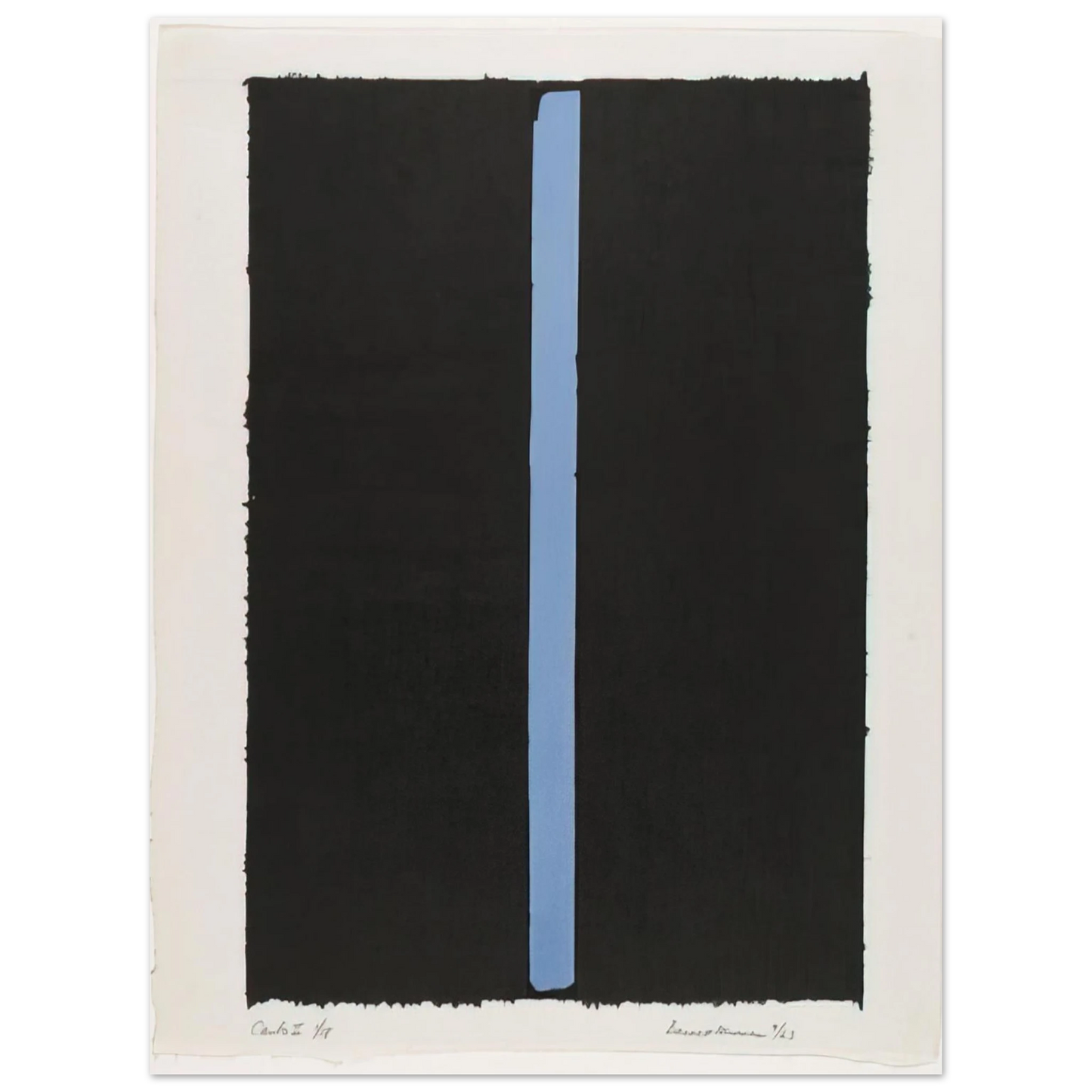
Barnett Newman - Canto II 75x100 cm / 30x40inches Fine Art Poster
Barnett Newman - Canto II 75x100 cm / 30x40inches Fine Art Poster
Couldn't load pickup availability
Experience the Sublime: Barnett Newman's Canto II
Barnett Newman, a titan of Abstract Expressionism and a pioneer of Color Field painting, sought to create art that transcends the decorative, aiming instead for the metaphysical. Canto II is a seminal piece from his 1963-64 lithographic portfolio, '18 Cantos'. This fine art print captures the stark, emotional resonance of Newman's signature 'zip'—a vertical element that creates a sense of scale and invites the viewer into a profound state of contemplation.
At RedKalion, we believe such a masterpiece deserves an equally masterful presentation. This 75x100 cm reproduction is not merely a poster; it is a meticulously crafted artifact designed to bring the intensity of Newman's vision into your personal collection. By utilizing the Master's Edition archival paper, we ensure that the interplay of form and space is rendered with the same gravity intended by the artist.
Unrivaled Print Specifications
To honor Newman’s dedication to precision, our prints are produced using the highest industry standards for museum-quality reproductions:
- Paper Quality: 250 gsm (110 lb) Master's Edition archival paper for a substantial, premium feel.
- Texture and Finish: A luxurious matte, uncoated, natural white finish that eliminates glare and highlights the depth of the composition.
- Archival Longevity: Acid-free (pH above 7) to prevent yellowing or degradation over time, ensuring your investment endures for decades.
- Sustainability: Printed on FSC-certified paper, reflecting a commitment to environmental responsibility.
- Physical Presence: A thickness of 0.29 mm (11.4 mils) provides the structural integrity required for high-end framing.
Elevate your space with an archival masterpiece that endures. RedKalion is dedicated to providing the definitive, trusted curation of world-class art, bringing the museum experience directly to your walls with sophisticated, confidence-building quality.
Discover Unlimited Art Possibilities
At RedKalion, you can find virtually any artwork from any artist, available in a wide range of sizes to perfectly match your space.
If you didn’t find what you’re looking for, contact us at support@redkalion.com . We will source any artwork and produce it in any size and format you need, including art prints, posters, canvas, framed pieces, framed canvas, and more.
For dedicated art enthusiasts, we also offer handcrafted replicas of any artwork, carefully painted by highly skilled artists using traditional techniques.
For custom requests, contact us at support@redkalion.com .
What makes the Canto II fine art print museum-quality?
Our Barnett Newman Canto II prints use Master's Edition archival paper. At 250 gsm and acid-free, this museum-quality reproduction ensures the deep pigments and structural integrity remain vibrant for generations without yellowing.
What are the physical specifications of the paper?
This print features 250 gsm (110 lb) paper with a thickness of 0.29 mm. It has a matte, uncoated, natural white finish, providing a sophisticated texture ideal for fine art photography and Abstract Expressionist works.
Is the paper used for this reproduction sustainable?
Yes. We use FSC-certified paper for our Canto II prints, ensuring that the materials are sourced responsibly from sustainably managed forests that provide environmental, social, and economic benefits.
How is the artwork shipped and fulfilled?
We operate on a print-on-demand basis with no minimum orders. Your Barnett Newman print is produced with care and shipped in protective packaging to ensure it arrives in pristine condition at your doorstep.
How long will the colors last on this Barnett Newman print?
Because we use acid-free archival paper with a pH above 7, the print is protected from chemical degradation. This museum-grade standard ensures your fine art poster remains color-fast and resists yellowing for decades.
What is the historical significance of the '18 Cantos' series?
The 18 Cantos (1963-64) represented Newman’s first major exploration of lithography. They allowed him to experiment with the margins of the paper and the 'zip' in a new medium, creating a rhythmic, musical sequence of visual space.
What does the 'zip' represent in Barnett Newman's work?
The 'zip' is a vertical line that Newman used to define the spatial structure of his paintings. Rather than dividing the canvas, the zip creates a human scale and unifies the composition, evoking a sense of presence and the sublime.