RedKalion
Berkeley 32 - Richard Diebenkorn 70x100 cm / 28x40 inches Framed Art Print – Black Wooden Frame
Berkeley 32 - Richard Diebenkorn 70x100 cm / 28x40 inches Framed Art Print – Black Wooden Frame
Couldn't load pickup availability
Elevate Your Space with Richard Diebenkorn’s Berkeley 32
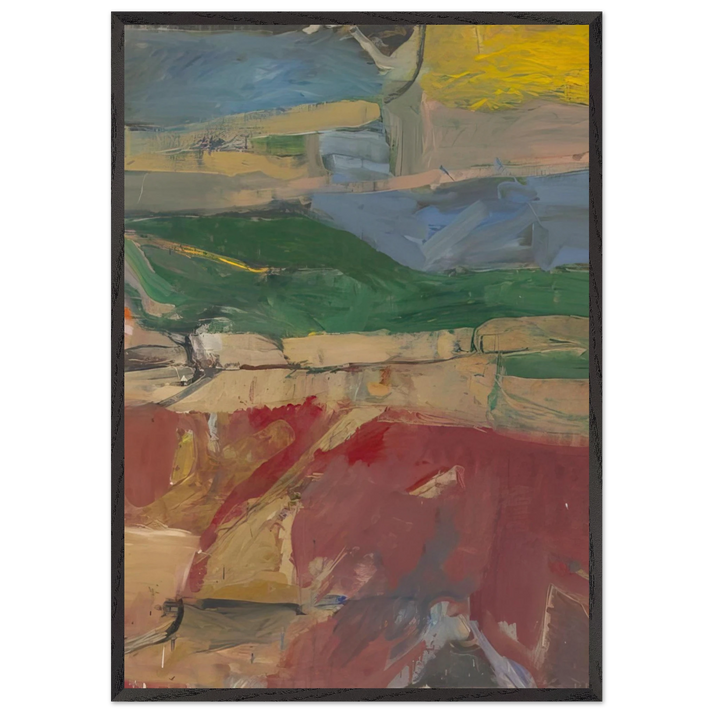
Experience the vibrant energy of the mid-century California art scene with this museum-quality reproduction of Berkeley 32 by Richard Diebenkorn. Created in 1955, this masterpiece represents a pivotal moment in American abstraction, where Diebenkorn blended the raw intensity of Abstract Expressionism with the atmospheric qualities of the Northern California landscape. This 70x100 cm (28x40 inches) framed art print captures every nuanced brushstroke and the luminous color palette that defines Diebenkorn’s Berkeley period.
Masterful Composition and Historical Significance
During his years in Berkeley, Richard Diebenkorn developed a visual language that was both visceral and intellectual. Berkeley 32 showcases his ability to organize chaotic, high-keyed colors—ochres, deep blues, and earthy greens—into a balanced, rhythmic structure. As an elite RedKalion reproduction, this print honors the original’s pentimenti—the visible layers of the artist's process—offering a window into the evolution of the Bay Area Figurative Movement.
Uncompromising Museum-Quality Craftsmanship
At RedKalion, we believe that fine art deserves a presentation that matches its historical weight. This reproduction is meticulously printed on 250 gsm (110 lb) archival museum-quality paper. The paper features a natural white, matte, and uncoated finish that prevents glare, allowing Diebenkorn’s complex color relationships to shine without distraction. The 0.29 mm thickness ensures the print remains perfectly flat and durable for generations.
Premium Framing and Sustainable Materials
This Berkeley 32 print comes encased in a sophisticated black frame crafted from responsibly sourced ash wood. Our frames are 20mm (0.79") thick, providing a sturdier, more premium presence on your wall than standard commercial frames. Protected by shatterproof plexiglass, your investment is shielded from environmental damage while maintaining crystal-clear visibility. Each piece is delivered ready-to-hang with an included hanging kit, ensuring a seamless transition from our gallery to your home.
- Artist: Richard Diebenkorn
- Title: Berkeley 32 (1955)
- Paper: 250 gsm archival, FSC-certified natural white
- Frame: 20mm premium black ash wood
- Dimensions: 70x100 cm / 28x40 inches
- Protection: Archival-grade shatterproof plexiglass

Discover Unlimited Art Possibilities
At RedKalion, you can find virtually any artwork from any artist, available in a wide range of sizes to perfectly match your space.
If you didn’t find what you’re looking for, contact us at support@redkalion.com . We will source any artwork and produce it in any size and format you need, including art prints, posters, canvas, framed pieces, framed canvas, and more.
For dedicated art enthusiasts, we also offer handcrafted replicas of any artwork, carefully painted by highly skilled artists using traditional techniques.
For custom requests, contact us at support@redkalion.com .
What kind of paper is used for this Diebenkorn print?
We use 250 gsm (110 lb) archival museum-quality paper. It is a natural white, matte, and uncoated paper with a thickness of 0.29 mm, ensuring high durability and a premium fine art feel for your Berkeley 32 reproduction.
How is the Berkeley 32 print framed?
The artwork is professionally mounted in a 20mm thick black frame made from responsibly sourced ash wood. It features shatterproof plexiglass for protection and a profile wider than standard frames to provide a gallery-quality aesthetic.
Is the artwork protected against fading?
Yes, we use archival-grade paper and lightfast inks designed to resist yellowing and fading. Combined with the shatterproof plexiglass, this ensures your Diebenkorn print maintains its vibrant colors and historical integrity for decades.
Is the print ready to hang upon arrival?
Absolutely. Your framed Berkeley 32 art print arrives with a pre-installed hanging kit. You can display it directly on your wall the moment it reaches your door without needing additional hardware.
Are the materials used in this product sustainable?
RedKalion is committed to sustainability. We use FSC-certified wood for our frames and paper (or equivalent certifications), ensuring that your fine art print supports responsible forest management practices.
What period of Richard Diebenkorn's career does Berkeley 32 represent?
Berkeley 32 belongs to Diebenkorn’s "Berkeley" period (1953–1956). This era is characterized by energetic, landscape-influenced Abstract Expressionism, bridging the gap between his earlier Albuquerque works and his later transition to the Bay Area Figurative Movement.
Does Berkeley 32 represent a specific landscape?
While abstract, Diebenkorn’s Berkeley series was deeply influenced by the aerial views and topography of the California coastline. The forms and colors in Berkeley 32 evoke the shifting light and spatial planes of the Berkeley hills.