

RedKalion
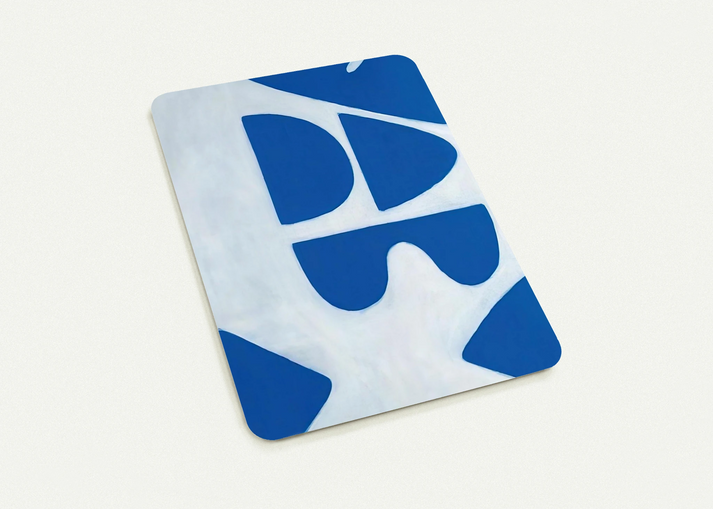
Berlin Blues 6 - 1966 By William Scott Pack of 10 Post Cards | William Scott Post Cards | A6 (10.5 x 14.8 cm) - 4.1 x 5.8 inches
Berlin Blues 6 - 1966 By William Scott Pack of 10 Post Cards | William Scott Post Cards | A6 (10.5 x 14.8 cm) - 4.1 x 5.8 inches
Couldn't load pickup availability
Elevate Your Correspondence with William Scott’s Berlin Blues 6 (1966)
Immerse yourself in the profound minimalism of mid-century British abstraction with this exclusive pack of 10 postcards featuring Berlin Blues 6 by the renowned artist William Scott. Created during Scott’s prestigious residency in West Berlin in the mid-1960s, this work represents a pivotal moment in his career where the boundaries between domestic objects and pure geometric form began to dissolve into a rhythmic exploration of deep, intellectual blues.
At RedKalion, we honor the integrity of Scott’s vision by utilizing 12-color fine art printing technology. Unlike standard 4-color commercial prints, our process captures the subtle shifts in saturation and the architectural weight of Scott’s silhouettes, ensuring each A6 card functions as a miniature museum-quality reproduction. The smooth matte finish eliminates glare, allowing the viewer to appreciate the composition’s balance and spatial tension without distraction.
Each card is printed on 200 gsm (80 lb) FSC-certified paper, providing a tactile thickness of 0.26 mm that reflects the premium standards of a world-class gallery. Whether used for thoughtful correspondence or as a curated set for framing, these archival-grade prints bring the sophisticated legacy of William Scott into the modern home.
- Artist: William Scott (1913–1989)
- Title: Berlin Blues 6, 1966
- Print Technology: 12-color archival giclée
- Paper: 200 gsm eco-friendly matte cardstock
- Dimensions: A6 (10.5 x 14.8 cm / 4.1 x 5.8 inches)


Discover Unlimited Art Possibilities
At RedKalion, you can find virtually any artwork from any artist, available in a wide range of sizes to perfectly match your space.
If you didn’t find what you’re looking for, contact us at support@redkalion.com . We will source any artwork and produce it in any size and format you need, including art prints, posters, canvas, framed pieces, framed canvas, and more.
For dedicated art enthusiasts, we also offer handcrafted replicas of any artwork, carefully painted by highly skilled artists using traditional techniques.
For custom requests, contact us at support@redkalion.com .
What defines the print quality of these Berlin Blues 6 postcards?
We use advanced 12-color fine art printing technology, which provides significantly more color depth and accuracy than standard inkjet printers. This ensures the complex blue tones of William Scott’s original work are reproduced with museum-quality precision.
What type of paper is used for these William Scott reproductions?
These cards are printed on 200 gsm (80 lb) FSC-certified paper with a thickness of 0.26 mm. The smooth matte finish ensures a clean, professional appearance that is perfect for writing or display.
Are these postcards suitable for framing as art prints?
Yes. Due to the high-weight paper and archival 12-color ink system, these A6 cards serve as exceptional small-format prints that maintain their vibrancy and structural integrity when placed in a frame.
How is my order shipped and are there minimums?
Every order is printed on demand to ensure quality control and reduce waste. We have no minimum order requirements, and each pack of 10 is carefully packaged to reach you in pristine condition.
Will the colors of the Berlin Blues 6 fade over time?
No. By utilizing archival inks and FSC-certified paper, our reproductions are designed for longevity. The 12-color technology creates a stable, fade-resistant image that endures as a lasting piece of art.
What is the historical significance of William Scott’s 'Berlin Blues' series?
The series was produced during Scott's Ford Foundation residency in Berlin (1963-65). It marks a transition toward larger, more abstract forms where his signature 'frying pan' and 'kitchen' motifs evolved into pure, rhythmic geometry.
Is Berlin Blues 6 considered a purely abstract work?
While Scott moved toward abstraction in the 1960s, his work always maintained a 'tension' with reality. The shapes in Berlin Blues 6 echo the essential forms of objects, transformed into a spatial arrangement of color and line.