

RedKalion
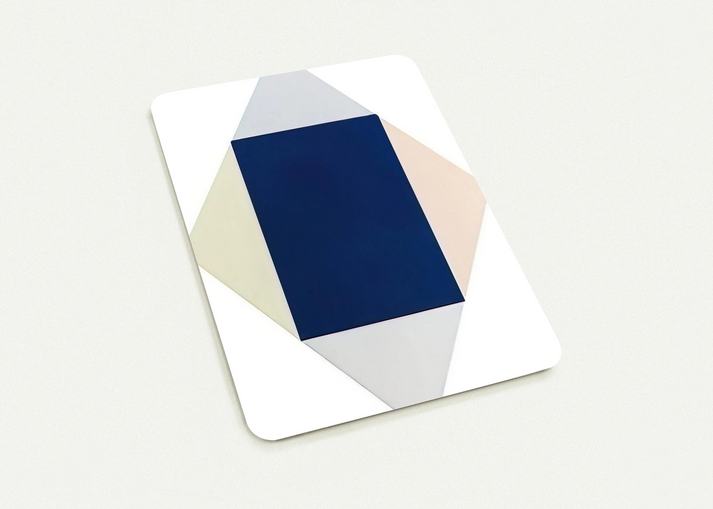
Blauer kern - 1969 By Max Bill Pack of 10 Post Cards | Max Bill Post Cards | A6 (10.5 x 14.8 cm) - 4.1 x 5.8 inches
Blauer kern - 1969 By Max Bill Pack of 10 Post Cards | Max Bill Post Cards | A6 (10.5 x 14.8 cm) - 4.1 x 5.8 inches
Couldn't load pickup availability
Max Bill's Mathematical Elegance: Blauer kern (1969)
Experience the precision of Swiss polymath Max Bill with this exquisite pack of 10 postcards featuring Blauer kern (1969). A towering figure of the Concrete Art movement, Bill utilized mathematical logic to create art that was entirely self-referential, devoid of external representation. This 1969 masterpiece is a profound exploration of geometric equilibrium and color theory, centered around a pulsating 'blue core' that defines the spatial tension of the composition.
These are not merely postcards; they are museum-quality reproductions curated by RedKalion for the discerning collector. Whether used for sophisticated correspondence or displayed as a miniature gallery set, these prints bring the intellectual rigor of Mid-Century modernism into your hands.
Archival Quality & Technical Precision
At RedKalion, we honor the artist's original intent by utilizing 12-color fine art printing technology. This advanced process ensures that the nuanced gradients and sharp geometric boundaries of Blauer kern are captured with a depth and accuracy that standard 4-color printing simply cannot achieve.
- Color Brilliance: 12-color technology delivers vivid, accurate tones and stunning depth.
- Premium Paper: 200 gsm (80 lb) paper with a thickness of 0.26 mm (10.3 mils) for a luxury feel.
- Matte Finish: A smooth, glare-free finish ensures your view is unobstructed by reflections.
- Eco-Conscious: Printed on FSC-certified paper to protect our global forests.
- Versatile Size: A6 format (10.5 x 14.8 cm), ideal for framing or mailing.
By choosing RedKalion, you are acquiring an archival-grade masterpiece. Each pack is printed on demand, ensuring that your collection meets the highest standards of modern curation and environmental responsibility.


Discover Unlimited Art Possibilities
At RedKalion, you can find virtually any artwork from any artist, available in a wide range of sizes to perfectly match your space.
If you didn’t find what you’re looking for, contact us at support@redkalion.com . We will source any artwork and produce it in any size and format you need, including art prints, posters, canvas, framed pieces, framed canvas, and more.
For dedicated art enthusiasts, we also offer handcrafted replicas of any artwork, carefully painted by highly skilled artists using traditional techniques.
For custom requests, contact us at support@redkalion.com .
What printing technology is used for these Max Bill postcards?
We use state-of-the-art 12-color fine art printing technology. This ensures far superior color vibrancy, tonal depth, and geometric precision compared to standard 4-color inkjet processes, perfectly capturing the nuances of Max Bill's work.
What is the paper weight and finish of the cards?
Each card is printed on premium 200 gsm (80 lb) paper with a thickness of 0.26 mm. The smooth matte finish provides a sophisticated, glare-free display that highlights the artwork's mathematical clarity.
Are the materials used for these postcards eco-friendly?
Yes, sustainability is central to RedKalion. These postcards are printed on demand to reduce waste and utilize FSC-certified paper, ensuring the materials are sourced from responsibly managed forests.
Is there a minimum order requirement for these prints?
No, these postcards are printed on demand with no minimum order requirements. This pack of 10 allows you to enjoy museum-quality art without the need for mass-produced inventory.
How long will these archival prints last?
Designed for longevity, our prints use archival-grade inks and acid-free paper. When kept out of direct sunlight, these cards will maintain their color vibrancy and structural integrity for decades.
Who was Max Bill and what was his contribution to Concrete Art?
Max Bill was a Swiss architect and artist who pioneered Concrete Art. He believed art should be based on mathematical structures to create a universal visual language of logic and harmony.
What does the title 'Blauer kern' represent in this composition?
German for 'Blue Core,' the title refers to the central focal point of the artwork. Bill uses this core to anchor the surrounding geometric forms, creating a balanced study of color interaction.