RedKalion
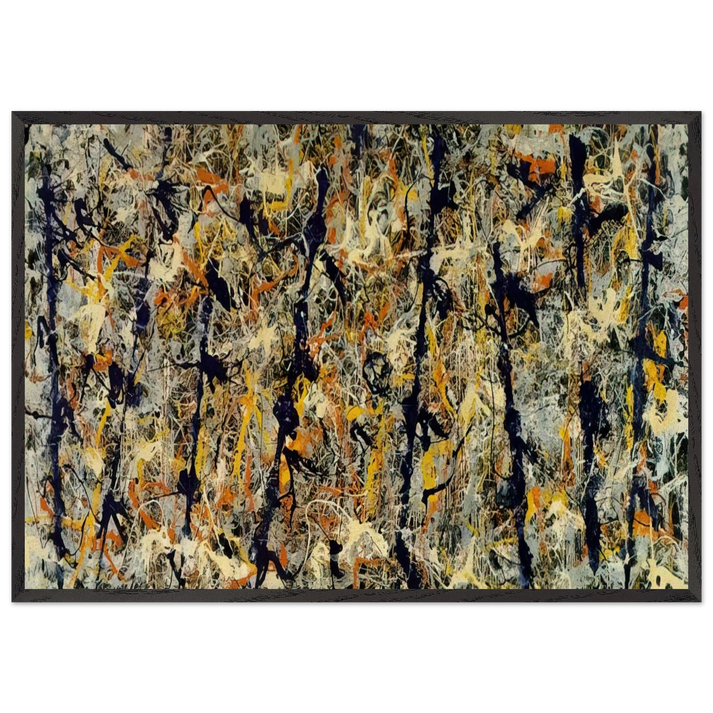
BLUE POLES NUMBER 11 1952 1 - Jackson Pollock 70x100 cm / 28x40 inches Framed Art Print – Black Wooden Frame
BLUE POLES NUMBER 11 1952 1 - Jackson Pollock 70x100 cm / 28x40 inches Framed Art Print – Black Wooden Frame
Couldn't load pickup availability
Jackson Pollock's Blue Poles: A Masterpiece of Abstract Expressionism
Experience the raw, kinetic energy of Jackson Pollock's Blue Poles (Number 11, 1952), one of the most significant works of the 20th century. This museum-quality reproduction captures the intricate web of lines and textures that defined Pollock’s revolutionary 'action painting' technique. Originally titled Number 11, 1952, the piece was later renamed to reflect the eight dark blue vertical forms that rhythmically anchor the chaotic, vibrant composition.
Authentic Reproduction and Archival Excellence
At RedKalion, we honor the legacy of Abstract Expressionism by utilizing archival-grade museum-quality paper. This 250 gsm (110 lb) natural white, uncoated paper features a matte finish that eliminates glare, allowing the complex layers of aluminum paint and industrial pigments to shine with clarity. With a thickness of 0.29 mm, the print offers a tactile weight that ensures longevity and resistance to aging.
Expertly Crafted Framing
Your Jackson Pollock fine art print is encased in a premium black frame made from responsibly sourced oak and ash. Distinguishing itself from standard gallery frames, our molding measures 20mm (0.79") in both width and thickness, providing a robust, sophisticated profile that enhances the artwork's visual impact. Each piece arrives ready-to-hang with a pre-installed hanging kit and is protected by shatterproof, transparent plexiglass.
- Sustainable Materials: FSC-certified paper and ethically sourced wood frames.
- Premium Protection: Shatterproof plexiglass ensures safety and clarity.
- Gallery Standards: Heavyweight 250 gsm paper for a professional aesthetic.
- Durability: Archival materials designed to endure for generations.
Elevate your interior with this iconic Jackson Pollock framed print—a definitive statement of modern art history and high-end craftsmanship.

Discover Unlimited Art Possibilities
At RedKalion, you can find virtually any artwork from any artist, available in a wide range of sizes to perfectly match your space.
If you didn’t find what you’re looking for, contact us at support@redkalion.com . We will source any artwork and produce it in any size and format you need, including art prints, posters, canvas, framed pieces, framed canvas, and more.
For dedicated art enthusiasts, we also offer handcrafted replicas of any artwork, carefully painted by highly skilled artists using traditional techniques.
For custom requests, contact us at support@redkalion.com .
What materials are used for the Jackson Pollock Blue Poles print?
This reproduction is printed on 250 gsm (110 lb) natural white, archival museum-quality paper. This uncoated, matte-finish paper ensures long-lasting color vibrancy and a premium, non-reflective feel.
How is the framed art print protected during shipping and display?
Each print is protected by shatterproof plexiglass, providing the clarity of glass without the risk of breaking. The 20mm black wooden frame is made from responsibly sourced oak or ash.
Is the artwork ready to hang upon arrival?
Yes. Your framed Jackson Pollock print arrives fully assembled with a specialized hanging kit included, allowing you to mount this masterpiece on your wall immediately.
Is this print produced using sustainable practices?
Absolutely. RedKalion uses FSC-certified materials or equivalent certifications, ensuring that both the paper and the wooden frames are sourced in an environmentally responsible manner.
What is the archival life of this museum-quality reproduction?
Due to the 250 gsm heavyweight paper and acid-free archival properties, this print is designed to last for decades without yellowing or significant fading when kept away from direct sunlight.
What is the significance of the title Blue Poles?
Originally titled Number 11, 1952, the title 'Blue Poles' was later adopted to describe the eight vertical blue lines that pierce the composition, acting as rhythmic anchors in the abstract field.
What technique did Jackson Pollock use for this artwork?
Pollock utilized his signature 'drip' or 'poured' technique, using his entire body to move around a canvas on the floor, applying industrial paints to create a sense of continuous motion.