RedKalion
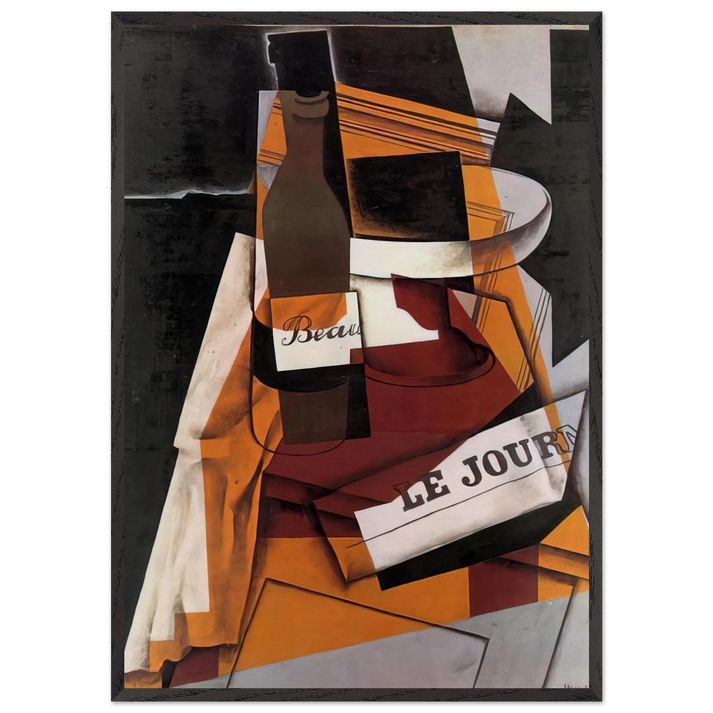
BOTTLE NEWSPAPER AND FRUIT BOWL 1915 - Juan Gris 70x100 cm / 28x40 inches Framed Art Print – Black Wooden Frame
BOTTLE NEWSPAPER AND FRUIT BOWL 1915 - Juan Gris 70x100 cm / 28x40 inches Framed Art Print – Black Wooden Frame
Couldn't load pickup availability
Elevate Your Space with Juan Gris’s Cubist Masterpiece
Experience the intellectual rigor and vibrant geometry of Synthetic Cubism with this museum-quality reproduction of Bottle Newspaper and Fruit Bowl (1915) by Juan Gris. As one of the most significant figures in the Cubist movement, Gris brought a mathematical precision and a crystalline clarity to his compositions that set him apart from his contemporaries. This 1915 work represents the height of his creative output, blending flattened perspectives with intricate patterns and a sophisticated color palette.
Museum-Quality Craftsmanship by RedKalion
At RedKalion, we curate archival-grade fine art prints that preserve the integrity of the original vision. This Juan Gris fine art print is produced on premium 250 gsm (110 lb) natural white paper. Unlike standard prints, our archival museum-quality paper is uncoated and matte, ensuring a glare-free viewing experience that highlights every stippled texture and sharp edge of Gris's technique. The 0.29 mm thickness provides a substantial, luxury feel that endures for generations.
Sophisticated Framing and Sustainable Materials
This 70x100 cm (28x40 inches) masterpiece arrives in a premium black wooden frame, crafted from responsibly sourced oak and ash. To provide a more presence-heavy aesthetic than standard gallery frames, our molding measures 20mm (0.79") in both width and thickness. Each piece is protected by shatterproof plexiglass, ensuring your investment remains pristine while hanging safely in any environment.
- Artist: Juan Gris (1887–1927)
- Title: Bottle Newspaper and Fruit Bowl (1915)
- Paper: 250 gsm archival, FSC-certified matte paper
- Frame: 20mm thick responsibly sourced black wood
- Ready-to-Hang: Includes a complete hanging kit for immediate installation
By choosing a RedKalion reproduction, you are not simply buying a poster; you are acquiring a piece of art history meticulously crafted to elevate your home or office with the enduring legacy of the avant-garde.

Discover Unlimited Art Possibilities
At RedKalion, you can find virtually any artwork from any artist, available in a wide range of sizes to perfectly match your space.
If you didn’t find what you’re looking for, contact us at support@redkalion.com . We will source any artwork and produce it in any size and format you need, including art prints, posters, canvas, framed pieces, framed canvas, and more.
For dedicated art enthusiasts, we also offer handcrafted replicas of any artwork, carefully painted by highly skilled artists using traditional techniques.
For custom requests, contact us at support@redkalion.com .
What defines the quality of this Juan Gris fine art print?
We use 250 gsm (110 lb) archival museum-quality paper with a matte, uncoated finish. This ensures vibrant color depth and longevity without the glare associated with inferior glossy prints, providing a true-to-life representation of Gris’s 1915 masterpiece.
Is the frame included and what are its dimensions?
Yes, this print comes in a 20mm (0.79") thick black wooden frame made from responsibly sourced oak and ash. It is sturdier than standard 14mm frames, offering a premium, gallery-ready presence on your wall.
How is the artwork protected during shipping and on the wall?
Each framed print is protected by shatterproof, transparent plexiglass. This provides the clarity of glass while ensuring the piece remains lightweight and safe from breakage during transit and while hanging in your home.
Does this print meet museum-quality archival standards?
Absolutely. RedKalion utilizes acid-free, natural white paper and archival inks. This combination prevents yellowing and fading over time, ensuring your Juan Gris reproduction retains its sophisticated hues and sharp details for decades.
Is the paper used for this reproduction sustainable?
Yes, we prioritize environmental responsibility. We use FSC-certified paper or equivalent sustainable materials, ensuring that your fine art purchase supports responsible forest management and ethical production standards.
What is the significance of the year 1915 in Juan Gris’s career?
1915 was a pivotal year for Gris. During World War I, he refined "Synthetic Cubism," moving away from the fragmentation of Analytic Cubism toward a more structured, colorful, and harmonious arrangement of flat geometric planes.
What does "Synthetic Cubism" mean in the context of this piece?
Synthetic Cubism involves "synthesizing" objects from simple geometric shapes and textures rather than breaking them down. In this work, Gris uses overlapping planes and patterns to suggest a bottle and bowl with mathematical elegance.