

RedKalion
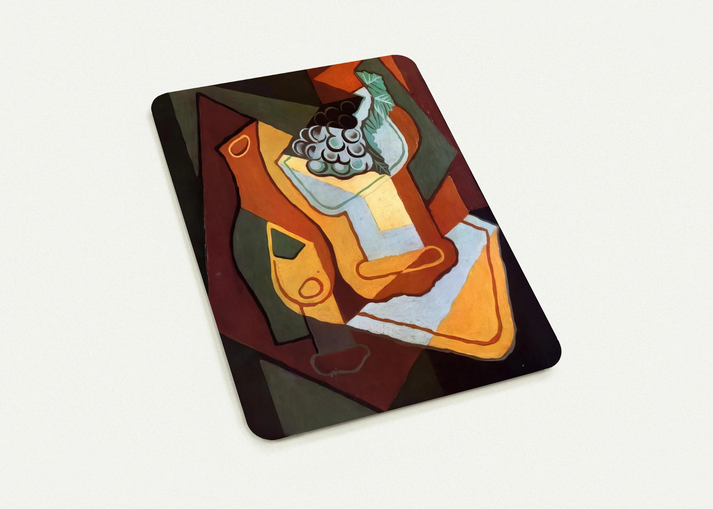
BOTTLE WINE GLASS AND FRUIT BOWL By Juan Gris Pack of 10 Post Cards | Juan Gris Post Cards | A6 (10.5 x 14.8 cm) - 4.1 x 5.8 inches
BOTTLE WINE GLASS AND FRUIT BOWL By Juan Gris Pack of 10 Post Cards | Juan Gris Post Cards | A6 (10.5 x 14.8 cm) - 4.1 x 5.8 inches
Couldn't load pickup availability
Experience the Structural Elegance of Juan Gris
Juan Gris, a definitive master of Synthetic Cubism, transformed the traditional still life into a rigorous exploration of geometry and rhythm. His 1917 masterpiece, "Bottle, Wine Glass, and Fruit Bowl," exemplifies his unique approach—often described as 'mathematical' compared to the more intuitive works of Picasso or Braque. This exclusive pack of 10 museum-quality postcards from RedKalion invites you to share this sophisticated aesthetic or create a curated miniature gallery within your personal space.
Gris’s technique involved building a composition from abstract shapes that gradually coalesce into recognizable objects. By capturing this structural harmony, our prints reveal the intricate layers of the original work. RedKalion honors this legacy by utilizing advanced 12-color fine art printing technology. This process delivers a color vibrancy and depth that standard 4-color inkjet printers simply cannot replicate, ensuring that every nuance of Gris’s palette is preserved.
Premium Craftsmanship and Sustainable Quality
Each postcard is rendered on substantial 200 gsm (80 lb) paper with a thickness of 0.26 mm, providing a tactile, premium feel that reflects the importance of the art it bears. The smooth matte finish ensures a clean, glare-free display under any lighting condition. At RedKalion, we believe that world-class art should not come at the expense of the planet; hence, we use FSC-certified, eco-friendly paper for all our reproductions.
- Authentic Reproduction: Meticulously color-matched to the original Juan Gris masterpiece.
- Archival Grade: Designed to resist fading and maintain clarity for years to come.
- Sophisticated Finish: Smooth matte surface for a timeless, glare-free look.
- Perfect Dimensions: A6 (10.5 x 14.8 cm), ideal for framing or thoughtful correspondence.
Elevate your collection with an archival masterpiece that endures. RedKalion remains the definitive source for those who seek the intersection of art history and premium print quality.


Discover Unlimited Art Possibilities
At RedKalion, you can find virtually any artwork from any artist, available in a wide range of sizes to perfectly match your space.
If you didn’t find what you’re looking for, contact us at support@redkalion.com . We will source any artwork and produce it in any size and format you need, including art prints, posters, canvas, framed pieces, framed canvas, and more.
For dedicated art enthusiasts, we also offer handcrafted replicas of any artwork, carefully painted by highly skilled artists using traditional techniques.
For custom requests, contact us at support@redkalion.com .
What makes the printing quality of these Juan Gris postcards unique?
We use 12-color fine art printing technology. This offers significantly more color depth and accuracy than standard 4-color prints, ensuring your Juan Gris postcards look like true museum-quality reproductions.
What is the weight and finish of the paper used?
The postcards are printed on 200 gsm (80 lb) FSC-certified paper with a smooth matte finish. This provides a premium, sturdy feel and a glare-free viewing experience.
Are the materials used in these postcards sustainable?
Yes. At RedKalion, we use environmentally conscious, FSC-certified paper. Our print-on-demand model also reduces waste, ensuring a more sustainable process for every pack of 10 postcards.
Will these prints fade over time?
Our archival-grade materials and 12-color inks are designed for longevity. These fine art reproductions are built to maintain their vibrancy and resist fading for decades when kept out of direct sunlight.
What are the exact dimensions of the Juan Gris postcards?
Each postcard in this pack of 10 is A6 size, measuring 10.5 x 14.8 cm (4.1 x 5.8 inches), making them perfect for standard framing or international shipping.
What was Juan Gris's role in the Cubist movement?
Juan Gris was a leader of Synthetic Cubism. Unlike Picasso, Gris used a more calculated, architectural approach, often starting with abstract geometry to find the subject matter within the shapes.
How does Gris’s use of color in this piece differ from early Cubism?
Early Cubism was often monochromatic. Gris, however, reintroduced vibrant color and decorative patterns, as seen in "Bottle, Wine Glass, and Fruit Bowl," creating a more harmonious and rhythmic visual experience.