RedKalion
Boulevard of Capucines - claude monet 70x100 cm / 28x40 inches Framed Art Print – Black Wooden Frame
Boulevard of Capucines - claude monet 70x100 cm / 28x40 inches Framed Art Print – Black Wooden Frame
Couldn't load pickup availability
Elevate Your Space with Monet’s Impressionist Masterpiece
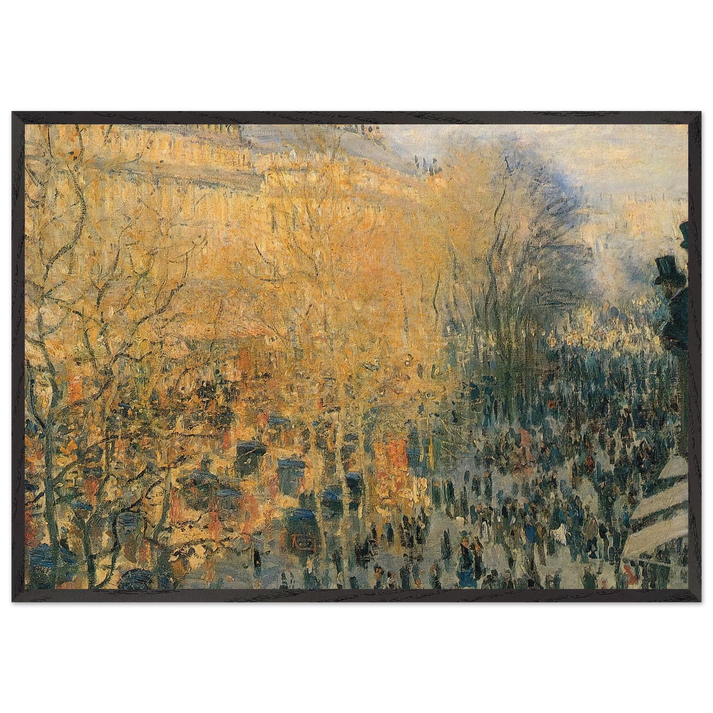
Experience the vibrant energy of 19th-century Paris with Claude Monet’s Boulevard of Capucines. This museum-quality reproduction captures the essence of the first Impressionist exhibition of 1874. Painted from the balcony of the photographer Nadar’s studio, Monet utilized a radical, high-angle perspective to document the fluid motion of the Parisian crowd. At RedKalion, we preserve this historical vision using archival museum-quality paper and premium framing techniques that ensure your fine art print remains a centerpiece for generations.
The Artistry Behind the Canvas
Monet’s Boulevard of Capucines is a definitive study in light and movement. Rather than focusing on individual faces, Monet used flickering, detached brushstrokes—dismissively called "tongue-licks" by contemporary critics—to represent the pulse of the city. This 70x100 cm (28x40 inches) framed art print allows you to appreciate the nuanced atmospheric effects and the delicate play of winter light that made Claude Monet the father of French Impressionism.
Premium Craftsmanship and Sustainable Elegance
To honor the integrity of Monet’s work, RedKalion provides a frame that balances durability with aesthetic sophistication. Each piece is housed in a responsibly sourced black wooden frame crafted from high-quality oak or ash. Our frames are 20mm (0.79") thick and wide, providing a robust, premium presence on your wall compared to standard commercial frames.
- Exquisite Paper: Printed on 250 gsm (110 lb) natural white, matte, uncoated archival paper.
- Protective Glazing: Features shatterproof plexiglass for enhanced clarity and protection.
- Ready-to-Hang: Delivered with a professional hanging kit for immediate installation.
- Eco-Conscious: Produced using FSC-certified materials, ensuring environmental responsibility.
A Legacy of Quality at RedKalion
Choosing a RedKalion print means investing in a piece of art history. Our commitment to using acid-free, 0.29 mm thick paper ensures that the vibrant tones and intricate details of the Boulevard of Capucines do not fade over time. This is more than a decoration; it is an archival masterpiece that brings the soul of the Musée d'Orsay into your personal collection.

Discover Unlimited Art Possibilities
At RedKalion, you can find virtually any artwork from any artist, available in a wide range of sizes to perfectly match your space.
If you didn’t find what you’re looking for, contact us at support@redkalion.com . We will source any artwork and produce it in any size and format you need, including art prints, posters, canvas, framed pieces, framed canvas, and more.
For dedicated art enthusiasts, we also offer handcrafted replicas of any artwork, carefully painted by highly skilled artists using traditional techniques.
For custom requests, contact us at support@redkalion.com .
What is the quality of the paper used for this Monet print?
We use 250 gsm (110 lb) natural white, matte, uncoated archival paper. This museum-quality paper is acid-free and 0.29 mm thick, ensuring the print remains vibrant and resists yellowing over time.
How is the frame constructed?
Our frames are made from responsibly sourced oak and ash wood. They measure 20mm (0.79") in width and thickness, offering a premium, sturdy look that exceeds standard 14mm frames.
Does the framed art print come ready to hang?
Yes, your Claude Monet framed print arrives ready to hang. It includes a specialized hanging kit and is protected by shatterproof, transparent plexiglass for safe delivery and display.
What makes RedKalion prints archival grade?
RedKalion utilizes pH-neutral, FSC-certified paper and high-pigment inks. This combination ensures long-term stability and color accuracy, qualifying the work as an archival-grade museum reproduction.
Is the packaging sustainable?
Yes, we use FSC-certified materials or local equivalents. By prioritizing sustainable paper and wood, we ensure your art collection has a minimal environmental footprint.
What was the historical significance of Boulevard of Capucines?
This 1873 masterpiece was shown at the first Impressionist exhibition. It broke traditional rules by using "sketchy" brushwork to capture the fleeting sensation of city life rather than fine details.
Where did Monet stand to paint this scene?
Monet painted this from the balcony of the studio of the famous photographer Nadar. This high-angle perspective was innovative, allowing him to capture the rhythmic movement of the Parisian crowd below.