

RedKalion
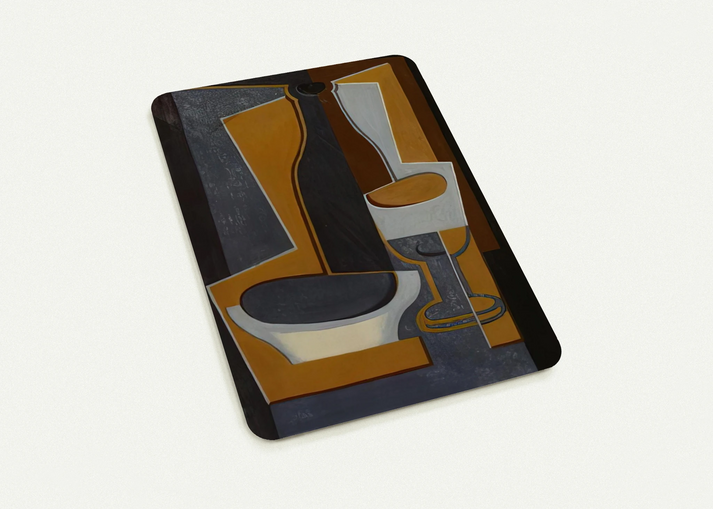
BOUTEILLE BOL ET VERRE 1922 By Juan Gris Pack of 10 Post Cards | Juan Gris Post Cards | A6 (10.5 x 14.8 cm) - 4.1 x 5.8 inches
BOUTEILLE BOL ET VERRE 1922 By Juan Gris Pack of 10 Post Cards | Juan Gris Post Cards | A6 (10.5 x 14.8 cm) - 4.1 x 5.8 inches
Couldn't load pickup availability
Elevate Your Correspondence with Juan Gris's Synthetic Cubist Mastery
Experience the architectural precision of Juan Gris with our museum-quality pack of 10 postcards featuring Bouteille, Bol et Verre (1922). As a leading figure of Synthetic Cubism, Gris moved beyond the fragmentation of early Cubism to create works of lyrical clarity and structural harmony. This late masterpiece demonstrates his sophisticated use of overlapping planes and rhythmic geometry, transforming a simple still life into a profound exploration of form and space.
At RedKalion, we honor the legacy of the avant-garde through meticulous reproduction standards. Each A6 card is produced using advanced 12-color fine art printing technology. Unlike standard 4-color commercial prints, our process ensures every nuance of Gris’s palette—from the deep earth tones to the subtle grays—is captured with stunning depth and accuracy. These are not merely postcards; they are archival-grade invitations to art history.
Premium Material Specifications
- Color Vibrancy: 12-color archival ink system for museum-quality color reproduction.
- Paper Finish: A smooth, glare-free matte finish that preserves the integrity of the original artwork.
- Substantial Weight: Printed on 200 gsm (80 lb) paper with a thickness of 0.26 mm for a premium, durable feel.
- Eco-Conscious: Proudly printed on FSC-certified paper, supporting responsible forest management.
- Craftsmanship: Each set is printed on demand to ensure the highest quality control for your collection.
Whether used for personal correspondence or as a curated set for a gallery wall, these Juan Gris fine art prints offer a sophisticated touch of modernism. Trust RedKalion to deliver archival masterpieces that endure, bridging the gap between historical significance and contemporary display.


Discover Unlimited Art Possibilities
At RedKalion, you can find virtually any artwork from any artist, available in a wide range of sizes to perfectly match your space.
If you didn’t find what you’re looking for, contact us at support@redkalion.com . We will source any artwork and produce it in any size and format you need, including art prints, posters, canvas, framed pieces, framed canvas, and more.
For dedicated art enthusiasts, we also offer handcrafted replicas of any artwork, carefully painted by highly skilled artists using traditional techniques.
For custom requests, contact us at support@redkalion.com .
What are the dimensions of these Juan Gris art postcards?
Each card in this pack of 10 is A6 size, measuring 10.5 x 14.8 cm (approximately 4.1 x 5.8 inches). This standard postcard size is perfect for framing in mini-galleries or mailing worldwide.
What printing technology is used for the Bouteille, Bol et Verre reproductions?
We utilize a sophisticated 12-color fine art printing technology. This exceeds standard inkjet methods by providing superior color depth, tonal transitions, and accuracy to Juan Gris’s original 1922 palette.
Is the paper used for these postcards environmentally friendly?
Yes. All RedKalion postcards are printed on FSC-certified paper. This ensures the 200 gsm (80 lb) matte paper comes from responsibly managed forests that provide environmental, social, and economic benefits.
How long will these archival prints last?
Our postcards are designed for longevity. Using archival-grade inks and high-quality 200 gsm matte paper, these prints resist fading and maintain their vibrancy for decades when kept out of direct sunlight.
What is the shipping policy for RedKalion fine art prints?
Every order is printed on demand to ensure peak quality. We ship globally with protective packaging to ensure your Juan Gris postcards arrive in pristine, museum-ready condition without minimum order requirements.
What is the historical significance of Juan Gris’s 1922 work?
By 1922, Juan Gris had perfected Synthetic Cubism. This piece represents a move toward 'flat-pictorial architecture,' where the subject is built from abstract shapes rather than being abstracted from reality.
How does Synthetic Cubism differ in this piece compared to earlier works?
Unlike the analytical phase which fragmented objects, this 1922 work uses broader planes and more cohesive structures. It reflects Gris's late-career desire to find a 'mathematical' harmony between objects and space.