RedKalion
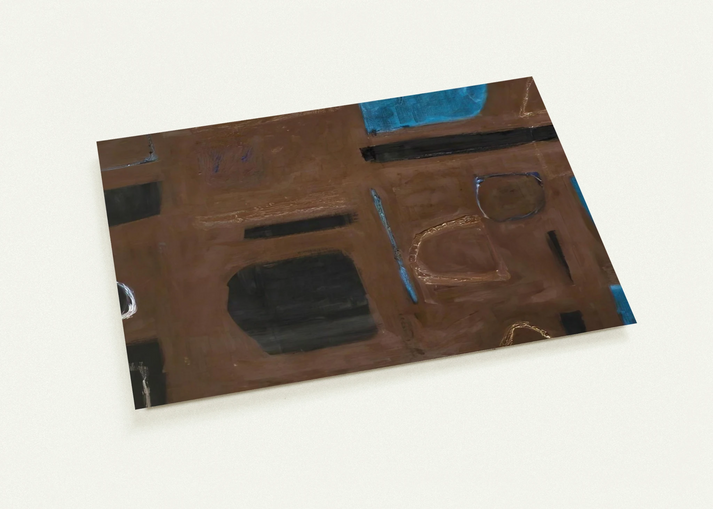
Brown and Black - 1960 By William Scott Pack of 10 Post Cards | William Scott Post Cards | A6 (10.5 x 14.8 cm) - 4.1 x 5.8 inches
Brown and Black - 1960 By William Scott Pack of 10 Post Cards | William Scott Post Cards | A6 (10.5 x 14.8 cm) - 4.1 x 5.8 inches
Couldn't load pickup availability
Embrace Mid-Century Minimalism with William Scott’s 'Brown and Black - 1960'
In the landscape of 20th-century British abstraction, few artists captured the essence of form and tension as masterfully as William Scott. His 1960 masterpiece, Brown and Black, represents a pivotal moment in his career where the boundaries between the figurative and the abstract dissolve into raw, primitive shapes. RedKalion is proud to offer this pack of 10 museum-quality postcards, allowing you to share a piece of art history with every note you write.
The Artistry of Form and Texture
By 1960, Scott had transitioned from his earlier 'Kitchen Sink' realism toward a more austere, minimalist vocabulary. In this composition, the interplay between the deep earth tones and the stark black forms creates a sense of monumental weight and balance. Scott’s technique often involved layering and scraping, a tactile quality we have meticulously preserved in our fine art reproduction.
Museum-Quality Craftsmanship for Your Correspondence
At RedKalion, we believe that even a postcard should be a work of art. These flat postcards are produced using 12-color fine art printing technology, ensuring that the subtle nuances of Scott's palette are rendered with stunning depth and accuracy. Unlike standard 4-color printing, our process captures the true soul of the original canvas.
- Paper Weight: Professional 200 gsm (80 lb) stock for a substantial, premium feel.
- Paper Finish: A smooth matte finish provides a sophisticated, glare-free display of the artwork.
- Eco-Conscious: Each card is printed on FSC-certified paper, reflecting our commitment to sustainable curation.
- Dimensions: Standard A6 (10.5 x 14.8 cm), perfect for framing as a miniature gallery or sending as a thoughtful sentiment.
Whether you are a collector of mid-century modernism or looking to elevate your daily correspondence, these William Scott postcards serve as a testament to archival quality and timeless design. Experience a reproduction that honors the integrity of the artist’s vision.

Discover Unlimited Art Possibilities
At RedKalion, you can find virtually any artwork from any artist, available in a wide range of sizes to perfectly match your space.
If you didn’t find what you’re looking for, contact us at support@redkalion.com . We will source any artwork and produce it in any size and format you need, including art prints, posters, canvas, framed pieces, framed canvas, and more.
For dedicated art enthusiasts, we also offer handcrafted replicas of any artwork, carefully painted by highly skilled artists using traditional techniques.
For custom requests, contact us at support@redkalion.com .
What makes the print quality of these William Scott postcards unique?
We utilize advanced 12-color fine art printing technology, which offers superior color vibrancy and tonal depth compared to standard 4-color inkjet reproductions, ensuring every William Scott print is museum-quality.
What are the technical specifications of the paper used?
These postcards are printed on 200 gsm (80 lb) FSC-certified paper with a thickness of 0.26 mm. The smooth matte finish ensures a clean, glare-free aesthetic suitable for both writing and display.
Are these postcards environmentally friendly?
Yes, RedKalion prioritizes sustainability. Our postcards are printed on demand using FSC-certified, environmentally conscious materials, which reduces waste and ensures responsible forest management.
How are the postcards packaged and shipped?
Our postcards are printed on demand to ensure perfection and are shipped in protective packaging to prevent bending. There are no minimum orders for our William Scott fine art collection.
Will the colors of 'Brown and Black - 1960' fade over time?
No, our archival-grade inks and 12-color printing process are designed for longevity, providing stunning color accuracy that resists fading, making them perfect for framing or long-term storage.
What is the significance of the year 1960 in William Scott’s career?
1960 marked a shift for Scott toward more simplified, abstract forms. During this era, he moved away from still life objects toward more primitive, architectural shapes that emphasized balance and space.
How does the palette of Brown and Black reflect Scott's style?
Scott was renowned for his restricted, earthy palettes. The use of brown and black in this 1960 work highlights his interest in the 'beauty of the ordinary' and the weight of geometric forms.