RedKalion
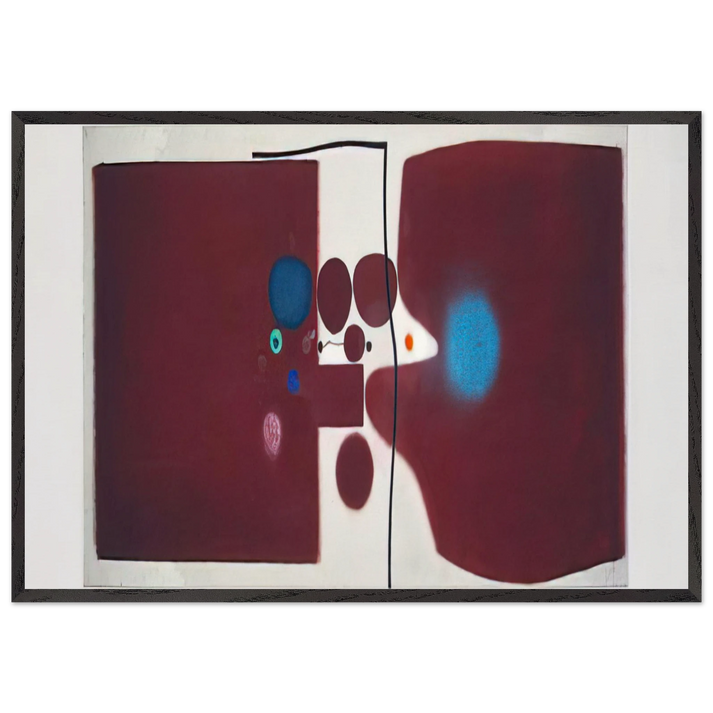
BROWN SYMPHONY 1979 - Victor Pasmore 70x100 cm / 28x40 inches Framed Art Print – Black Wooden Frame
BROWN SYMPHONY 1979 - Victor Pasmore 70x100 cm / 28x40 inches Framed Art Print – Black Wooden Frame
Couldn't load pickup availability
Elevate Your Space with Victor Pasmore's Brown Symphony (1979)
Experience the lyrical abstraction of British master Victor Pasmore with this museum-quality reproduction of Brown Symphony (1979). This piece represents a pivotal moment in Pasmore’s career, where he transitioned from rigid constructivism to a more fluid, organic, and poetic visual language. The 'symphony' of earthy tones and undulating lines creates a rhythmic balance that transforms any interior into a gallery-like environment.
Authentic Artistry & Archival Quality
At RedKalion, we specialize in archival-grade fine art prints that preserve the integrity of the original work. This print is rendered on 250 gsm (110 lb) natural white paper, featuring a matte, uncoated finish that eliminates glare and enhances the depth of Pasmore's palette. As a museum-quality reproduction, the paper is archival and acid-free, ensuring that the warm, ochre hues of the 1979 masterpiece remain vibrant for generations.
The RedKalion Framing Excellence
This 70x100 cm (28x40 inches) masterpiece is housed in a premium black wooden frame, meticulously crafted from responsibly sourced oak and ash. Our frames feature a sophisticated 20mm (0.79") profile, providing a more substantial and luxurious presence than standard commercial frames. Each piece is protected by shatterproof plexiglass, ensuring the safety of the print while maintaining crystal-clear visibility.
- Artist: Victor Pasmore
- Paper: 250 gsm archival museum-quality paper
- Frame: Sustainably sourced black oak/ash wood (20mm thickness)
- Ready-to-hang: Hanging kit included for immediate installation
- Sustainability: FSC-certified materials for a lower environmental footprint
By choosing a RedKalion print, you are not just purchasing a decoration; you are investing in a piece of art history curated with technical precision and a deep appreciation for the abstract movement.

Discover Unlimited Art Possibilities
At RedKalion, you can find virtually any artwork from any artist, available in a wide range of sizes to perfectly match your space.
If you didn’t find what you’re looking for, contact us at support@redkalion.com . We will source any artwork and produce it in any size and format you need, including art prints, posters, canvas, framed pieces, framed canvas, and more.
For dedicated art enthusiasts, we also offer handcrafted replicas of any artwork, carefully painted by highly skilled artists using traditional techniques.
For custom requests, contact us at support@redkalion.com .
What makes the print quality of Brown Symphony museum-grade?
We use 250 gsm (110 lb) natural white, archival-quality paper. The matte finish and acid-free properties ensure long-term durability and color accuracy, matching the standards of world-class art galleries.
What materials are used for the black wooden frame?
Our frames are crafted from responsibly sourced oak and ash. They are 20mm thick and wide, providing a sturdy, premium aesthetic that exceeds the quality of common 14mm frames.
How is the artwork protected during shipping and display?
The print is protected by shatterproof plexiglass, which is more durable and safer than standard glass. We ship each framed print in specialized protective packaging to ensure it arrives in pristine condition.
Is the frame ready to be mounted on the wall?
Yes, every framed print from RedKalion includes a pre-installed hanging kit. This allows you to hang your Victor Pasmore reproduction immediately upon arrival without additional hardware.
Are the materials used in this art print sustainable?
Absolutely. RedKalion utilizes FSC-certified paper and wood, or equivalent regional certifications, ensuring that your art acquisition supports sustainable forestry and ethical production practices.
What is the significance of the year 1979 in Pasmore's work?
By 1979, Victor Pasmore had fully embraced 'lyrical abstraction.' Brown Symphony showcases his mastery of organic forms and spatial relationships, moving away from the geometric rigidity of his earlier constructivist period.
Why is this Victor Pasmore piece titled a 'Symphony'?
Pasmore often used musical analogies to describe his abstract work. 'Symphony' refers to the rhythmic arrangement of lines and tones, suggesting a visual harmony that resonates like a musical composition.