RedKalion
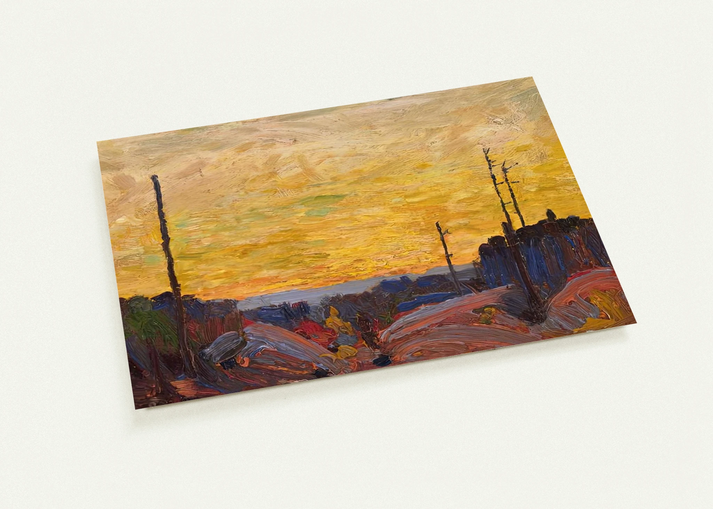
BURNED OVER LAND 1916 By Tom Thomson Pack of 10 Post Cards | Tom Thomson Post Cards | A6 (10.5 x 14.8 cm) - 4.1 x 5.8 inches
BURNED OVER LAND 1916 By Tom Thomson Pack of 10 Post Cards | Tom Thomson Post Cards | A6 (10.5 x 14.8 cm) - 4.1 x 5.8 inches
Couldn't load pickup availability
Embrace the Raw Spirit of the North with Tom Thomson’s 'Burned Over Land' (1916)
Experience the visceral power of the Canadian wilderness with this exquisite pack of 10 fine art postcards featuring Tom Thomson's 'Burned Over Land' (1916). Thomson, a seminal figure who profoundly influenced the Group of Seven, was a master at capturing the rugged, untamed beauty of Algonquin Park. In this particular piece, he explores the aftermath of a forest fire—a scene of stark destruction that simultaneously pulses with the latent energy of regeneration. The jagged silhouettes and bold, expressionistic brushwork transform a charred landscape into a compelling study of color and form.
Museum-Quality Reproductions for the Discerning Collector
At RedKalion, we believe that fine art should be accessible without compromising on technical excellence. These are not standard stationery items; they are archival-grade reproductions. Utilizing state-of-the-art 12-color fine art printing technology, we achieve a depth of color and tonal accuracy that traditional 4-color processes simply cannot replicate. Every nuance of Thomson’s original oil sketch is preserved, from the deep charcoal greys to the unexpected flashes of ochre and sky blue.
Premium Material Specifications
- Color Vibrancy: Advanced 12-color pigment-based inks for stunningly vivid, museum-quality depth.
- Paper Finishing: A sophisticated smooth matte finish that eliminates glare and enhances the tactile experience.
- Weight and Durability: Printed on 200 gsm (80 lb) archival paper with a thickness of 0.26 mm (10.3 mils) for a premium, substantial feel.
- Eco-Conscious Standards: Responsibly sourced, FSC-certified paper ensures your collection respects the environment Thomson so loved.
- Format: Pack of 10 flat postcards, A6 size (10.5 x 14.8 cm / 4.1 x 5.8 inches), perfect for personal correspondence or gallery-style display.
Elevate your space or share a piece of Canadian art history with these archival masterpieces. Each set is printed on demand, ensuring that your postcards arrive in pristine condition, ready to endure as timeless keepsakes of a national legacy.

Discover Unlimited Art Possibilities
At RedKalion, you can find virtually any artwork from any artist, available in a wide range of sizes to perfectly match your space.
If you didn’t find what you’re looking for, contact us at support@redkalion.com . We will source any artwork and produce it in any size and format you need, including art prints, posters, canvas, framed pieces, framed canvas, and more.
For dedicated art enthusiasts, we also offer handcrafted replicas of any artwork, carefully painted by highly skilled artists using traditional techniques.
For custom requests, contact us at support@redkalion.com .
What defines the print quality of these Tom Thomson postcards?
We use 12-color fine art printing technology, which offers superior color vibrancy and depth compared to standard 4-color prints, ensuring a museum-quality reproduction of the original artwork.
Is the paper used for these postcards environmentally friendly?
Yes, all postcards are printed on FSC-certified paper, which ensures the material is sourced from responsibly managed forests that provide environmental, social, and economic benefits.
What are the physical dimensions and weight of the postcards?
Each postcard is A6 size (10.5 x 14.8 cm), printed on heavy 200 gsm (80 lb) paper with a smooth matte finish for a premium, non-glare display.
How many postcards are included in this set?
This item is a curated pack of 10 identical flat postcards, allowing you to share Tom Thomson's masterpiece with friends or keep them for a consistent art display.
How long will these prints last without fading?
By utilizing archival-grade pigments and acid-free paper, these postcards are designed for longevity, resisting fading and maintaining their color integrity for decades under normal display conditions.
What is the historical significance of 'Burned Over Land' (1916)?
Painted in 1916, this work highlights Thomson's fascination with the cycle of nature in Algonquin Park, showcasing his transition toward the bold, modernistic style that defined Canadian landscape art.
Why is Tom Thomson considered a precursor to the Group of Seven?
Though he passed away in 1917, Thomson's innovative use of color and raw brushwork provided the aesthetic foundation for his friends who later formed the Group of Seven in 1920.