RedKalion
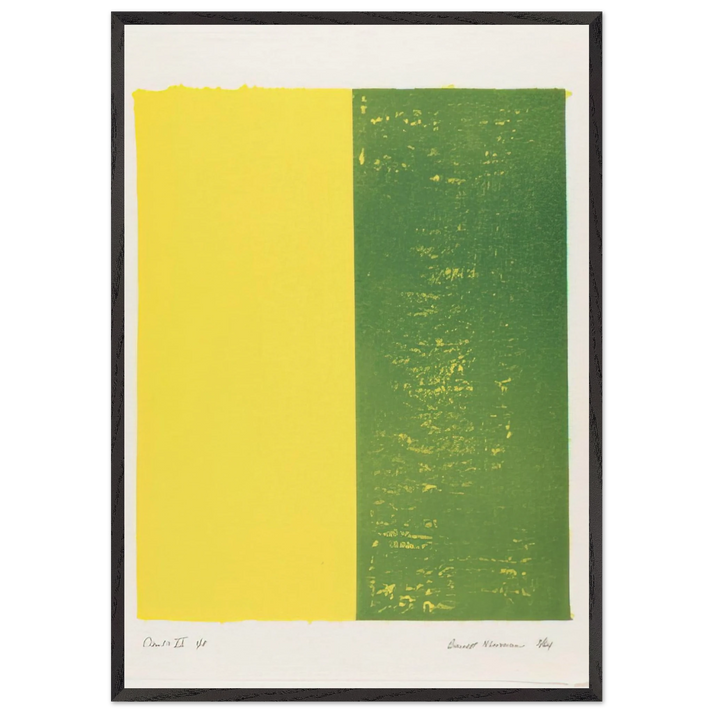
Canto XII - Barnett Newman 70x100 cm / 28x40 inches Framed Art Print – Black Wooden Frame
Canto XII - Barnett Newman 70x100 cm / 28x40 inches Framed Art Print – Black Wooden Frame
Couldn't load pickup availability
Elevate Your Space with Barnett Newman’s Canto XII
Barnett Newman’s Canto XII is a definitive expression of Color Field painting and Abstract Expressionism. Originally part of his renowned 18 Cantos portfolio from the early 1960s, this piece represents a masterclass in spatial tension and metaphysical exploration. By distilling the visual language to its most essential elements, Newman invites the viewer into a profound dialogue with the sublime.
The Geometry of the Sublime
In Canto XII, Newman utilizes his signature "zip"—the vertical line that punctuates the canvas—to define the composition. This element does not merely divide the space; it creates a structural harmony that commands the room. Our museum-quality reproduction captures the precise tonal nuances and the intellectual rigor of the original lithograph, ensuring that the work’s authoritative presence is felt in any contemporary interior.
Curated Craftsmanship by RedKalion
RedKalion is dedicated to preserving the integrity of fine art through archival-grade materials. This Barnett Newman fine art print is rendered on 250 gsm (110 lb) natural white, archival-grade paper. The matte, uncoated finish prevents glare, allowing the deep inks to resonate with the same intensity Newman intended for his lithography. Housed in a premium 20mm (0.79") black frame crafted from responsibly sourced oak and ash wood, this piece offers a more robust profile than standard frames, providing a gallery-standard aesthetic.
Product Specifications:
- Paper Quality: 250 gsm museum-quality, natural white, FSC-certified paper.
- Frame: 20mm thick black wooden frame (oak and ash) with a modern matte finish.
- Protection: Shatterproof plexiglass for optimal clarity and long-term protection.
- Ready-to-Hang: Includes a professional hanging kit for immediate installation.
- Sustainability: Printed on demand using ethically sourced, archival materials.
As a centerpiece for a minimalist office or a sophisticated living space, this framed Canto XII print stands as an enduring testament to 20th-century modernism. Experience a piece of art history with a reproduction that honors the legacy of Barnett Newman.

Discover Unlimited Art Possibilities
At RedKalion, you can find virtually any artwork from any artist, available in a wide range of sizes to perfectly match your space.
If you didn’t find what you’re looking for, contact us at support@redkalion.com . We will source any artwork and produce it in any size and format you need, including art prints, posters, canvas, framed pieces, framed canvas, and more.
For dedicated art enthusiasts, we also offer handcrafted replicas of any artwork, carefully painted by highly skilled artists using traditional techniques.
For custom requests, contact us at support@redkalion.com .
What is the paper quality of the Canto XII fine art print?
The print is produced on 250 gsm (110 lb) museum-quality, archival paper. It features a natural white, matte finish that ensures color depth without reflection, maintaining the integrity of Newman’s minimalist aesthetic for decades.
What materials are used for the frame?
Our frames are crafted from responsibly sourced, FSC-certified oak and ash wood. The black frame is 20mm (0.79") thick and wide, providing a premium, substantial look compared to thinner, standard 14mm frames.
How is the artwork protected during shipping and display?
Each print is protected by shatterproof, transparent plexiglass, ensuring the artwork remains safe during transit and is shielded from environmental factors while on your wall.
Is the artwork ready to hang upon arrival?
Yes. Every RedKalion framed print arrives ready-to-hang with a pre-installed hanging kit. This allows you to elevate your interior space immediately without the need for additional hardware.
How long will this archival print last?
Because we use acid-free, 250 gsm paper and archival-grade inks, this museum-quality reproduction is designed to resist yellowing and fading, preserving the work’s brilliance for a lifetime.
What was the significance of the 18 Cantos series for Barnett Newman?
The 18 Cantos represented Newman's first major foray into lithography. He used the medium to explore the margins of the paper, treating the white space as an active participant in the composition alongside his iconic vertical "zips."
What does the "zip" represent in Newman's work?
The "zip" is a vertical line intended to define the spatial structure of the work. Rather than dividing the canvas, it serves to unify it, creating a sense of human scale and existential presence within the vast field of color.