RedKalion
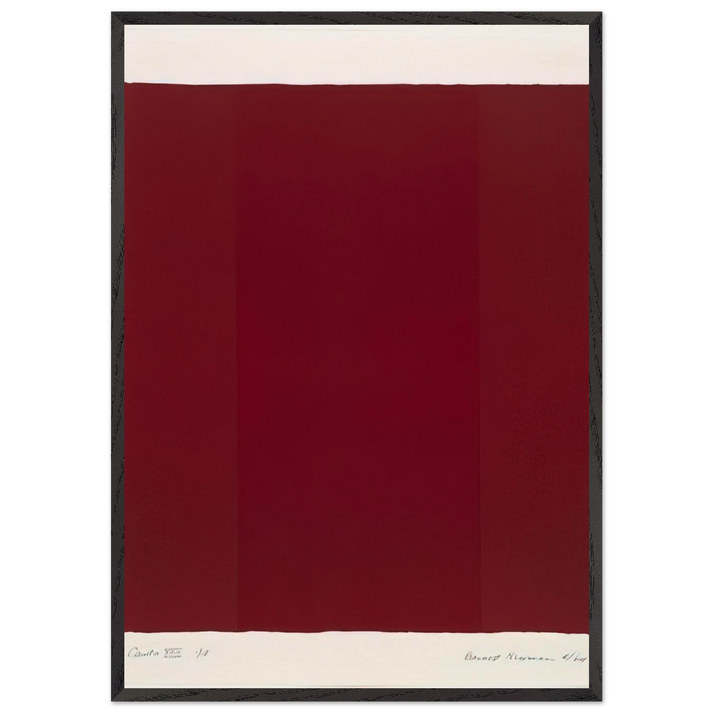
Canto XVII - Barnett Newman 70x100 cm / 28x40 inches Framed Art Print – Black Wooden Frame
Canto XVII - Barnett Newman 70x100 cm / 28x40 inches Framed Art Print – Black Wooden Frame
Couldn't load pickup availability
Barnett Newman’s Canto XVII: A Masterpiece of Abstract Expressionism
Experience the profound depth of Barnett Newman’s Canto XVII, a seminal work from his celebrated '18 Cantos' series. This fine art print represents a pivotal moment in 20th-century American art, where Newman transitioned his iconic 'zip' aesthetic into the medium of lithography. Our museum-quality reproduction honors the original’s spatial tension and intellectual rigor, offering a sophisticated focal point for the modern interior.
Artistic Significance and Historical Context
Barnett Newman, a titan of the Color Field movement, sought to evoke the sublime through minimalist geometry. In Canto XVII, the deliberate placement of vertical elements creates a sense of metaphysical space, inviting the viewer into a state of contemplation. By choosing this archival-grade reproduction, you are bringing a piece of art history into your home—meticulously curated by RedKalion to ensure every tonal nuance is preserved.
Uncompromising Quality and Craftsmanship
At RedKalion, we believe a masterpiece deserves an equally masterful presentation. This 70x100 cm / 28x40 inches framed art print is produced on 250 gsm (110 lb) archival museum-quality paper. The natural white, uncoated matte finish ensures a glare-free experience, while the 0.29 mm thickness provides the substantial feel of an original lithograph. Your artwork is encased in a premium black frame, expertly crafted from responsibly sourced oak and ash wood.
- Sustainable Materials: Printed on FSC-certified paper for environmental integrity.
- Premium Framing: A 20mm (0.79") thick frame provides a bold, gallery-standard profile.
- Archival Protection: Shatterproof, transparent plexiglass ensures the longevity and safety of the print.
- Ready to Exhibit: Arrives with a hanging kit included, allowing for immediate installation.
Elevate your collection with a piece that transcends mere decoration. This Barnett Newman print is an investment in timeless design and archival excellence, destined to endure as a cornerstone of your space.

Discover Unlimited Art Possibilities
At RedKalion, you can find virtually any artwork from any artist, available in a wide range of sizes to perfectly match your space.
If you didn’t find what you’re looking for, contact us at support@redkalion.com . We will source any artwork and produce it in any size and format you need, including art prints, posters, canvas, framed pieces, framed canvas, and more.
For dedicated art enthusiasts, we also offer handcrafted replicas of any artwork, carefully painted by highly skilled artists using traditional techniques.
For custom requests, contact us at support@redkalion.com .
What defines the quality of this Barnett Newman print?
We use 250 gsm (110 lb) archival museum-quality paper. This natural white, matte, and uncoated paper ensures the Canto XVII reproduction remains vibrant and resistant to yellowing over time, providing a premium fine art experience.
How is the artwork framed and finished?
The print is housed in a 20mm thick frame made from solid, responsibly sourced oak and ash. We use shatterproof plexiglass to protect the artwork, offering a clear, safe, and gallery-standard presentation for your home.
Is the paper used for this print sustainable?
Yes, RedKalion is committed to sustainability. This Barnett Newman art print uses FSC-certified paper or equivalent certifications, ensuring that your high-end decor choice supports responsible forest management and environmental protection.
How will my framed art print arrive?
Your 70x100 cm print arrives ready-to-hang. We include a complete hanging kit with every order, ensuring a seamless installation process immediately upon delivery. The robust packaging prevents damage during transit.
What is the archival longevity of RedKalion prints?
Our prints are designed to last for decades. By combining acid-free 250 gsm paper with UV-protective plexiglass and archival inks, we ensure your Barnett Newman reproduction maintains its structural and visual integrity indefinitely.
What is the significance of the '18 Cantos' series?
Created between 1963 and 1964, the 18 Cantos marked Newman's first major foray into lithography. The series explores the relationship between the margins of the paper and the central 'zip,' reflecting a spiritual, musical rhythm.
Why did Barnett Newman use vertical lines called 'zips'?
Newman's 'zips' were intended to define the spatial structure of the painting while simultaneously unifying the composition. They represent a human presence within the infinite void, creating a sense of scale and profound emotional resonance.