RedKalion
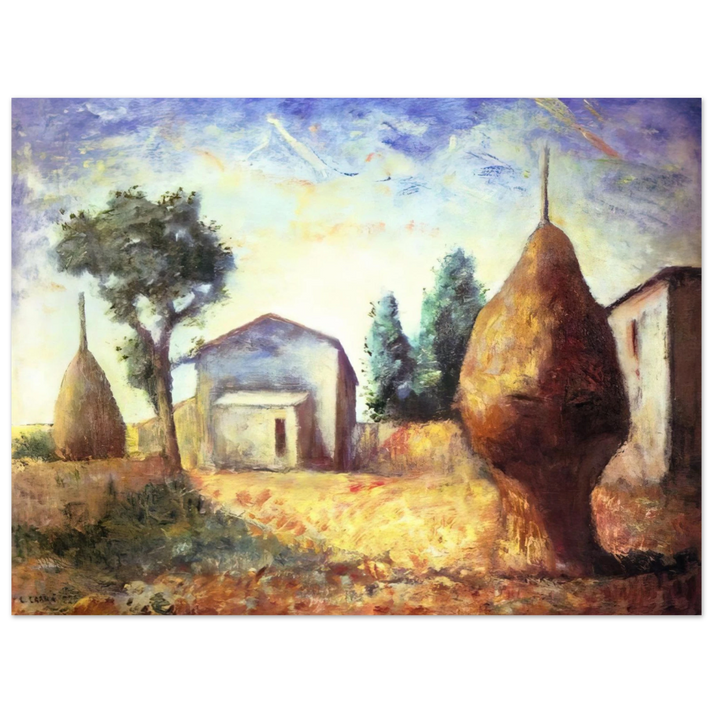
Carlo Carra - PAGLIAI 1929 75x100 cm / 30x40inches Fine Art Poster
Carlo Carra - PAGLIAI 1929 75x100 cm / 30x40inches Fine Art Poster
Couldn't load pickup availability
Elevate Your Space with the Timeless Stillness of Carlo Carrà’s Pagliai (1929)
Experience the profound silence and architectural beauty of the Italian countryside through this museum-quality reproduction of Pagliai (1929). Created during Carlo Carrà’s pivotal 'return to order' phase, this masterpiece represents the zenith of the Novecento Italiano movement. Moving away from the frantic energy of his Futurist roots, Carrà captures the haystacks not as mere agricultural objects, but as monumental, geometric forms bathed in an ethereal Mediterranean light.
At RedKalion, we treat every fine art print as a legacy piece. To honor Carrà’s meticulous attention to volume and texture, we utilize our Master's Edition archival paper. This premium, off-white substrate provides a sophisticated matte finish that eliminates glare, allowing the subtle ochre and earth tones of the 1929 original to resonate with authentic depth and clarity.
- Master’s Edition Quality: Printed on 250 gsm (110 lb) paper for a substantial, luxurious feel.
- Archival Longevity: Acid-free (pH above 7) to ensure your artwork remains pristine without yellowing over time.
- Museum-Grade Texture: A thickness of 0.29 mm (11.4 mils) provides a robust, professional-grade surface.
- Sustainable Excellence: We utilize FSC-certified paper, ensuring your archival masterpiece is as responsible as it is beautiful.
This 75x100 cm (30x40 inches) format allows the viewer to fully appreciate Carrà’s 'poetic realism'—a style that bridges the gap between modern structuralism and the classical tradition of the Italian masters. Secure an enduring piece of art history for your collection today.

Discover Unlimited Art Possibilities
At RedKalion, you can find virtually any artwork from any artist, available in a wide range of sizes to perfectly match your space.
If you didn’t find what you’re looking for, contact us at support@redkalion.com . We will source any artwork and produce it in any size and format you need, including art prints, posters, canvas, framed pieces, framed canvas, and more.
For dedicated art enthusiasts, we also offer handcrafted replicas of any artwork, carefully painted by highly skilled artists using traditional techniques.
For custom requests, contact us at support@redkalion.com .
What are the specific qualities of the Master's Edition paper?
Our Master's Edition is a 250 gsm (110 lb) archival paper with a thickness of 0.29 mm. It features a natural white, matte finish that provides a luxurious, reflection-free texture for your fine art poster.
How does the acid-free composition benefit this Carlo Carrà print?
The paper is acid-free with a pH above 7, meaning it is chemically stable. This prevents the "Pagliai" print from yellowing or becoming brittle over time, ensuring the colors remain vibrant for decades.
Is this fine art print produced sustainably?
Yes, RedKalion is committed to environmental responsibility. We use FSC-certified paper or equivalent certifications, ensuring the materials for your museum-quality reproduction are sourced from sustainably managed forests.
What is the shipping and fulfillment process?
We offer on-demand printing with no minimum order requirements. Each order is carefully packaged and shipped directly to your door, ensuring the print arrives in pristine condition for immediate display.
Does the print include a frame or mounting?
This product is a standalone fine art poster. Its standard 75x100 cm dimensions make it compatible with high-end custom frames, allowing you to choose a mounting that fits your decor.
What was Carlo Carrà’s artistic intent in "Pagliai" (1929)?
In 1929, Carrà focused on "poetic realism." "Pagliai" captures the monumentality of simple rural objects, transforming haystacks into architectural forms that echo the spatial purity of early Italian masters like Giotto.
Why is "Pagliai" considered a masterpiece of the Novecento period?
The work exemplifies the "return to order" in European art. It rejects avant-garde abstraction for a solid, classical representation of nature, emphasizing form, volume, and the spiritual weight of the physical world.