RedKalion
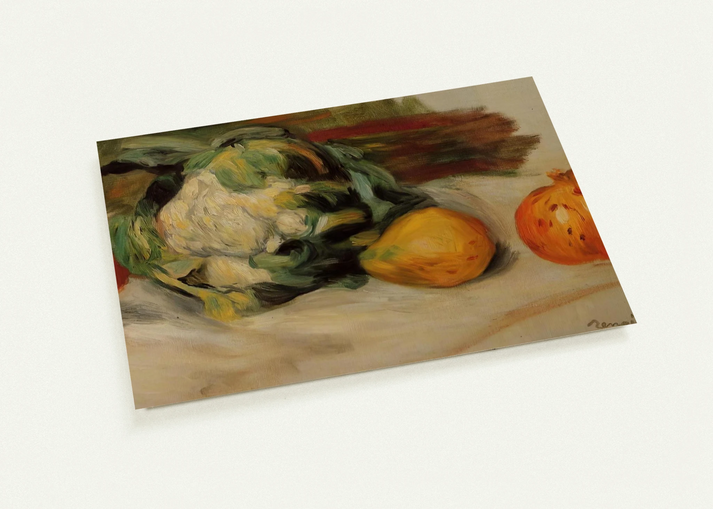
Cauliflower and Pomegranates By Pierre-Auguste Renoir Pack of 10 Post Cards | Pierre-Auguste Renoir Post Cards | A6 (10.5 x 14.8 cm) - 4.1 x 5.8 inches
Cauliflower and Pomegranates By Pierre-Auguste Renoir Pack of 10 Post Cards | Pierre-Auguste Renoir Post Cards | A6 (10.5 x 14.8 cm) - 4.1 x 5.8 inches
Couldn't load pickup availability
Elevate Your Correspondence with Pierre-Auguste Renoir’s Still Life Masterpiece
Invite the timeless elegance of French Impressionism into your daily life with this exclusive set of ten postcards featuring Pierre-Auguste Renoir’s 'Cauliflower and Pomegranates.' Originally painted during Renoir's later years, this work demonstrates the artist's shift from the ephemeral light of landscape to the rich, tactile presence of domestic objects. The juxtaposition of the structured, creamy florets of the cauliflower against the luminous, ruby-toned pomegranates showcases a master at the height of his colorist capabilities.
At RedKalion, we bridge the gap between museum archives and your personal collection. These are not standard stationery items; they are archival-grade reproductions designed for those who appreciate the finer details of art history and the physical sensation of premium materials.
Museum-Quality Technical Specifications
- Advanced 12-Color Printing: Unlike common 4-color commercial prints, we utilize a 12-color fine art printing process. This ensures every brushstroke and color gradation of Renoir’s palette is captured with stunning accuracy and depth.
- Premium Paper Stock: Each card is printed on 200 gsm (80 lb) FSC-certified paper with a thickness of 0.26 mm (10.3 mils), providing a substantial, luxurious feel.
- Sophisticated Matte Finish: The smooth matte surface eliminates glare, allowing the vibrant Impressionist hues to resonate under any lighting condition.
- Eco-Conscious Curation: In line with our commitment to the planet, our cards are produced on demand using environmentally responsible materials, minimizing waste without compromising on quality.
Whether used for thoughtful correspondence or displayed as a miniature gallery wall, these postcards offer an archival-grade experience that honors the legacy of Pierre-Auguste Renoir. Transform a simple note into an enduring masterpiece.
Discover Unlimited Art Possibilities
At RedKalion, you can find virtually any artwork from any artist, available in a wide range of sizes to perfectly match your space.
If you didn’t find what you’re looking for, contact us at support@redkalion.com . We will source any artwork and produce it in any size and format you need, including art prints, posters, canvas, framed pieces, framed canvas, and more.
For dedicated art enthusiasts, we also offer handcrafted replicas of any artwork, carefully painted by highly skilled artists using traditional techniques.
For custom requests, contact us at support@redkalion.com .
What makes the 12-color printing technology superior for Renoir’s art?
Standard printing often misses the subtle tonal shifts in Impressionist works. Our 12-color technology uses a broader gamut of pigments, capturing the specific warmth and complexity of Renoir's palette with museum-grade precision.
What are the exact dimensions and weight of these postcards?
These A6 postcards measure 10.5 x 14.8 cm (4.1 x 5.8 inches). They are printed on 200 gsm (80 lb) paper with a thickness of 0.26 mm, ensuring a sturdy and premium feel.
Is the paper archival and environmentally friendly?
Yes, we use FSC-certified paper, which ensures responsible forestry practices. The smooth matte finish is designed for longevity, maintaining its integrity and color vibrancy over time.
How are the postcards packaged and shipped?
Each set of 10 postcards is printed on demand to ensure perfection. They are carefully packaged to prevent bending and shipped directly from our archival facility to your door.
Will the colors fade if I display these cards on a wall?
Our archival-grade inks and matte-coated paper are highly resistant to UV degradation. While we recommend avoiding direct sunlight, these prints are designed to endure for years without significant fading.
What is the historical significance of 'Cauliflower and Pomegranates'?
Painted circa 1912-1915, this piece reflects Renoir's fascination with the 'volume' and 'weight' of objects in his later 'Cagnes' period, moving beyond the soft focus of his earlier Impressionist works.
Why did Renoir choose such humble subjects like cauliflower for his still lifes?
Renoir believed that art should be 'lovable' and 'pretty.' He found beauty in the organic textures of everyday items, using them as a vehicle to explore complex light interactions and rich, earthy pigments.