RedKalion
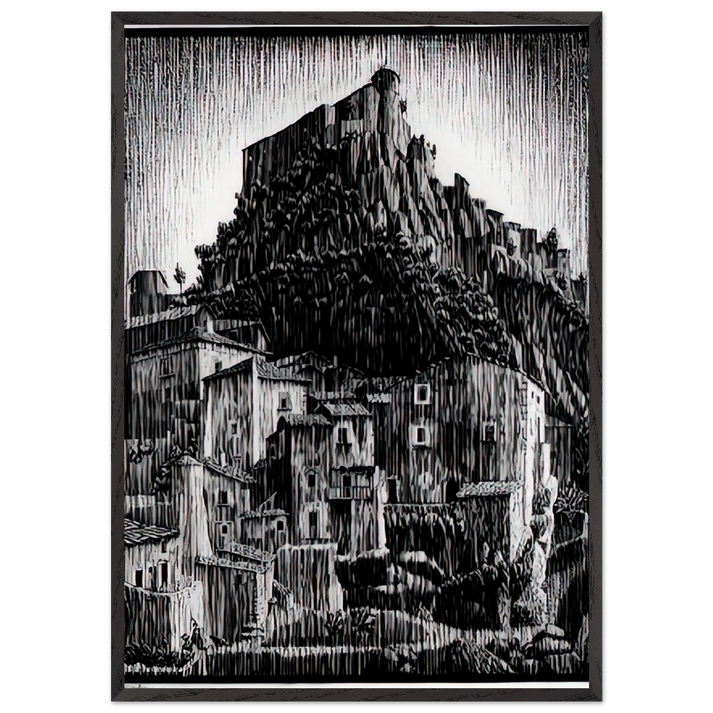
CERRO AL VOLTURNO ABRUZZI JANUARY 1930 1930 - MC Escher 70x100 cm / 28x40 inches Framed Art Print – Black Wooden Frame | Maurits Cornelis Escher Prints
CERRO AL VOLTURNO ABRUZZI JANUARY 1930 1930 - MC Escher 70x100 cm / 28x40 inches Framed Art Print – Black Wooden Frame | Maurits Cornelis Escher Prints
Couldn't load pickup availability
The Architect of Nature: M.C. Escher’s Cerro al Volturno
Before his transition into the mathematical enigmas of impossible staircases and infinite tessellations, Maurits Cornelis Escher was profoundly inspired by the stark, rugged landscapes of Italy. Cerro al Volturno Abruzzi January 1930 captures a pivotal moment in his career, showcasing his mastery of perspective and light during his travels through the Italian countryside. This piece is not merely a landscape; it is a meticulous study of geometric harmony found within the natural world and human architecture.
RedKalion is proud to present this museum-quality reproduction, capturing the intricate linework and deep tonal contrasts that define Escher’s Italian period. The scene, depicting the village and castle of Cerro al Volturno, utilizes a dramatic perspective that foreshadows the artist's future obsession with structural complexity. Every shadow and contour of the Molise mountains is rendered with the surgical precision of an artist who viewed the world as a complex visual puzzle.
Archival Excellence for Your Private Gallery
Our M.C. Escher fine art print is crafted to meet the highest standards of the global art market. We utilize 250 gsm (110 lb), archival-grade natural white paper with a sophisticated matte, uncoated finish. This specific paper weight and texture ensure that the deep blacks and subtle greys of Escher’s original lithographic technique are preserved without the distraction of glare.
- Museum-Quality Paper: 250 gsm (110 lb) archival, FSC-certified paper for long-lasting brilliance.
- Premium Framing: Encased in a 20mm (0.79") thick black wooden frame, crafted from responsibly sourced oak and ash.
- Durable Protection: Protected by shatterproof, transparent plexiglass to ensure safety and clarity.
- Ready-to-Hang: Delivered with a professional hanging kit for immediate installation.
Elevate your interior space with an archival masterpiece that endures. This 70x100 cm framed print represents RedKalion’s commitment to curated excellence, bringing the genius of M.C. Escher into the modern home with timeless sophistication.

Discover Unlimited Art Possibilities
At RedKalion, you can find virtually any artwork from any artist, available in a wide range of sizes to perfectly match your space.
If you didn’t find what you’re looking for, contact us at support@redkalion.com . We will source any artwork and produce it in any size and format you need, including art prints, posters, canvas, framed pieces, framed canvas, and more.
For dedicated art enthusiasts, we also offer handcrafted replicas of any artwork, carefully painted by highly skilled artists using traditional techniques.
For custom requests, contact us at support@redkalion.com .
What kind of paper is used for this M.C. Escher print?
We use 250 gsm (110 lb) natural white, museum-quality paper. It is archival and acid-free, featuring a matte finish that perfectly captures the fine details and textures of the original artwork without any reflective glare.
Is the frame included and ready to hang?
Yes, your print arrives in a 20mm thick black wooden frame made from oak and ash. It includes a pre-installed hanging kit, allowing you to display your artwork directly on the wall upon arrival.
How is the artwork protected during shipping and display?
Each framed print is protected by shatterproof plexiglass, offering superior clarity and durability. We use secure, impact-resistant packaging to ensure your museum-quality reproduction reaches you in perfect condition.
Are the materials used in this print sustainable?
Sustainability is core to RedKalion. We use FSC-certified wood for our frames and paper materials, ensuring that your art acquisition supports responsible forest management and environmental standards.
Will the colors of this print fade over time?
No, we use archival-grade paper and high-pigment inks designed for longevity. The 250 gsm paper is specifically selected for its thickness and resistance to aging, ensuring your investment remains vibrant for decades.
What was M.C. Escher’s inspiration for Cerro al Volturno?
Escher was captivated by the "structural rhythm" of Italian hill towns. In 1930, he focused on the geometric interplay between the medieval castle and the rugged Molise landscape, seeking to find mathematical order within the chaos of nature.
How does this landscape differ from Escher's later "impossible" works?
While his later work focused on mental constructs, this period highlights his skill as a realist observer. However, you can see early signs of his genius in the dramatic perspectives and the way he organizes architectural planes.