RedKalion
CIRCLE LIMIT I - MC Escher 70x100 cm / 28x40 inches Framed Art Print – Black Wooden Frame | Maurits Cornelis Escher Prints
CIRCLE LIMIT I - MC Escher 70x100 cm / 28x40 inches Framed Art Print – Black Wooden Frame | Maurits Cornelis Escher Prints
Couldn't load pickup availability
Mathematical Elegance: Circle Limit I by M.C. Escher
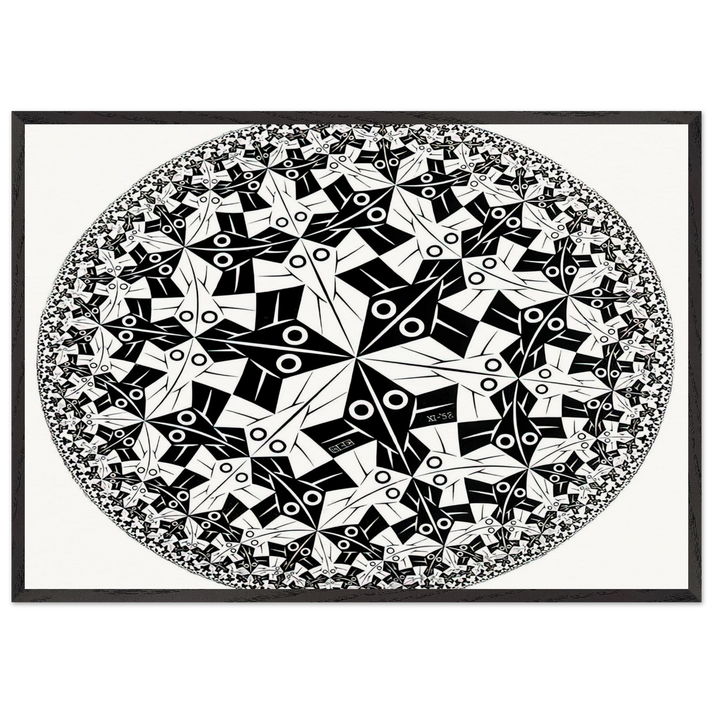
Step into the mesmerizing world of Maurits Cornelis Escher with this museum-quality reproduction of Circle Limit I. Created originally in 1958, this work represents the artist's first foray into hyperbolic geometry, a concept inspired by his correspondence with mathematician H.S.M. Coxeter. The piece features a complex tessellation of stylized fish that diminish in size as they approach the edge of the circular boundary, creating a profound visual representation of the infinite within a finite space.
As a hallmark of Op-Art and mathematical visualization, Circle Limit I is more than a decorative piece; it is a study in symmetry and perception. Escher’s mastery of the woodcut medium is translated here into a premium fine art print, capturing the subtle contrasts and intricate linework that define his legacy. This piece serves as a sophisticated focal point for those who appreciate the intersection of high art and scientific inquiry.
Archival Quality & Premium Craftsmanship
At RedKalion, we curate our prints to meet the exacting standards of discerning collectors. This framed masterpiece is constructed using only the finest materials to ensure it remains a cornerstone of your collection for decades:
- Museum-Grade Paper: Printed on 250 gsm (110 lb) natural white, archival paper with a thickness of 0.29 mm (11.4 mils) for a substantial, premium feel.
- Matte Finish: The uncoated, matte surface eliminates glare, allowing the viewer to appreciate Escher’s intricate details from any angle.
- Solid Wood Framing: Encased in a 20mm (0.79") thick black frame crafted from responsibly sourced oak and ash, offering a bolder profile than standard 14mm alternatives.
- Protective Glazing: High-clarity, shatterproof plexiglass guards the artwork against dust and environmental wear without compromising visual fidelity.
- Sustainable Excellence: Every component utilizes FSC-certified materials, aligning with our commitment to environmental responsibility.
Each order arrives ready-to-hang with an included hanging kit, allowing you to elevate your interior space with an archival masterpiece that endures. Experience the definitive curation of M.C. Escher prints with RedKalion.

Discover Unlimited Art Possibilities
At RedKalion, you can find virtually any artwork from any artist, available in a wide range of sizes to perfectly match your space.
If you didn’t find what you’re looking for, contact us at support@redkalion.com . We will source any artwork and produce it in any size and format you need, including art prints, posters, canvas, framed pieces, framed canvas, and more.
For dedicated art enthusiasts, we also offer handcrafted replicas of any artwork, carefully painted by highly skilled artists using traditional techniques.
For custom requests, contact us at support@redkalion.com .
What makes the paper quality of this Circle Limit I print unique?
We use 250 gsm (110 lb) archival museum-quality paper. This natural white, uncoated matte paper features a thickness of 0.29 mm, ensuring high durability and a sophisticated texture that prevents glare and preserves the fine details of M.C. Escher’s linework.
How is the M.C. Escher print framed?
The print is mounted in a premium black frame made from responsibly sourced oak or ash. The frame is 20mm (0.79") wide and thick, providing a more robust and high-end aesthetic compared to thinner, standard gallery frames.
Is the artwork protected against damage?
Yes, each framed print is protected by shatterproof plexiglass. This provides the clarity of glass with added safety and protection against impact, ensuring your fine art investment remains pristine during shipping and while on display.
How is the framed print shipped and ready for display?
Your Escher print arrives fully assembled and ready-to-hang. We include a dedicated hanging kit with each order, ensuring a seamless installation process immediately upon delivery to your home or office.
Will the colors of this fine art print fade over time?
No. By utilizing archival-grade, FSC-certified paper and museum-quality inks, RedKalion ensures long-term color stability. The matte finish and protective plexiglass further shield the artwork from degradation, maintaining its integrity for decades.
What is the mathematical significance of Circle Limit I?
Circle Limit I is Escher's first exploration of hyperbolic geometry using the Poincaré disk model. It represents an infinite repetition of patterns that diminish in scale as they approach the edge, visualizing a space that is infinite yet bounded.
How does Escher create the illusion of infinity in this piece?
Escher utilizes a systematic reduction in the size of the interlocking fish figures as they move from the center to the perimeter. This mathematical tessellation suggests that the pattern continues infinitely, despite being contained within a circular frame.