RedKalion
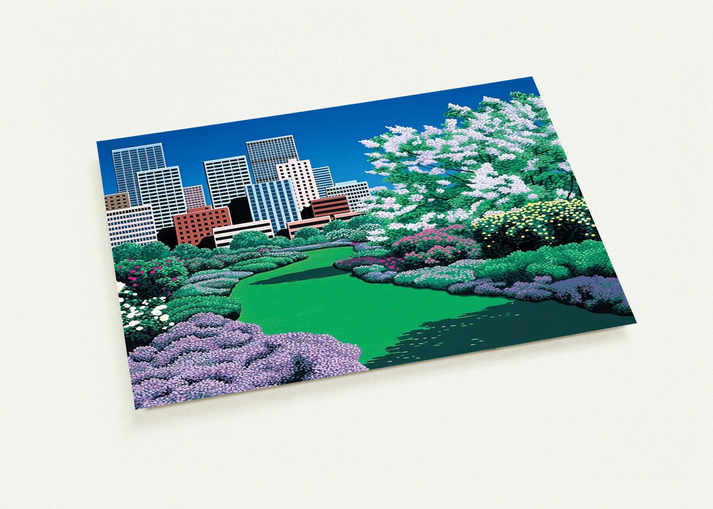
City Garden By Hiroshi Nagai Pack of 10 Post Cards | Hiroshi Nagai Post Cards | A6 (10.5 x 14.8 cm) - 4.1 x 5.8 inches
City Garden By Hiroshi Nagai Pack of 10 Post Cards | Hiroshi Nagai Post Cards | A6 (10.5 x 14.8 cm) - 4.1 x 5.8 inches
Couldn't load pickup availability
The Ethereal Urbanism of Hiroshi Nagai’s 'City Garden'
Evoke the nostalgia of the 1980s Japanese 'CityPop' era with this exclusive 10-pack of Hiroshi Nagai post cards. Featuring the iconic City Garden, these cards encapsulate Nagai’s signature aesthetic: a world of saturated cerulean skies, crisp architectural lines, and the serene, stylized leisure of an eternal urban summer. As a pioneer of Japanese graphic art, Nagai’s work defines a movement that blended Western mid-century modernism with a uniquely Japanese sensibility.
Museum-Quality Reproductions in Your Hands
At RedKalion, we believe fine art should be accessible without compromising on technical excellence. These museum-quality reproductions are crafted using our advanced 12-color fine art printing technology. Unlike standard 4-color inkjet processes, our method ensures breathtaking color vibrancy and depth, capturing every nuance of Nagai's vivid palette. Printed on 200 gsm (80 lb) FSC-certified paper, each card offers a substantial, premium feel with a smooth matte finish that eliminates glare.
The RedKalion Commitment to Excellence
Whether you are sending a heartfelt note or curating a miniature gallery in your own space, these archival-grade post cards are designed to endure. Our commitment to sustainability means each set is printed on environmentally conscious materials, ensuring that the beauty of Nagai's vision is preserved for future generations. Elevate your correspondence with a piece of art history that resonates with sophistication and timeless cool.
- Color Accuracy: Professional 12-color pigment-based printing for stunning vibrancy.
- Paper Quality: 200 gsm (80 lb) weight with a 0.26 mm (10.3 mils) thickness.
- Eco-Conscious: Produced on FSC-certified paper from sustainable sources.
- Dimensions: Standard A6 (10.5 x 14.8 cm) perfect for framing or mailing.

Discover Unlimited Art Possibilities
At RedKalion, you can find virtually any artwork from any artist, available in a wide range of sizes to perfectly match your space.
If you didn’t find what you’re looking for, contact us at support@redkalion.com . We will source any artwork and produce it in any size and format you need, including art prints, posters, canvas, framed pieces, framed canvas, and more.
For dedicated art enthusiasts, we also offer handcrafted replicas of any artwork, carefully painted by highly skilled artists using traditional techniques.
For custom requests, contact us at support@redkalion.com .
What is the printing quality of these Hiroshi Nagai post cards?
We use 12-color fine art printing technology, which provides superior color depth and accuracy compared to standard 4-color processes. This ensures the neon blues and vibrant sunsets of Nagai's work are perfectly captured.
What type of paper is used for the City Garden collection?
The cards are printed on premium 200 gsm (80 lb) FSC-certified paper with a smooth matte finish. This provides a clean, glare-free display and a substantial, high-quality tactile feel.
How long will these prints last without fading?
Our archival-grade inks and acid-free paper are designed for longevity. When kept out of direct sunlight, these museum-quality reproductions will maintain their vibrancy for decades.
Are these postcards environmentally friendly?
Yes. RedKalion is committed to sustainability. These postcards are printed on FSC-certified paper, ensuring the materials are sourced from responsibly managed forests.
How are the orders fulfilled?
Every pack of Hiroshi Nagai postcards is printed on demand to reduce waste. We maintain a zero-minimum order policy and ship in protective packaging to ensure they arrive in pristine condition.
What is the significance of the 'City Garden' series in Hiroshi Nagai's career?
'City Garden' exemplifies Nagai's ability to transform urban landscapes into dreamlike, idealized spaces. It represents the height of the CityPop aesthetic, focusing on clean lines and a sense of 'tropical' urbanism.
Why is Hiroshi Nagai considered a pioneer of the CityPop aesthetic?
Nagai's work provided the visual identity for Japan's 1980s music scene. His fusion of American pop art influences with Japanese precision created an enduring style that continues to influence modern synthwave and lo-fi aesthetics.