RedKalion
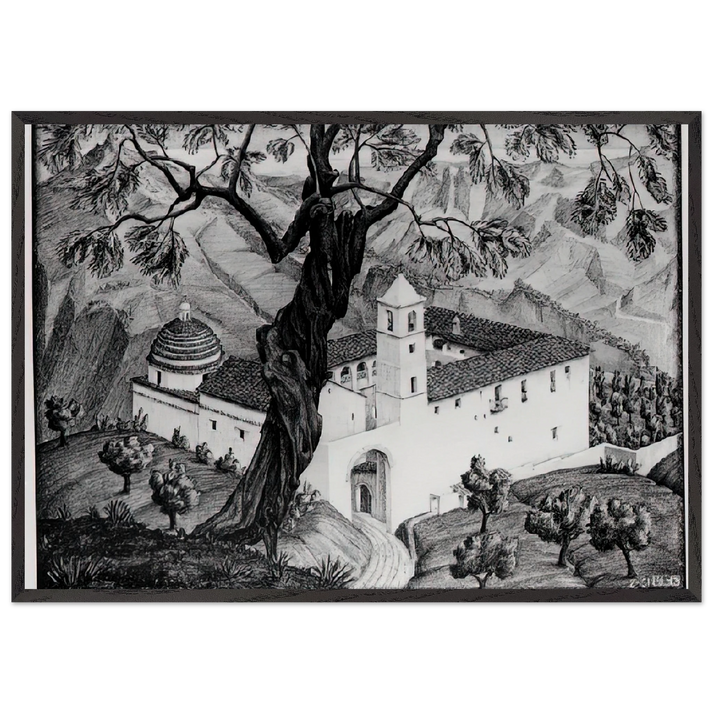
CLOISTER NEAR ROCCA IMPERIALE CALABRIA - MC Escher 70x100 cm / 28x40 inches Framed Art Print – Black Wooden Frame | Maurits Cornelis Escher Prints
CLOISTER NEAR ROCCA IMPERIALE CALABRIA - MC Escher 70x100 cm / 28x40 inches Framed Art Print – Black Wooden Frame | Maurits Cornelis Escher Prints
Couldn't load pickup availability
CLOISTER NEAR ROCCA IMPERIALE CALABRIA by M.C. Escher - Museum-Quality Framed Art Print
Immerse yourself in the architectural intricacies and unique perspective of Maurits Cornelis Escher with this stunning fine art print of "Cloister near Rocca Imperiale, Calabria." Escher, a master of impossible constructions and tessellations, challenges the viewer's perception of reality in this captivating depiction of an Italian cloister. This museum-quality reproduction captures the artist's meticulous detail and his fascination with classical forms.
Elevate your space with an archival masterpiece that endures. Our prints are produced on heavy, 250 gsm (110 lb), uncoated, natural white, matte paper with a thickness of 0.29 mm (11.4 mils). This sustainable, FSC-certified paper is specifically chosen for its archival qualities, ensuring vibrant colors and sharp details for generations. The print is protected by shatterproof plexiglass, offering clarity without the fragility of traditional glass.
Each framed art print is meticulously prepared and ready to hang. The frame is crafted from responsibly sourced oak and ash wood, featuring a substantial profile of 20mm (0.79") in thickness and width, providing a premium, gallery-worthy presentation that surpasses standard frame sizes. This piece, "Cloister near Rocca Imperiale, Calabria," is more than just a print; it's a conversation starter and a testament to Escher's unparalleled genius.
Product Details:
- Artwork: CLOISTER NEAR ROCCA IMPERIALE CALABRIA by M.C. Escher
- Paper: 250 gsm (110 lb) matte, uncoated, natural white, archival museum-quality paper (0.29 mm thickness)
- Frame: 20mm (0.79") thick and wide, made from responsibly sourced oak and ash wood
- Protection: Shatterproof plexiglass
- Features: Ready-to-hang with included hanging kit
- Sustainability: FSC-certified materials

Discover Unlimited Art Possibilities
At RedKalion, you can find virtually any artwork from any artist, available in a wide range of sizes to perfectly match your space.
If you didn’t find what you’re looking for, contact us at support@redkalion.com . We will source any artwork and produce it in any size and format you need, including art prints, posters, canvas, framed pieces, framed canvas, and more.
For dedicated art enthusiasts, we also offer handcrafted replicas of any artwork, carefully painted by highly skilled artists using traditional techniques.
For custom requests, contact us at support@redkalion.com .
What artwork is featured in this framed print?
This exquisite framed art print features "Cloister near Rocca Imperiale, Calabria" by the renowned Dutch artist M.C. Escher, a classic example of his architectural studies.
What are the dimensions of the framed print?
The print itself is 70x100 cm (28x40 inches). The frame adds to the overall dimensions, featuring a substantial 20mm (0.79") profile.
What type of paper is used for the M.C. Escher print?
The artwork is printed on premium, archival museum-quality paper. It's a matte, uncoated, natural white stock weighing 250 gsm (110 lb) with a thickness of 0.29 mm (11.4 mils).
What is the frame made of and what are its dimensions?
The frame is constructed from responsibly sourced oak and ash wood, measuring 20mm (0.79") thick and wide, offering a robust and elegant presentation for your M.C. Escher print.
How is the print protected?
Your museum-quality print is safeguarded by shatterproof plexiglass, ensuring durability and clear viewing of the intricate details of Escher's "Cloister near Rocca Imperiale, Calabria.".
Is the print ready to hang upon arrival?
Yes, this fine art print comes with a pre-attached hanging kit, making it ready to be displayed on your wall immediately after unboxing.
What is the historical significance of "Cloister near Rocca Imperiale, Calabria"?
Created in 1930, this artwork showcases M.C. Escher's early interest in realistic architectural landscapes before his more famous explorations of impossible structures. It highlights his skillful rendering of light and shadow.
What does the term 'tessellation' mean in relation to M.C. Escher's work?
Tessellation refers to Escher's use of repeating patterns that fit together perfectly without any gaps or overlaps, a technique he masterfully applied to geometric shapes and even representations of animals.