RedKalion
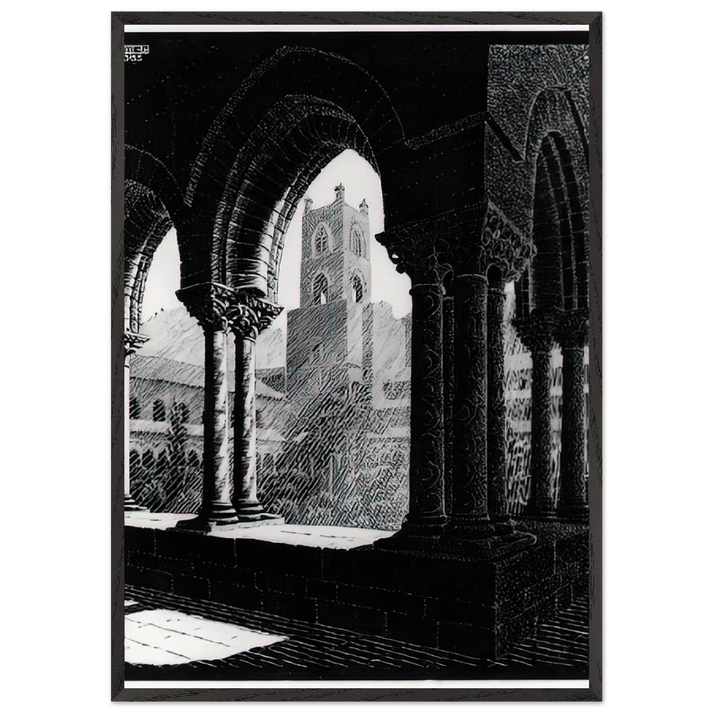
CLOISTER OF MONREALE SICILY - MC Escher 70x100 cm / 28x40 inches Framed Art Print – Black Wooden Frame | Maurits Cornelis Escher Prints
CLOISTER OF MONREALE SICILY - MC Escher 70x100 cm / 28x40 inches Framed Art Print – Black Wooden Frame | Maurits Cornelis Escher Prints
Couldn't load pickup availability
MC Escher "Cloister of Monreale Sicily" 70x100 cm / 28x40 inches Framed Art Print
Immerse yourself in the architectural wonder and optical illusion of M.C. Escher's "Cloister of Monreale Sicily." This masterful fine art print captures the intricate details and unique perspective that made Escher a pioneer of graphic art. Created with meticulous attention to detail, this museum-quality reproduction brings the complex beauty of the Monreale Cloister into your home.
Maurits Cornelis Escher, renowned for his impossible constructions and explorations of infinity, often drew inspiration from real-world structures, reinterpreting them through his distinctive lens. "Cloister of Monreale Sicily" exemplifies his ability to transform familiar scenes into thought-provoking visual puzzles, inviting viewers to question their perception of space and form.
RedKalion is proud to present this exquisite fine art print, meticulously reproduced on 250 gsm (110 lb) weight, 0.29 mm (11.4 mils) thick matte, uncoated, natural white archival museum-quality paper. This sustainable, FSC-certified paper provides a rich, tactile surface ideal for showcasing Escher's detailed linework and tonal gradations. Each print is protected by shatterproof plexiglass and arrives ready-to-hang with an included hanging kit.
The print is presented in a 20mm (0.79") thick and wide frame crafted from responsibly sourced oak and ash wood, offering a substantial and elegant presentation that complements the artwork's depth. This substantial frame is wider than the classic 14mm (0.55") frame, enhancing the print's visual impact.
Elevate your space with an archival masterpiece that endures. This M.C. Escher "Cloister of Monreale Sicily" framed art print is a testament to both artistic genius and our commitment to delivering unparalleled quality in fine art reproductions.

Discover Unlimited Art Possibilities
At RedKalion, you can find virtually any artwork from any artist, available in a wide range of sizes to perfectly match your space.
If you didn’t find what you’re looking for, contact us at support@redkalion.com . We will source any artwork and produce it in any size and format you need, including art prints, posters, canvas, framed pieces, framed canvas, and more.
For dedicated art enthusiasts, we also offer handcrafted replicas of any artwork, carefully painted by highly skilled artists using traditional techniques.
For custom requests, contact us at support@redkalion.com .
What artwork is featured in this framed print?
This framed art print features the iconic "Cloister of Monreale Sicily" by the renowned Dutch artist M.C. Escher, a celebrated graphic artist known for his impossible constructions.
What are the dimensions of the artwork and the frame?
The artwork print measures 70x100 cm / 28x40 inches. The frame is made of responsibly sourced wood and measures 20mm (0.79") thick and wide.
What type of paper is used for this M.C. Escher reproduction?
This museum-quality print uses 250 gsm (110 lb) weight, 0.29 mm (11.4 mils) thick, matte, uncoated, natural white archival paper, ensuring exceptional detail and longevity.
How is the print protected, and is it ready to hang?
The print is protected by shatterproof plexiglass and comes with a hanging kit, making it ready to hang directly on your wall upon arrival.
What materials are used for the frame and paper?
The frame is crafted from responsibly sourced oak and ash wood. The paper is sustainable, FSC-certified, ensuring an eco-conscious and high-quality fine art print.
Can you tell me more about the historical context of "Cloister of Monreale Sicily"?
Escher visited the Monreale Cloister in Sicily in 1931, a period when his work began incorporating more architectural elements and exploring complex spatial relationships.
What is unique about M.C. Escher's artistic style as seen in this print?
Escher's signature style, evident in "Cloister of Monreale Sicily," involves meticulous detail, rhythmic patterns, and often an exploration of impossible perspectives and tessellations.