
RedKalion
Composition 8 Art Print by Wassily Kandinsky | RedKalion
Composition 8 Art Print by Wassily Kandinsky | RedKalion
Couldn't load pickup availability
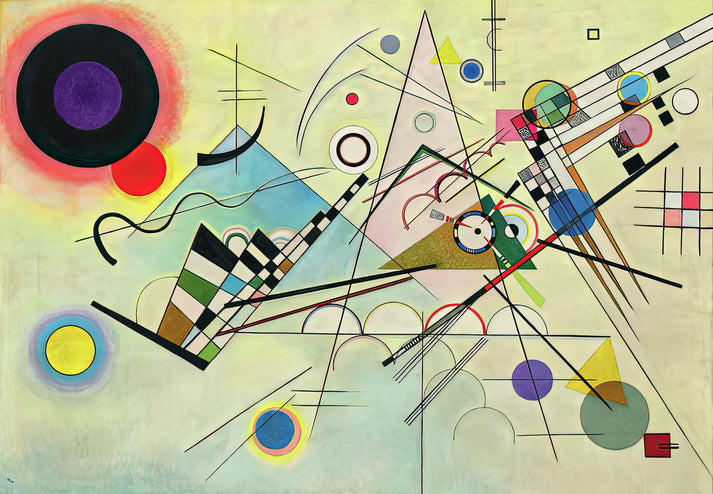
Wassily Kandinsky's Composition 8 (1923) marks a pivotal moment in abstract art, blending geometric precision with dynamic energy. This seminal work from his Bauhaus period explores spiritual harmony through circles, triangles, and lines. RedKalion offers a premium fine art print, meticulously reproduced to honor Kandinsky's visionary palette and intricate forms.
Analyzing Composition 8 by Wassily Kandinsky
Kandinsky described this piece as his most complex composition, synthesizing his theories on color and form. The canvas balances structured geometry with fluid movement, reflecting his shift toward a more disciplined abstraction. Circles symbolize cosmic unity, while sharp angles introduce tension, creating a visual symphony that transcends representation.
Composition VIII Art Print Details
Our archival print captures every nuance of the original oil painting, from the vibrant yellows and reds to the subtle grays. Expert color calibration ensures fidelity to Kandinsky's 1923 masterpiece. This print serves as a centerpiece for modern interiors, offering a glimpse into avant-garde innovation.
Print Specifications & Materials
- Available Sizes: 75×100 cm / 30×40″, 40×50 cm / 16×20″, 21×29.7 cm / 8×12″
- Paper Finishing: Matte, uncoated, natural white (off-white)
- Acid-Free: pH above 7 to prevent yellowing over time
- Paper Weight: 250 gsm (110 lb) | Thickness: 0.29 mm (11.4 mils)
- Sustainable Paper: FSC-certified
Acquire this Kandinsky Composition 8 art print from RedKalion for a museum-quality addition to your collection. Our prints are trusted by curators and enthusiasts for their archival integrity and artistic precision.

Discover Unlimited Art Possibilities
At RedKalion, you can find virtually any artwork from any artist, available in a wide range of sizes to perfectly match your space.
If you didn’t find what you’re looking for, contact us at support@redkalion.com . We will source any artwork and produce it in any size and format you need, including art prints, posters, canvas, framed pieces, framed canvas, and more.
For dedicated art enthusiasts, we also offer handcrafted replicas of any artwork, carefully painted by highly skilled artists using traditional techniques.
For custom requests, contact us at support@redkalion.com .
What is the historical significance of Composition 8 by Wassily Kandinsky?
Painted in 1923, Composition 8 represents Kandinsky's Bauhaus period, where he refined abstract art using geometric forms to express spiritual ideas, influencing modern art movements.
How does RedKalion ensure color accuracy in this Kandinsky art print?
We use professional-grade color calibration and high-resolution sourcing to match Kandinsky's original 1923 palette, ensuring vibrant and true-to-life reproduction for fine art displays.
What paper is used for the Composition VIII fine art print?
Our prints use FSC-certified, acid-free paper with a matte finish and 250 gsm weight, providing archival quality that resists fading and yellowing over decades.
How is the Composition 8 print shipped to prevent damage?
We ship prints in rigid, protective packaging with reinforced corners and climate-controlled materials to ensure they arrive in pristine condition, ready for framing.
How long will this Kandinsky print last without fading?
With acid-free, pH-balanced paper and pigment-based inks, this print maintains its color integrity for over 100 years under standard indoor lighting conditions.
What are the key geometric elements in Composition 8?
Kandinsky employed circles, triangles, and intersecting lines in Composition 8 to create a balanced yet dynamic composition, symbolizing cosmic harmony and spiritual tension.
How does Composition 8 reflect Kandinsky's artistic theories?
This work embodies Kandinsky's belief in the spiritual in art, using abstract forms and colors to evoke emotional and metaphysical responses, as outlined in his writings.