
RedKalion
Crossbow Drawing Art Print | Premium Historical Weapon Illustration | RedKalion
Crossbow Drawing Art Print | Premium Historical Weapon Illustration | RedKalion
Couldn't load pickup availability
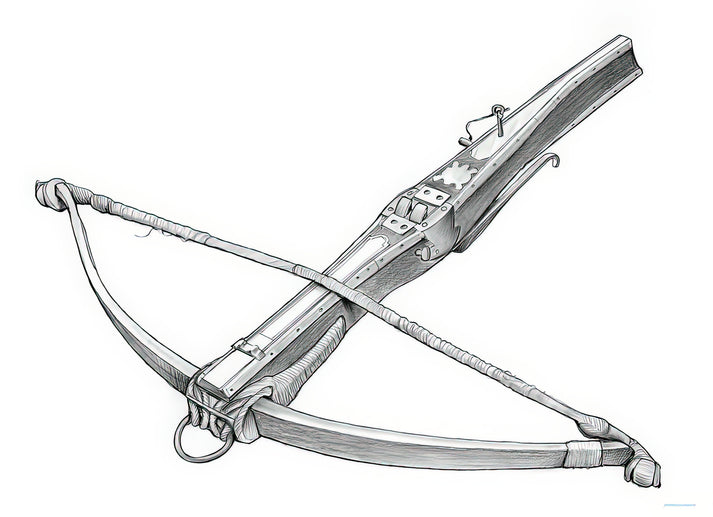
This crossbow drawing art print offers a meticulous study of a medieval weapon, capturing its mechanical precision and historical significance. Created as part of a series on historical armaments, the artwork blends technical accuracy with artistic flair, presenting the crossbow's complex trigger mechanism, spanning device, and stock in fine detail. It appeals to historians, collectors, and art enthusiasts seeking a nuanced depiction of martial technology from the Middle Ages.
Historical Context of Crossbow Drawings
Crossbows emerged in Europe around the 10th century, revolutionizing warfare with their power and ease of use compared to longbows. This crossbow drawing reflects the weapon's evolution, highlighting features like the stirrup for spanning and the nut-and-trigger release system. Such illustrations were often found in military treatises and armory records, serving both practical and artistic purposes in documenting medieval engineering.
Artistic Analysis of the Crossbow Illustration
The drawing employs clean, precise lines to emphasize the crossbow's functional design, with shading used to suggest depth and material textures like wood and metal. Stylistically, it echoes Renaissance-era technical drawings, where clarity and proportion were paramount. This approach not only educates viewers on the weapon's mechanics but also elevates it to an object of aesthetic appreciation, showcasing the intersection of art and historical artifact.
Print Specifications & Materials
- Available Sizes: 75×100 cm / 30×40″, 40×50 cm / 16×20″, 21×29.7 cm / 8×12″
- Paper Finishing: Matte, uncoated, natural white (off-white)
- Acid-Free: pH above 7 to prevent yellowing over time
- Paper Weight: 250 gsm (110 lb) | Thickness: 0.29 mm (11.4 mils)
- Sustainable Paper: FSC-certified
At RedKalion, we specialize in museum-quality reproductions that honor the original crossbow drawing's detail and historical value. Our prints are crafted to archival standards, ensuring they remain vibrant for generations, making this piece a sophisticated addition to any collection focused on historical art or weaponry.

Discover Unlimited Art Possibilities
At RedKalion, you can find virtually any artwork from any artist, available in a wide range of sizes to perfectly match your space.
If you didn’t find what you’re looking for, contact us at support@redkalion.com . We will source any artwork and produce it in any size and format you need, including art prints, posters, canvas, framed pieces, framed canvas, and more.
For dedicated art enthusiasts, we also offer handcrafted replicas of any artwork, carefully painted by highly skilled artists using traditional techniques.
For custom requests, contact us at support@redkalion.com .
What is the historical period depicted in this crossbow drawing?
This crossbow drawing represents a medieval European design from the 12th to 15th centuries, featuring typical elements like a wooden stock and metal trigger mechanism used in warfare and hunting.
What paper type is used for the crossbow art print?
We use FSC-certified, acid-free paper with a matte finish and 250 gsm weight to ensure archival longevity and accurate color reproduction for historical illustrations.
How is the crossbow drawing art print shipped?
Prints are shipped flat in protective packaging to prevent damage, with options for standard and expedited delivery to ensure safe arrival of your fine art print.
Will the crossbow illustration print fade over time?
No, our acid-free paper and archival inks resist fading and yellowing, preserving the crossbow drawing's details for decades under proper display conditions.
What sizes are available for this crossbow weapon print?
Available in 75×100 cm, 40×50 cm, and 21×29.7 cm sizes to fit various display spaces, from gallery walls to study areas.
How does this drawing compare to actual medieval crossbow designs?
It accurately depicts key features like the spanning stirrup and nut mechanism, based on historical records and artifacts, making it a reliable educational resource.
What artistic techniques are used in the crossbow illustration?
The drawing uses precise line work and subtle shading to highlight mechanical details, reflecting Renaissance-era technical illustration styles for clarity and realism.