RedKalion
CUBIC SPACE DIVISION - MC Escher 70x100 cm / 28x40 inches Framed Art Print – Black Wooden Frame | Maurits Cornelis Escher Prints
CUBIC SPACE DIVISION - MC Escher 70x100 cm / 28x40 inches Framed Art Print – Black Wooden Frame | Maurits Cornelis Escher Prints
Couldn't load pickup availability
Cubic Space Division by M.C. Escher - Museum-Quality Framed Art Print
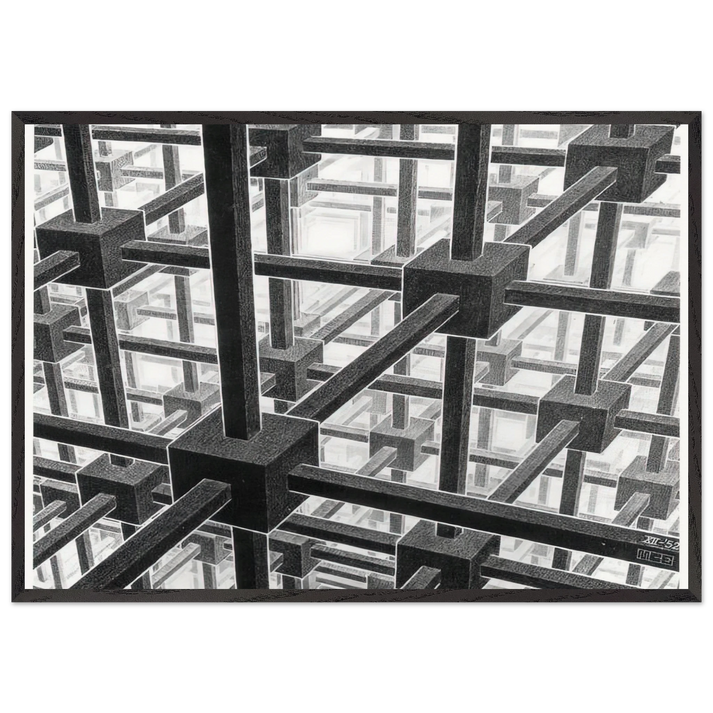
Immerse yourself in the paradoxical world of Maurits Cornelis Escher with this museum-quality fine art print of "Cubic Space Division." Escher, a master of impossible constructions and tessellations, invites viewers into a realm where geometric precision meets optical illusion. This iconic work, meticulously reproduced by RedKalion, showcases Escher's fascination with spatial relationships and the division of planes.
Crafted with unparalleled attention to detail, this print captures the intricate linework and profound depth characteristic of M.C. Escher's genius. Our commitment to preserving the integrity of original artworks ensures that this archival masterpiece will endure for generations. Elevate your space with a print that is not only visually captivating but also a testament to artistic innovation and historical significance.
This exquisite reproduction is presented in a frame made from responsibly sourced oak and ash wood, featuring a sleek black finish. The frame measures a substantial 20mm (0.79") thick and wide, offering a more robust and visually impactful presentation than standard frames. Protected by shatterproof plexiglass, your fine art print is safeguarded against damage while maintaining clarity.
Product Details:
- Artwork: Cubic Space Division by M.C. Escher
- Dimensions: 70x100 cm / 28x40 inches
- Print Quality: Museum-quality, archival, matte, uncoated, natural white paper
- Paper Specifications: 250 gsm (110 lb) weight, 0.29 mm (11.4 mils) thickness
- Frame: Black, made from responsibly sourced oak and ash wood (20mm / 0.79" thickness & width)
- Protection: Shatterproof plexiglass
- Sustainability: FSC-certified paper or equivalent
- Ready-to-Hang: Includes a pre-installed hanging kit for immediate display.

Discover Unlimited Art Possibilities
At RedKalion, you can find virtually any artwork from any artist, available in a wide range of sizes to perfectly match your space.
If you didn’t find what you’re looking for, contact us at support@redkalion.com . We will source any artwork and produce it in any size and format you need, including art prints, posters, canvas, framed pieces, framed canvas, and more.
For dedicated art enthusiasts, we also offer handcrafted replicas of any artwork, carefully painted by highly skilled artists using traditional techniques.
For custom requests, contact us at support@redkalion.com .
What is the artwork "Cubic Space Division" about?
"Cubic Space Division" by M.C. Escher explores geometric abstraction and the partitioning of space. It demonstrates Escher's fascination with tessellation and complex spatial arrangements, creating a visually intriguing pattern.
What are the paper specifications for this M.C. Escher print?
This fine art print uses museum-quality, matte, uncoated, natural white paper with a weight of 250 gsm (110 lb) and a thickness of 0.29 mm (11.4 mils) for exceptional archival longevity.
How is the print protected?
The artwork is protected by shatterproof plexiglass, ensuring durability and clarity while safeguarding the museum-quality reproduction from damage.
Is the frame sustainable?
Yes, the frame is crafted from responsibly sourced oak and ash wood, aligning with our commitment to environmental consciousness and sustainable practices.
What does "ready-to-hang" mean for this print?
The "ready-to-hang" feature means a hanging kit is pre-installed on the frame, allowing you to display your archival print immediately upon arrival without additional setup.
Tell me more about M.C. Escher's technique.
M.C. Escher was renowned for his woodcuts, mezzotints, and lithographs that often featured impossible constructions, explorations of infinity, and tessellations, blending mathematical concepts with artistic expression.
What is the historical context of "Cubic Space Division"?
Created during a period of prolific exploration for Escher, "Cubic Space Division" reflects his ongoing interest in metamorphic concepts and the regular division of the plane, a theme he revisited throughout his career.