
RedKalion
Drawing of Heliocentric System Art Print | Premium Museum-Quality | RedKalion
Drawing of Heliocentric System Art Print | Premium Museum-Quality | RedKalion
Couldn't load pickup availability
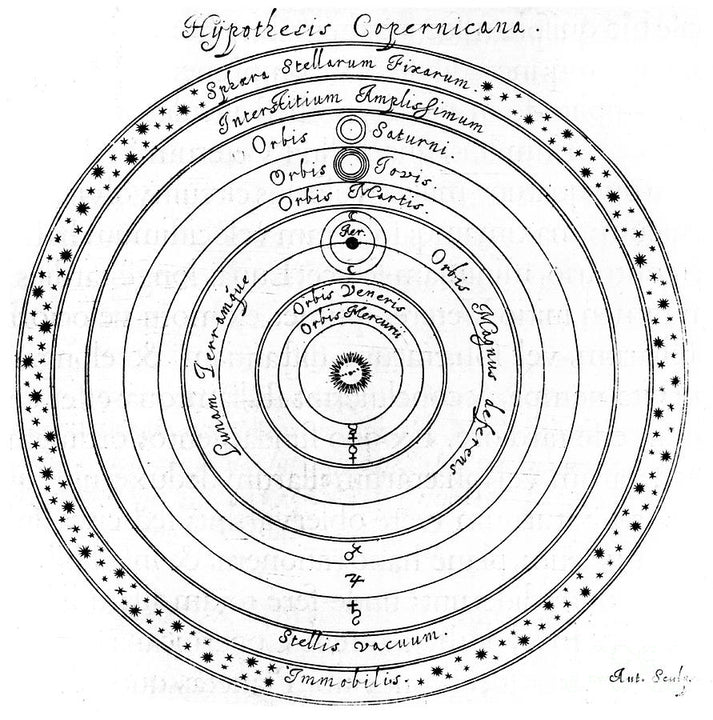
This drawing of the heliocentric system, attributed to Nicolaus Copernicus or his contemporaries, represents a pivotal moment in scientific history. Created in the 16th century, it visually articulates the revolutionary theory that placed the Sun at the center of the universe, challenging centuries of Ptolemaic geocentric thought. The artwork, likely an engraving or manuscript illustration, combines precise astronomical diagrams with Renaissance artistic sensibilities, using clean lines and symbolic elements to convey complex cosmological ideas.
Historical Context of the Heliocentric Drawing
Emerging during the Scientific Revolution, this drawing of the heliocentric model reflects Copernicus's seminal work, De revolutionibus orbium coelestium (1543). It served as an educational tool, disseminating the radical concept that Earth and other planets orbit the Sun. The style blends medieval schematic traditions with early modern scientific illustration, aiming for clarity and persuasive power in an era of intellectual upheaval.
Artistic and Scientific Analysis
As a drawing of the heliocentric system, this piece prioritizes didactic function over decorative flourish. Circular orbits are rendered with geometric precision, while annotations or labels may accompany celestial bodies, emphasizing its role in advancing astronomical understanding. The composition often centers the Sun, radiating order and harmony, symbolizing the Enlightenment pursuit of natural laws.
Why Choose This Heliocentric Art Print
RedKalion's reproduction captures the intricate details and historical gravitas of the original drawing of the heliocentric universe. Our archival-grade materials ensure longevity, making it an ideal addition for scholars, educators, or enthusiasts seeking to celebrate the legacy of Copernican thought. This print not only decorates but also inspires, bridging art and science.
Print Specifications & Materials
- Available Sizes: 75×100 cm / 30×40″, 40×50 cm / 16×20″, 21×29.7 cm / 8×12″
- Paper Finishing: Matte, uncoated, natural white (off-white)
- Acid-Free: pH above 7 to prevent yellowing over time
- Paper Weight: 250 gsm (110 lb) | Thickness: 0.29 mm (11.4 mils)
- Sustainable Paper: FSC-certified
This drawing of the heliocentric system art print from RedKalion offers a timeless tribute to scientific innovation, crafted with museum-quality standards for discerning collectors.


Discover Unlimited Art Possibilities
At RedKalion, you can find virtually any artwork from any artist, available in a wide range of sizes to perfectly match your space.
If you didn’t find what you’re looking for, contact us at support@redkalion.com . We will source any artwork and produce it in any size and format you need, including art prints, posters, canvas, framed pieces, framed canvas, and more.
For dedicated art enthusiasts, we also offer handcrafted replicas of any artwork, carefully painted by highly skilled artists using traditional techniques.
For custom requests, contact us at support@redkalion.com .
What is the historical significance of this heliocentric drawing?
This 16th-century drawing illustrates Copernicus's revolutionary heliocentric model, which placed the Sun at the center of the solar system, challenging earlier geocentric views and marking a key moment in the Scientific Revolution.
What are the details of the paper used for this art print?
We use FSC-certified, acid-free paper with a matte finish, 250 gsm weight, and natural white color to ensure archival longevity and prevent yellowing, ideal for preserving this historical drawing.
How is this heliocentric system art print shipped?
Prints are carefully rolled in protective tubes and shipped via tracked courier, with options for expedited delivery to ensure safe arrival of your premium museum-quality artwork.
How long will this art print last without fading?
With acid-free, archival-grade materials, this print resists fading and deterioration for decades under normal indoor lighting conditions, maintaining the integrity of the heliocentric drawing.
What sizes are available for this Copernican art print?
Available in 75×100 cm, 40×50 cm, and 21×29.7 cm sizes, offering flexibility for display in homes, offices, or educational settings as a fine art print.
Who created the original heliocentric drawing?
Attributed to Nicolaus Copernicus or his contemporaries in the 16th century, it was likely produced as an engraving or manuscript illustration to accompany his astronomical theories.
What artistic style characterizes this heliocentric diagram?
It blends Renaissance precision with medieval schematic traditions, using clean lines and symbolic elements to visually explain the complex Copernican model of the solar system.