
RedKalion
Helium Emission Spectrum Art Print | Fine Art Print | RedKalion
Helium Emission Spectrum Art Print | Fine Art Print | RedKalion
Couldn't load pickup availability
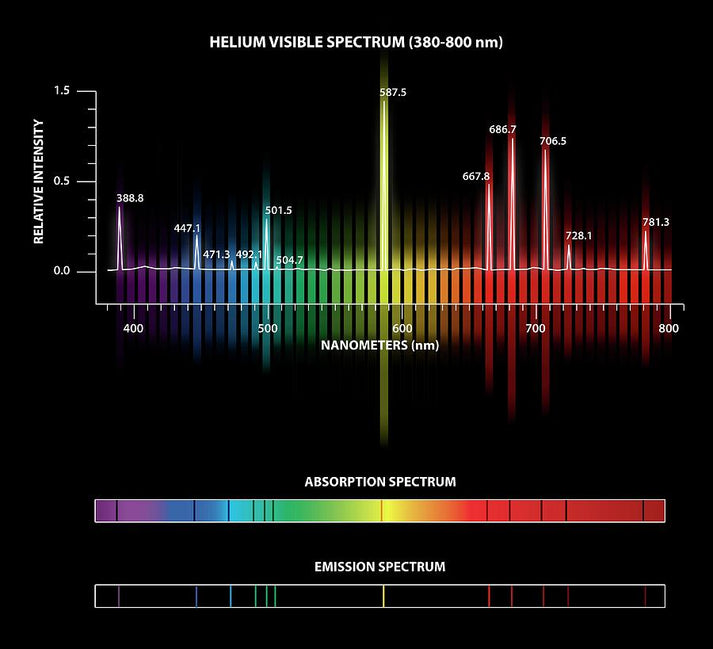
The helium emission spectrum, a fundamental phenomenon in atomic physics, reveals the unique energy transitions of helium atoms as they emit light at specific wavelengths. This results in a series of distinct spectral lines, each corresponding to an electron moving to a lower energy state. The pattern is a signature of helium's atomic structure, offering insights into quantum mechanics and stellar composition.
Scientific and Artistic Significance of the Helium Emission Spectrum
First observed in the 19th century through spectroscopy, the helium emission spectrum was pivotal in developing quantum theory. Its lines—such as the prominent red (667.8 nm) and yellow (587.6 nm)—are not just data points but visual representations of atomic behavior. In art, this spectrum transforms abstract science into a striking visual motif, blending precision with aesthetic appeal.
Helium Spectrum Analysis and Details
The emission spectrum for helium features lines primarily in the visible range, with key intensities in red, yellow, and blue-violet regions. These correspond to transitions like 3d to 2p and 4d to 2p. Unlike absorption spectra, emission spectra display bright lines on a dark background, highlighting helium's energetic properties. This print captures these details with accuracy, making it ideal for educational or decorative purposes.
Print Specifications & Materials
- Available Sizes: 75×100 cm / 30×40″, 40×50 cm / 16×20″, 21×29.7 cm / 8×12″
- Paper Finishing: Matte, uncoated, natural white (off-white)
- Acid-Free: pH above 7 to prevent yellowing over time
- Paper Weight: 250 gsm (110 lb) | Thickness: 0.29 mm (11.4 mils)
- Sustainable Paper: FSC-certified
At RedKalion, we combine scientific rigor with artisanal craftsmanship to produce premium prints that honor the helium emission spectrum's legacy. Our archival materials ensure this piece remains vibrant for generations, serving as a trusted resource for enthusiasts and scholars alike.

Discover Unlimited Art Possibilities
At RedKalion, you can find virtually any artwork from any artist, available in a wide range of sizes to perfectly match your space.
If you didn’t find what you’re looking for, contact us at support@redkalion.com . We will source any artwork and produce it in any size and format you need, including art prints, posters, canvas, framed pieces, framed canvas, and more.
For dedicated art enthusiasts, we also offer handcrafted replicas of any artwork, carefully painted by highly skilled artists using traditional techniques.
For custom requests, contact us at support@redkalion.com .
What is depicted in this helium emission spectrum art print?
This print shows the visible emission spectrum for helium, with distinct spectral lines representing energy transitions of helium atoms, such as red at 667.8 nm and yellow at 587.6 nm.
What paper is used for this fine art print?
We use FSC-certified, acid-free paper with a matte finish, 250 gsm weight, and natural white color to ensure archival quality and prevent yellowing.
How is this art print shipped and packaged?
Prints are shipped in sturdy, flat packaging with protective layers to prevent damage during transit, with tracking provided for all orders.
How long will this print last without fading?
With acid-free, archival materials, this print resists fading and yellowing for decades under normal indoor lighting conditions.
What are the key historical discoveries related to the helium emission spectrum?
The helium emission spectrum was first observed in the 1860s, aiding the development of quantum mechanics and confirming helium's presence in the sun before its discovery on Earth.
How does the emission spectrum differ from the absorption spectrum for helium?
The emission spectrum for helium displays bright lines on a dark background from emitted light, while the absorption spectrum shows dark lines on a bright background from absorbed light.