
RedKalion
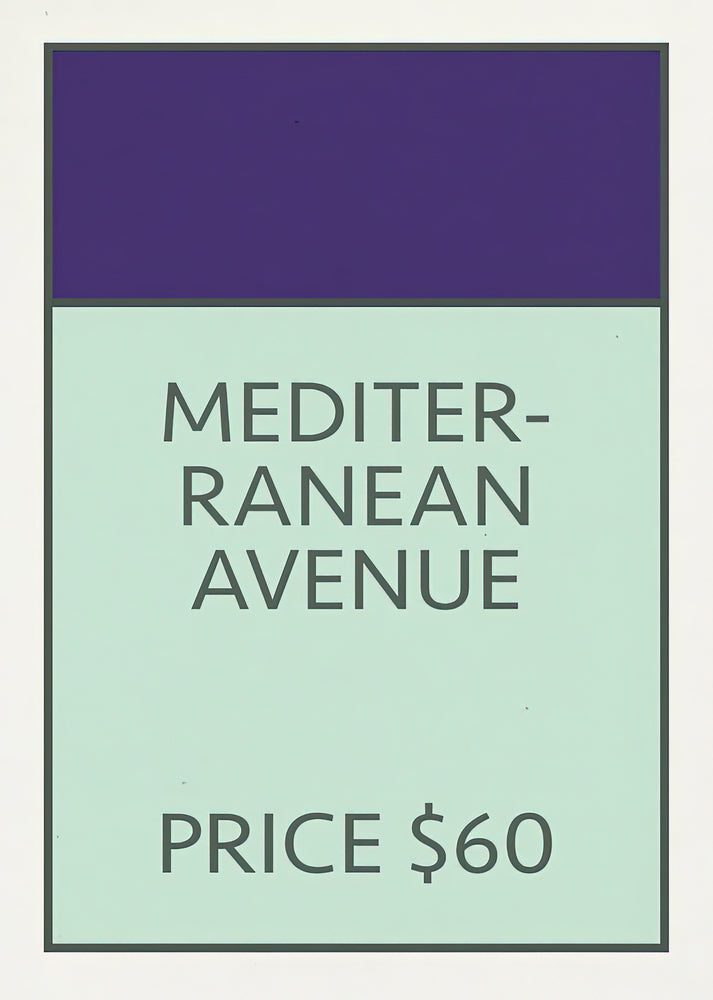
Mediterranean Avenue Vintage Monopoly Card Art Print | RedKalion
Mediterranean Avenue Vintage Monopoly Card Art Print | RedKalion
Couldn't load pickup availability
Mediterranean Avenue, the iconic starting property from the classic Monopoly board game, represents a nostalgic slice of 20th-century American leisure culture. This vintage game card, with its simple yet evocative design, captures the essence of early 20th-century board game aesthetics, where utility and charm intersected in family entertainment. As the lowest-priced property on the board, it holds a unique place in gaming history, symbolizing humble beginnings and strategic acquisition in a capitalist-themed pastime.
Artistic Analysis of the Mediterranean Avenue Monopoly Card
Designed in the 1930s by Charles Darrow and later refined by Parker Brothers, the Mediterranean Avenue card exemplifies the Art Deco and Streamline Moderne influences prevalent in graphic design of the era. Its minimalist layout—featuring bold typography, a straightforward color palette of maroon and white, and a clean border—prioritizes readability and function, reflecting the game's roots in economic simulation. The card's lack of elaborate illustration contrasts with later properties, underscoring its role as an introductory asset in Monopoly's property ladder.
Historical Context of Monopoly's Mediterranean Avenue
Mediterranean Avenue is named after the Mediterranean Sea, evoking exotic travel and trade routes, a theme consistent with Monopoly's Atlantic City-inspired property names. In the game's evolution from Elizabeth Magie's Landlord's Game to its commercial success, this card became a symbol of entry-level investment, often overlooked by players but crucial for early-game strategy. Its vintage appeal lies in its connection to mid-century American board game culture, where Monopoly reigned as a household staple, fostering competitive play and financial lessons across generations.
Print Specifications & Materials
- Available Sizes: 75×100 cm / 30×40″, 40×50 cm / 16×20″, 21×29.7 cm / 8×12″
- Paper Finishing: Matte, uncoated, natural white (off-white)
- Acid-Free: pH above 7 to prevent yellowing over time
- Paper Weight: 250 gsm (110 lb) | Thickness: 0.29 mm (11.4 mils)
- Sustainable Paper: FSC-certified
This Mediterranean Avenue art print from RedKalion offers a premium reproduction of a classic Monopoly card, ideal for gaming enthusiasts and retro decor aficionados. Our museum-quality standards ensure that every detail, from the typography to the color tones, is preserved with archival integrity, making it a timeless piece for collectors and nostalgic displays.

Discover Unlimited Art Possibilities
At RedKalion, you can find virtually any artwork from any artist, available in a wide range of sizes to perfectly match your space.
If you didn’t find what you’re looking for, contact us at support@redkalion.com . We will source any artwork and produce it in any size and format you need, including art prints, posters, canvas, framed pieces, framed canvas, and more.
For dedicated art enthusiasts, we also offer handcrafted replicas of any artwork, carefully painted by highly skilled artists using traditional techniques.
For custom requests, contact us at support@redkalion.com .
What is the historical significance of the Mediterranean Avenue Monopoly card?
The Mediterranean Avenue card dates to the 1930s Monopoly release, representing the lowest-priced property and reflecting Art Deco design trends in early board games.
What sizes are available for this Mediterranean Avenue art print?
This fine art print comes in 75×100 cm, 40×50 cm, and 21×29.7 cm sizes, suitable for various display needs from large wall art to smaller collectibles.
Is the paper used for this print archival and acid-free?
Yes, our paper is acid-free with a pH above 7 and FSC-certified, ensuring long-term color stability and resistance to yellowing for archival quality prints.
How is this Mediterranean Avenue print shipped and packaged?
We ship prints in sturdy, flat packaging with protective layers to prevent damage during transit, ensuring your vintage Monopoly art arrives in perfect condition.
Can this art print be framed easily?
Yes, the standard sizes and matte finish make framing straightforward; we recommend acid-free mats and UV-protective glass for optimal preservation.
Why is Mediterranean Avenue considered a strategic property in Monopoly?
As the cheapest property, it offers low investment risk and can be part of a monopoly with Baltic Avenue, enabling rent collection and early-game advantage.
How does the design of this card compare to other Monopoly properties?
Mediterranean Avenue features simpler graphics than later properties, emphasizing functionality and minimalism typical of 1930s game card design aesthetics.