
RedKalion
Potassium Electron Configuration Art Print | Fine Art Print | RedKalion
Potassium Electron Configuration Art Print | Fine Art Print | RedKalion
Couldn't load pickup availability
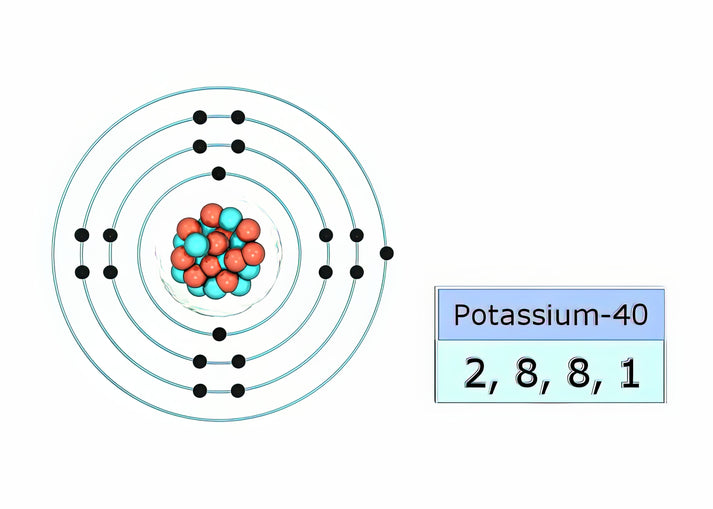
The potassium electron configuration, [Ar] 4s¹, represents a fundamental concept in atomic physics and chemistry. This notation describes the distribution of potassium's 19 electrons across its atomic orbitals, highlighting its position as an alkali metal in Group 1 of the periodic table. The single valence electron in the 4s orbital explains potassium's high reactivity and its role in biological and industrial processes.
Understanding Potassium Electron Configuration
Potassium (atomic number 19) has an electron configuration of 1s² 2s² 2p⁶ 3s² 3p⁶ 4s¹, often abbreviated as [Ar] 4s¹. This configuration follows the Aufbau principle and Hund's rule, placing electrons in the lowest energy orbitals first. The 4s orbital is filled before the 3d orbitals, a key example of the n+l rule in quantum mechanics. This arrangement underpins potassium's chemical behavior, including its tendency to lose one electron to form K⁺ ions.
Scientific and Educational Significance
This electron configuration is crucial for understanding periodic trends, such as atomic radius and ionization energy. Potassium's single 4s electron makes it highly electropositive, contributing to its use in fertilizers, soaps, and biological functions like nerve transmission. RedKalion's art print captures this scientific elegance with precision, offering a visual aid for students, educators, and enthusiasts.
Print Specifications & Materials
- Available Sizes: 75×100 cm / 30×40″, 40×50 cm / 16×20″, 21×29.7 cm / 8×12″
- Paper Finishing: Matte, uncoated, natural white (off-white)
- Acid-Free: pH above 7 to prevent yellowing over time
- Paper Weight: 250 gsm (110 lb) | Thickness: 0.29 mm (11.4 mils)
- Sustainable Paper: FSC-certified
Explore the potassium electron configuration through RedKalion's premium print, designed for clarity and durability in educational or decorative settings.

Discover Unlimited Art Possibilities
At RedKalion, you can find virtually any artwork from any artist, available in a wide range of sizes to perfectly match your space.
If you didn’t find what you’re looking for, contact us at support@redkalion.com . We will source any artwork and produce it in any size and format you need, including art prints, posters, canvas, framed pieces, framed canvas, and more.
For dedicated art enthusiasts, we also offer handcrafted replicas of any artwork, carefully painted by highly skilled artists using traditional techniques.
For custom requests, contact us at support@redkalion.com .
What is the electron configuration of potassium?
The electron configuration of potassium is [Ar] 4s¹, indicating it has 19 electrons with one valence electron in the 4s orbital.
Why is potassium's electron configuration important in chemistry?
It explains potassium's reactivity and placement in the periodic table, influencing properties like ionization energy and atomic radius for chemical studies.
What paper is used for this fine art print?
We use FSC-certified, acid-free paper with a matte finish and 250 gsm weight to ensure archival quality and prevent yellowing over time.
How is this art print shipped and packaged?
Prints are shipped flat in protective packaging to prevent damage, with tracking provided for secure delivery to your location.
How long will this print last without fading?
With acid-free materials and proper framing, this print can last decades without significant fading or deterioration under normal conditions.
How does potassium's electron configuration affect its chemical properties?
The single 4s electron makes potassium highly reactive, leading to easy loss of this electron to form positive ions in compounds and reactions.
What is the abbreviated notation for potassium's electron configuration?
The abbreviated notation is [Ar] 4s¹, where [Ar] represents the electron configuration of argon, the preceding noble gas.