
RedKalion
Telegraph Drawing: Morse's First Telegraph Apparatus Art Print | RedKalion
Telegraph Drawing: Morse's First Telegraph Apparatus Art Print | RedKalion
Couldn't load pickup availability
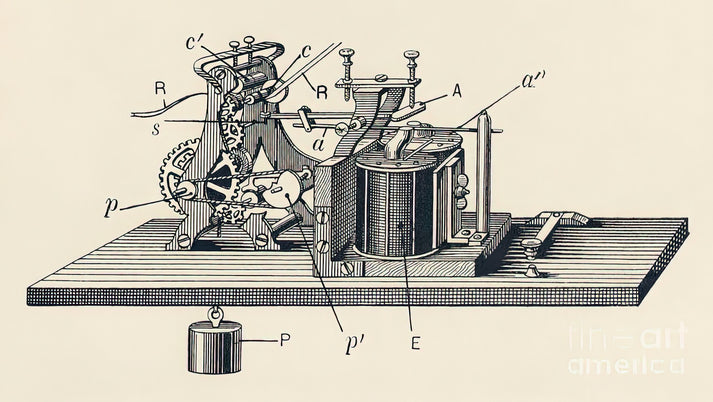
This telegraph drawing captures Samuel F.B. Morse's pioneering 1837 telegraph apparatus, a pivotal invention in communication history. The detailed technical illustration, often attributed to Morse or his contemporaries, showcases the original electromagnetic design with its key, register, and battery components. It reflects the transition from visual art to scientific documentation during the Industrial Revolution.
Historical Context of the Telegraph Drawing
Created in the early 19th century, this telegraph drawing documents Morse's initial prototype, which laid the groundwork for the first long-distance telegraph line in 1844. The artwork blends engineering precision with artistic draftsmanship, typical of patent illustrations from the era. Its clean lines and functional focus highlight the utilitarian aesthetic of early American innovation.
Artistic Analysis of Morse's Apparatus
As a telegraph drawing, this piece exemplifies technical illustration as an art form. The composition emphasizes clarity and accuracy, using cross-sections and annotations to explain the apparatus's mechanics. The monochromatic style, likely in ink on paper, underscores the drawing's purpose as a blueprint for technological progress, devoid of decorative flourishes.
RedKalion's fine art print preserves every nuance of this historical telegraph drawing, offering a museum-quality reproduction for scholars and enthusiasts. Our archival standards ensure the print's longevity, making it a trusted addition to any collection focused on scientific heritage.
Print Specifications & Materials
- Available Sizes: 75×100 cm / 30×40″, 40×50 cm / 16×20″, 21×29.7 cm / 8×12″
- Paper Finishing: Matte, uncoated, natural white (off-white)
- Acid-Free: pH above 7 to prevent yellowing over time
- Paper Weight: 250 gsm (110 lb) | Thickness: 0.29 mm (11.4 mils)
- Sustainable Paper: FSC-certified


Discover Unlimited Art Possibilities
At RedKalion, you can find virtually any artwork from any artist, available in a wide range of sizes to perfectly match your space.
If you didn’t find what you’re looking for, contact us at support@redkalion.com . We will source any artwork and produce it in any size and format you need, including art prints, posters, canvas, framed pieces, framed canvas, and more.
For dedicated art enthusiasts, we also offer handcrafted replicas of any artwork, carefully painted by highly skilled artists using traditional techniques.
For custom requests, contact us at support@redkalion.com .
What is depicted in this telegraph drawing?
This telegraph drawing illustrates Samuel F.B. Morse's first telegraph apparatus from 1837, showing key components like the electromagnetic key and register in a detailed technical illustration.
What are the paper specifications for this art print?
The print uses 250 gsm, acid-free, FSC-certified paper with a matte finish to ensure archival quality and accurate reproduction of the telegraph drawing details.
How is the art print shipped and packaged?
We ship prints in sturdy, flat packaging with protective layers to prevent damage, ensuring your telegraph drawing arrives ready for framing.
How long will the print last without fading?
With acid-free paper and archival inks, this fine art print of the telegraph drawing resists fading and yellowing for decades under proper display conditions.
Who created the original telegraph drawing?
The original is attributed to Samuel F.B. Morse or his associates, made around 1837 as a patent illustration for the first electromagnetic telegraph apparatus.
Why is this telegraph drawing historically significant?
It documents Morse's prototype that revolutionized communication, marking a key moment in the Industrial Revolution and the history of technology.