

RedKalion
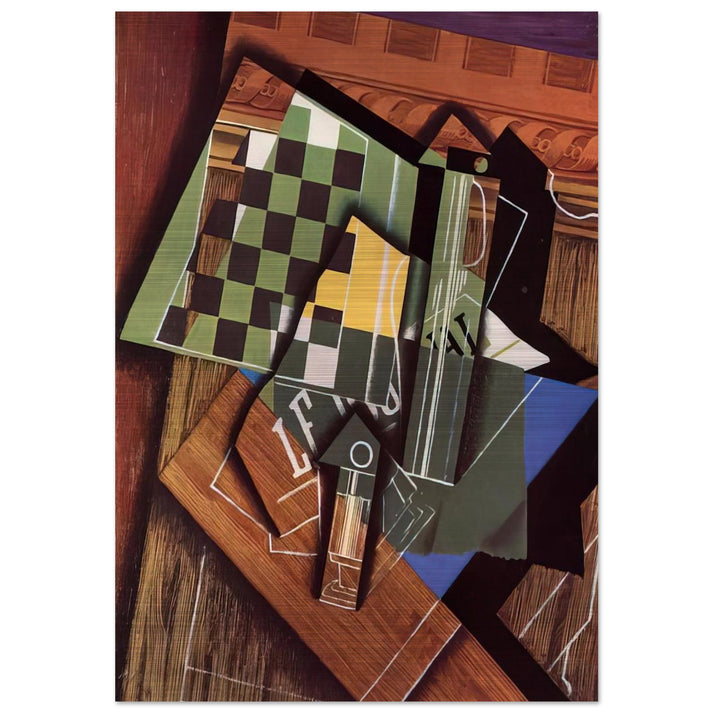
THE CHECKERBOARD 1915 - Juan Gris Brushed Aluminum Print - 70x100 cm / 28x40 inches | Juan Gris Aluminum Print | Juan Gris Prints
THE CHECKERBOARD 1915 - Juan Gris Brushed Aluminum Print - 70x100 cm / 28x40 inches | Juan Gris Aluminum Print | Juan Gris Prints
Couldn't load pickup availability
THE CHECKERBOARD 1915 - Juan Gris Brushed Aluminum Print
Immerse yourself in the analytical precision of Juan Gris, a master of Synthetic Cubism, with this museum-quality reproduction of "The Checkerboard" (1915). This iconic work exemplifies Gris's revolutionary approach to still life, where fragmented planes, geometric forms, and a restrained palette of grays, blacks, and whites converge to create a harmonious, intellectually charged composition. The checkerboard pattern, a recurring motif in Cubist art, serves as both a structural grid and a metaphor for the artist's methodical deconstruction and reassembly of reality.
RedKalion presents this masterpiece as a premium brushed silver Aluminum DIBOND® print, meticulously crafted to honor Gris's vision. The 3mm thick, rigid base ensures durability, while the direct print technology captures every nuanced shade with vivid clarity. The matte, glare-free finish accentuates the artwork's stark contrasts, and the horizontal grain of the metal adds a dynamic, contemporary texture. Unprinted areas reveal a subtle metallic silver effect, enhancing the piece's modern aesthetic.
Measuring 70x100 cm (28x40 inches), this archival-grade reproduction is designed to elevate any space—from a minimalist home office to a sophisticated gallery wall. Each print includes a complete hanging kit for effortless installation. Trust RedKalion to deliver not just a print, but a lasting piece of art history, where expert curation meets unparalleled craftsmanship.


Discover Unlimited Art Possibilities
At RedKalion, you can find virtually any artwork from any artist, available in a wide range of sizes to perfectly match your space.
If you didn’t find what you’re looking for, contact us at support@redkalion.com . We will source any artwork and produce it in any size and format you need, including art prints, posters, canvas, framed pieces, framed canvas, and more.
For dedicated art enthusiasts, we also offer handcrafted replicas of any artwork, carefully painted by highly skilled artists using traditional techniques.
For custom requests, contact us at support@redkalion.com .
What are the dimensions and material of this Juan Gris aluminum print?
This fine art print measures 70x100 cm (28x40 inches) and is crafted from brushed silver Aluminum DIBOND® with a 3mm thickness for a durable, museum-quality reproduction.
How does the printing process enhance the artwork's details?
Direct printing on Aluminum DIBOND® ensures vivid colors and a matte finish, ideal for capturing Juan Gris's Cubist contrasts, with unprinted areas revealing a metallic silver effect.
Is a hanging kit included with the brushed aluminum print?
Yes, a complete hanging kit is included for easy installation; specific components may vary by fulfillment country to ensure secure mounting.
What makes this print archival and long-lasting?
Made with premium Aluminum DIBOND® and archival-grade inks, this print resists fading and damage, offering a durable, museum-quality reproduction for years.
How does the brushed finish affect the artwork's appearance?
The horizontal grain and matte finish reduce glare, highlighting the stark contrasts in Juan Gris's "The Checkerboard" while adding a dynamic, modern texture.
What is the historical significance of "The Checkerboard" by Juan Gris?
Created in 1915, this work is a key example of Synthetic Cubism, where Gris used geometric fragmentation and a checkerboard motif to deconstruct and reassemble still life with intellectual precision.
How does Juan Gris's technique differ in this artwork?
Gris employed a restrained palette and structured planes in "The Checkerboard" to explore spatial relationships, moving beyond earlier Cubist styles to emphasize harmony and analytical depth.