
RedKalion
Viva la Vida Watermelons Art Print by Frida Kahlo | RedKalion
Viva la Vida Watermelons Art Print by Frida Kahlo | RedKalion
Couldn't load pickup availability
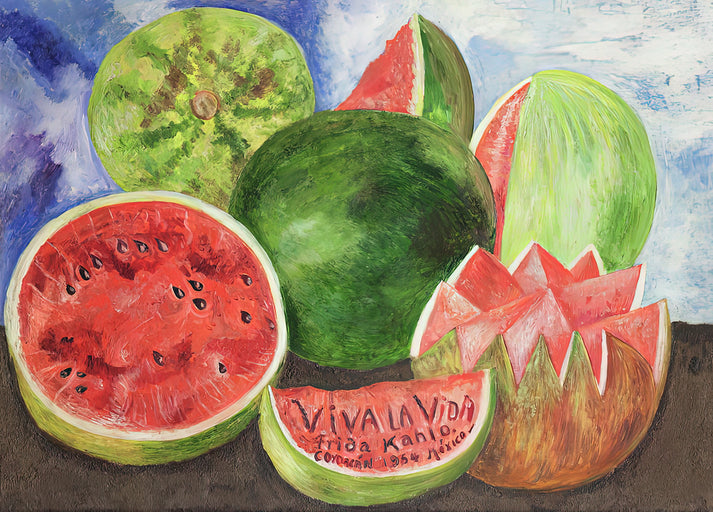
Frida Kahlo's final painting, Viva la Vida, Watermelons (1954), is a profound testament to her enduring spirit. Created just days before her death, this vibrant still life transforms watermelons into a powerful symbol of life, resilience, and Mexican identity. The bold inscription "VIVA LA VIDA" (Long Live Life) on a central slice serves as her defiant farewell, merging personal pain with celebratory color.
Frida Kahlo's Viva la Vida: A Final Masterpiece
Kahlo's late work often utilized still life to explore complex themes. Here, the luscious red fruit against a stark blue sky creates a dynamic contrast, reflecting her mastery of symbolic color. The composition's raw, almost visceral quality connects to her lifelong exploration of physical and emotional existence, making it a cornerstone of 20th-century art.
Watermelons in Mexican Art and Symbolism
In Mexican culture, watermelons are associated with the Day of the Dead and life's cyclical nature. Kahlo elevates this everyday subject, infusing it with personal meaning—her own vitality amidst suffering. The painting's textured brushwork and vivid palette demonstrate her unique blend of folk art and surrealist techniques, offering viewers a deeply resonant visual narrative.
Print Specifications & Materials
- Available Sizes: 75×100 cm / 30×40″, 40×50 cm / 16×20″, 21×29.7 cm / 8×12″
- Paper Finishing: Matte, uncoated, natural white (off-white)
- Acid-Free: pH above 7 to prevent yellowing over time
- Paper Weight: 250 gsm (110 lb) | Thickness: 0.29 mm (11.4 mils)
- Sustainable Paper: FSC-certified
RedKalion's premium art print of Viva la Vida, Watermelons captures every detail of Kahlo's iconic work, from the rich hues to the expressive brushstrokes. Our museum-quality reproduction ensures this powerful symbol of life and resilience is preserved for your collection, honoring Kahlo's legacy with archival integrity.

Discover Unlimited Art Possibilities
At RedKalion, you can find virtually any artwork from any artist, available in a wide range of sizes to perfectly match your space.
If you didn’t find what you’re looking for, contact us at support@redkalion.com . We will source any artwork and produce it in any size and format you need, including art prints, posters, canvas, framed pieces, framed canvas, and more.
For dedicated art enthusiasts, we also offer handcrafted replicas of any artwork, carefully painted by highly skilled artists using traditional techniques.
For custom requests, contact us at support@redkalion.com .
What is the historical significance of Frida Kahlo's Viva la Vida painting?
Painted in 1954, it was Kahlo's final work, created days before her death. The inscription "VIVA LA VIDA" on a watermelon slice symbolizes her defiant embrace of life amidst pain, reflecting Mexican cultural themes and her personal resilience.
What materials are used for the Viva la Vida fine art print?
Our print uses FSC-certified, acid-free paper (pH above 7) with a matte, uncoated finish. It's 250 gsm thick to ensure durability and prevent yellowing, making it a museum-quality reproduction for long-term display.
How is the Viva la Vida art print shipped and packaged?
Prints are carefully rolled in a protective tube with acid-free tissue, shipped via tracked courier. This method prevents creases and damage, ensuring your Frida Kahlo artwork arrives in perfect condition for framing.
Is the Viva la Vida print archival and fade-resistant?
Yes, the acid-free paper and high-quality inks are designed for archival longevity, resisting fading for decades under normal indoor lighting. This preserves the vibrant colors of Kahlo's watermelons artwork.
What sizes are available for the Viva la Vida watermelons print?
Available in 75×100 cm (30×40″), 40×50 cm (16×20″), and 21×29.7 cm (8×12″). Each size is produced to scale, maintaining the original painting's proportions for an authentic display.
Why did Frida Kahlo choose watermelons for this painting?
Watermelons are a symbol of life and Mexican identity, often linked to the Day of the Dead. Kahlo used them to convey vitality and resilience, with the red flesh representing passion and the green rind symbolizing hope.
How does the Viva la Vida print compare to the original artwork?
Our print is a high-resolution reproduction that captures Kahlo's brushstrokes and color palette. While not the original, it offers an accurate, detailed version for home or gallery display, made with archival materials.