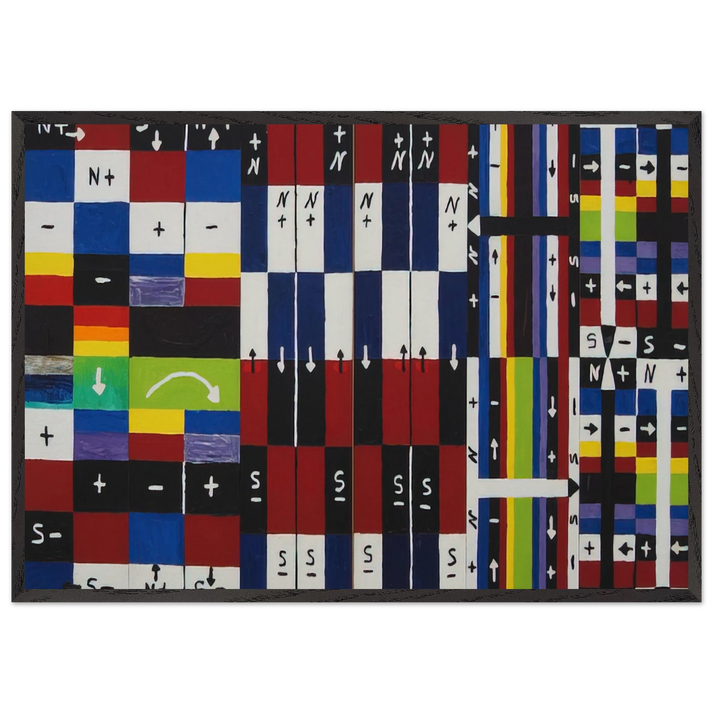

What makes the "A World in Itself" print museum-quality?
RedKalion utilizes 250 gsm archival paper and premium inks to ensure the highest color accuracy and detail. This museum-quality reproduction captures Alfred Jensen’s intricate geometric patterns with precision, providing a long-lasting fine art print that resists fading over time.
What are the specifications of the paper used for this Alfred Jensen print?
We use a natural white, matte, uncoated paper weighing 250 gsm (110 lb). With a thickness of 0.29 mm (11.4 mils), this archival paper is chosen specifically for its ability to hold rich pigments without sheen, perfect for high-end gallery displays.
What are the dimensions and materials of the black wooden frame?
The frame is crafted from responsibly sourced ash wood, finished in an elegant black. It measures 20mm (0.79") in both width and thickness, offering a sturdier and more premium aesthetic compared to standard 14mm frames, perfectly complementing the 70x100 cm print.
How does RedKalion ensure the archival longevity of the artwork?
Our use of FSC-certified, archival-grade museum paper combined with shatterproof plexiglass protection ensures the print remains pristine. These materials prevent yellowing and physical damage, allowing your Alfred Jensen reproduction to endure as a legacy piece in your collection.
Is the framed artwork ready to hang upon delivery?
Yes, your framed Alfred Jensen print arrives fully assembled and ready-to-hang. We include a professional hanging kit with every order, ensuring a secure and effortless installation immediately upon unboxing your new masterpiece.
What is the significance of the year 1961 in Alfred Jensen's career?
1961 marked a peak in Jensen's career when his "conceptual" abstraction gained significant recognition. During this era, his work was featured in major exhibitions like "The Art of Assemblage," cementing his reputation as a master of systemic and mathematical art.
What influenced the geometric patterns in Jensen's "A World in Itself"?
Jensen’s patterns were influenced by diverse systems including the Maya calendar, the I Ching, and Faraday's laws of electromagnetism. "A World in Itself" reflects this synthesis of ancient wisdom and modern science through its rhythmic, grid-like composition.