
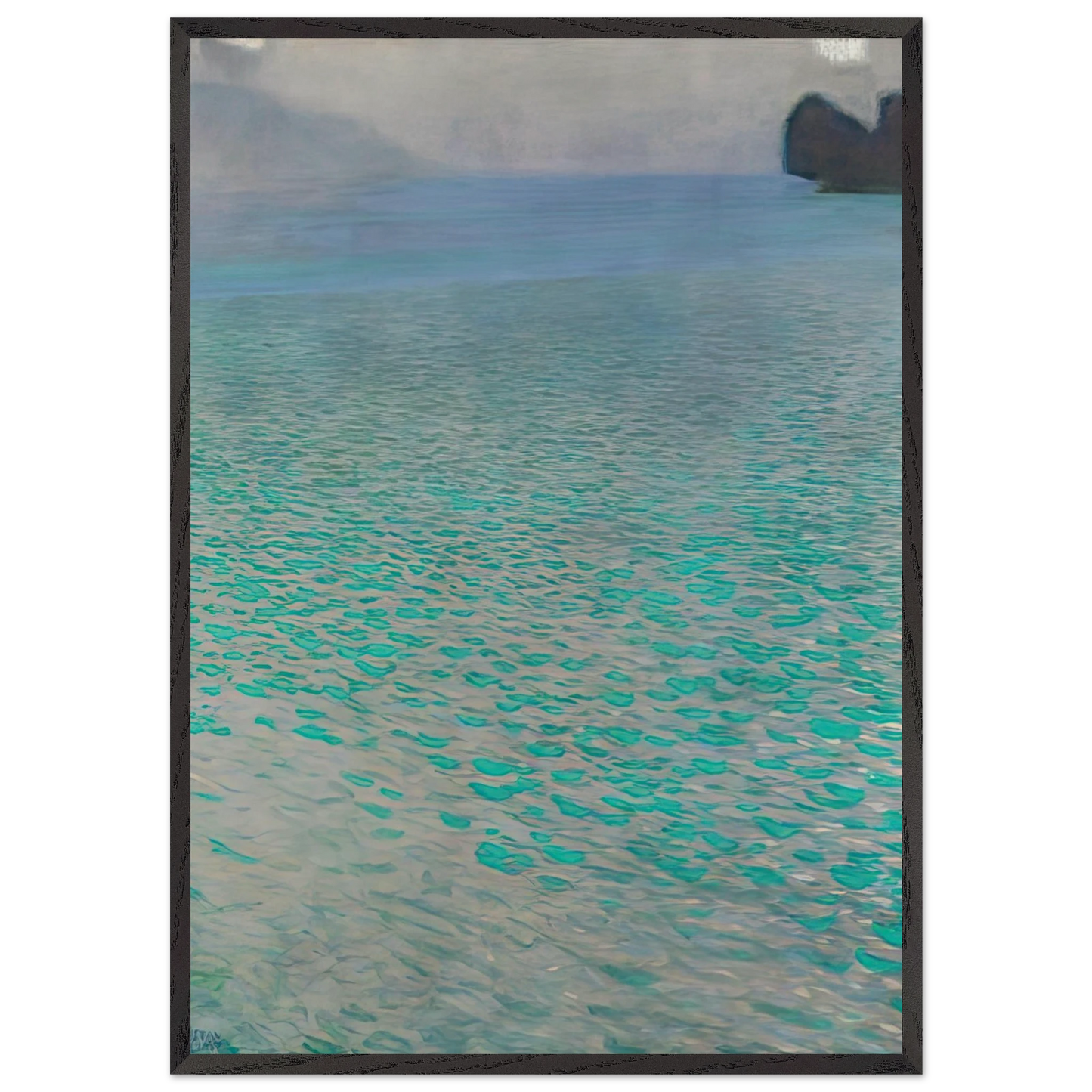
What is the significance of Gustav Klimt's Attersee 1900?
Attersee 1900 marks Klimt’s transition toward landscape painting. It focuses on the lake’s surface, utilizing a unique square-crop perspective and Pointillist techniques to explore light and water, significantly influencing modern landscape abstraction.
How does Klimt capture the water's texture in this piece?
Klimt employed a mosaic-like brushwork style, applying small dabs of color to simulate the shimmering effects of light reflecting on the water. This technique emphasizes the flat, decorative surface while suggesting depth through color variation.
What kind of paper is used for this Klimt reproduction?
We use 250 gsm (110 lb) natural white, matte archival paper. It is uncoated and museum-quality, ensuring the high-resolution details of Klimt’s work are captured without reflective glare.
How is the Attersee 1900 print framed?
The print is housed in a 20mm (0.79") thick black frame made from responsibly sourced oak and ash. This premium frame is wider than standard options, providing a modern, high-end gallery aesthetic.
Is the artwork protected from environmental damage?
Yes, each framed print features shatterproof plexiglass. This provides superior protection against dust and impact while maintaining the visual clarity required for fine art appreciation.
Is the framed print ready to hang upon arrival?
Absolutely. Every order from RedKalion includes a professional hanging kit. The 70x100 cm framed print is designed to be ready-to-hang directly out of the box.
Are the materials used in this print sustainable?
RedKalion prioritizes sustainability. We use FSC-certified wood for our frames and paper, ensuring that your museum-quality reproduction is environmentally responsible and ethically produced.