

RedKalion
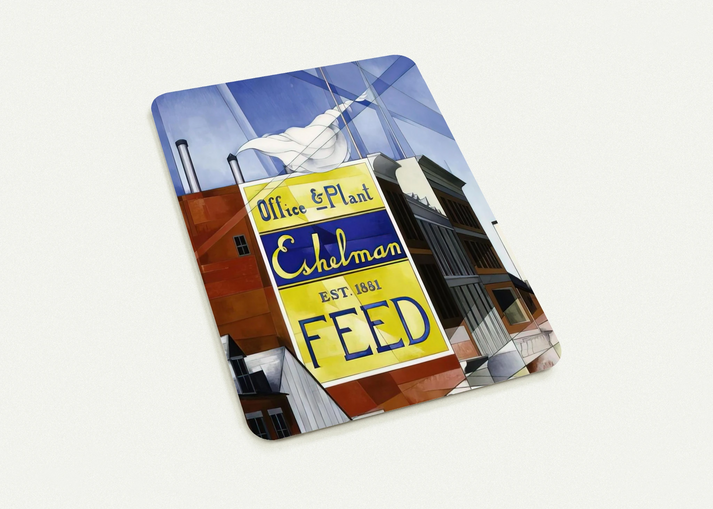
Buildings, Lancaster - 1930 By Charles Demuth Pack of 10 Post Cards | Charles Demuth Post Cards | A6 (10.5 x 14.8 cm) - 4.1 x 5.8 inches
Buildings, Lancaster - 1930 By Charles Demuth Pack of 10 Post Cards | Charles Demuth Post Cards | A6 (10.5 x 14.8 cm) - 4.1 x 5.8 inches
Não foi possível carregar a disponibilidade de recolha
The Industrial Elegance of Charles Demuth’s Buildings, Lancaster (1930)
Experience a definitive masterpiece of American Modernism with this pack of 10 archival postcards featuring Charles Demuth’s Buildings, Lancaster (1930). As a pioneer of the Precisionist movement, Demuth transformed the industrial architecture of his Pennsylvania hometown into a symphony of geometric clarity and rhythmic lines. This specific work, created toward the end of his life, represents the pinnacle of his ability to fuse Cubist abstraction with a clean, uniquely American realism.
In Buildings, Lancaster, Demuth explores the interplay between light and structure, using sharp-edged forms to elevate the utilitarian factory into a subject of profound beauty. Each postcard serves as a portable tribute to this era, capturing the subtle tonal shifts and architectural precision that defined the artist's legacy. Whether used for personal correspondence or as a curated mini-gallery for your workspace, these prints offer a sophisticated connection to 20th-century art history.
Museum-Grade Reproduction by RedKalion
RedKalion is dedicated to preserving the integrity of world-class art through meticulous printing standards. These postcards are not mere stationary; they are professional-grade reproductions designed for the discerning collector. Utilizing 12-color fine art printing technology, we achieve a depth of color and vibrancy that standard commercial printing cannot replicate, ensuring every shade of Demuth’s palette is rendered with absolute fidelity.
- Color Accuracy: Advanced 12-color ink systems for stunning depth and archival permanence.
- Paper Quality: Printed on 200 gsm (80 lb) FSC-certified paper with a thickness of 0.26 mm (10.3 mils).
- Refined Finish: A smooth matte surface that eliminates glare while maintaining a tactile, premium feel.
- Sustainability: Responsibly sourced, eco-friendly materials printed on demand to reduce environmental impact.
- Dimensions: Classic A6 format (10.5 x 14.8 cm / 4.1 x 5.8 inches), ideal for framing or mailing.
Elevate your correspondence or decor with these archival masterpieces—a testament to historical significance and modern craft that endures for years to come.


Discover Unlimited Art Possibilities
At RedKalion, you can find virtually any artwork from any artist, available in a wide range of sizes to perfectly match your space.
If you didn’t find what you’re looking for, contact us at support@redkalion.com . We will source any artwork and produce it in any size and format you need, including art prints, posters, canvas, framed pieces, framed canvas, and more.
For dedicated art enthusiasts, we also offer handcrafted replicas of any artwork, carefully painted by highly skilled artists using traditional techniques.
For custom requests, contact us at support@redkalion.com .
What makes the printing quality of these postcards unique?
We utilize 12-color fine art printing technology, which provides significantly more color depth and accuracy than standard 4-color inkjet methods, ensuring your Charles Demuth prints look museum-quality.
What kind of paper finish should I expect?
These postcards feature a smooth matte finish on 200 gsm (80 lb) paper. This provides a clean, glare-free display and a premium, substantial feel when held.
Are these postcards environmentally friendly?
Yes. We use FSC-certified paper from responsibly managed forests and print each order on demand to minimize waste and ensure eco-conscious production.
How durable are these fine art postcards?
The 0.26 mm thickness and archival-grade materials ensure these postcards are resistant to bending and aging, maintaining their aesthetic integrity for years.
What is the shipping and production process?
Each pack of 10 is printed on demand with no minimum order requirements, ensuring you receive a freshly produced set that meets our strict quality control standards.
What is the art historical significance of Buildings, Lancaster (1930)?
This work is a quintessential example of Precisionism, a movement that celebrated the industrial landscape through sharp lines and geometric abstraction, reflecting America’s modernization in the early 20th century.
Why is Charles Demuth considered a master of his craft?
Demuth bridged the gap between European Cubism and American realism. His meticulous technique and ability to find beauty in industrial structures redefined modern American art.