RedKalion
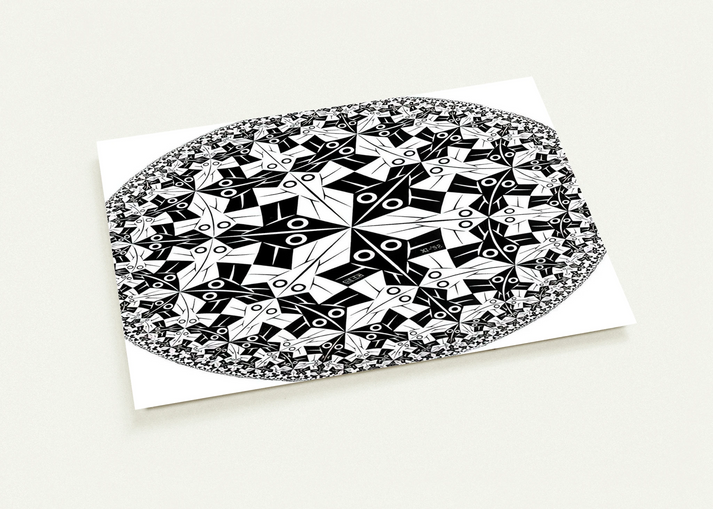
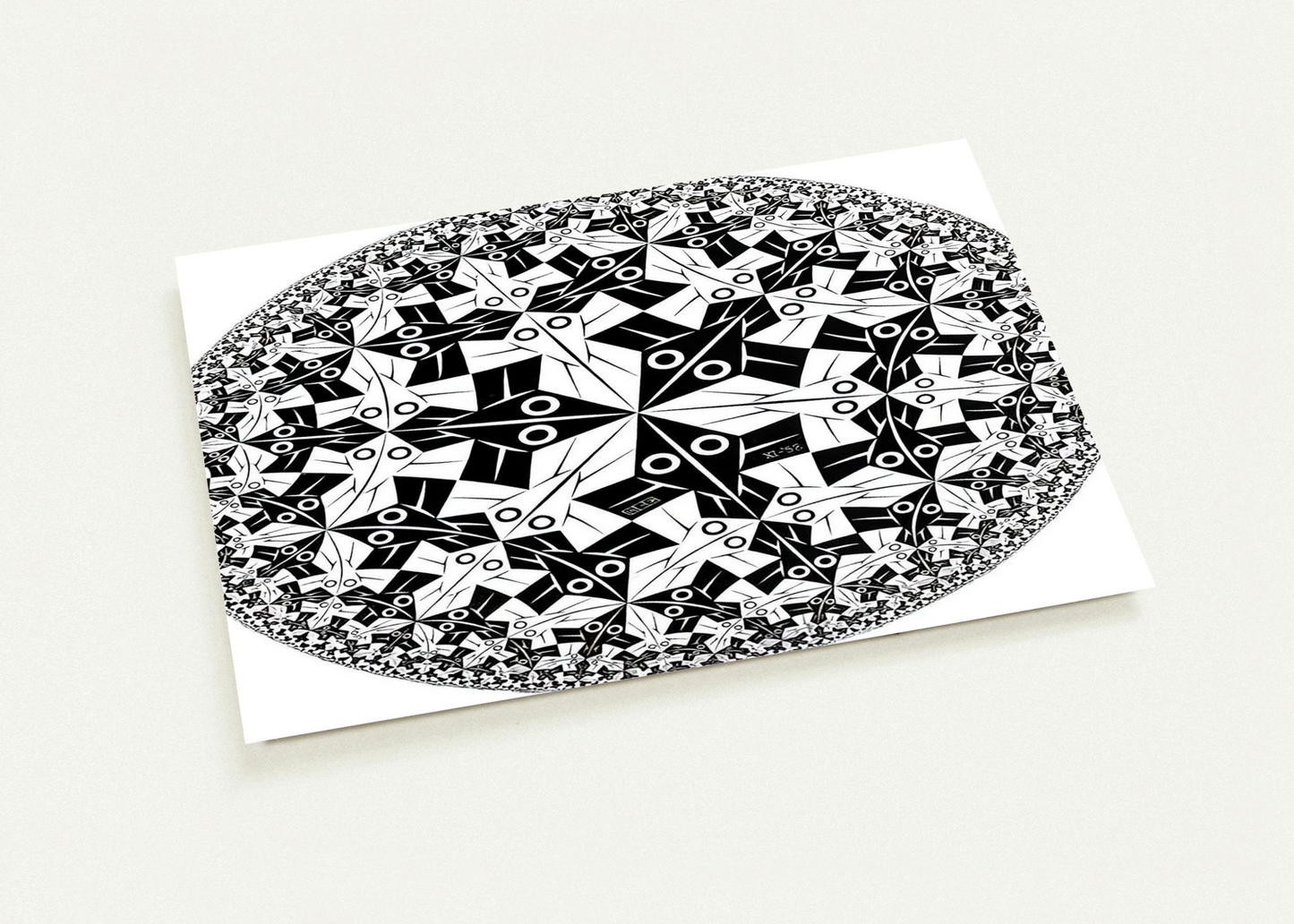
CIRCLE LIMIT I By MC Escher Pack of 10 Post Cards | MC Escher Post Cards | A6 (10.5 x 14.8 cm) - 4.1 x 5.8 inches
CIRCLE LIMIT I By MC Escher Pack of 10 Post Cards | MC Escher Post Cards | A6 (10.5 x 14.8 cm) - 4.1 x 5.8 inches
Não foi possível carregar a disponibilidade de recolha
An Infinite Vision: Circle Limit I by M.C. Escher
Experience the mathematical brilliance of M.C. Escher with this premium pack of 10 Circle Limit I postcards. Originally created in 1958, this woodcut represents Escher's first foray into representing the infinite within a finite boundary. Influenced by the hyperbolic geometry of mathematician H.S.M. Coxeter, Escher meticulously arranged stylized fish that diminish in size as they approach the circle's edge, creating a stunning visual metaphor for the concept of infinity.
Museum-Quality Reproductions for the Discerning Collector
At RedKalion, we bridge the gap between historical masterpiece and modern archival technology. These fine art prints are not standard stationery; they are crafted using a sophisticated 12-color fine art printing process. This technology ensures a depth of color and precision that far exceeds common 4-color inkjet alternatives, capturing every intricate line of Escher's woodcut aesthetic.
- Color Fidelity: 12-color giclée technology for vivid, accurate reproduction of the original monochromatic contrast.
- Premium Paper: 200 gsm (80 lb) FSC-certified paper with a thickness of 0.26 mm (10.3 mils).
- Refined Finish: A smooth matte finish provides a glare-free viewing experience, perfect for framing or mailing.
- Eco-Conscious Excellence: Sustainably sourced materials that meet rigorous environmental standards.
Whether you are sending a thoughtful note to a fellow art lover or curating a miniature gallery wall, these MC Escher postcards elevate any space with an archival masterpiece that endures. RedKalion remains the definitive source for those who demand museum-grade quality in every print.
Discover Unlimited Art Possibilities
At RedKalion, you can find virtually any artwork from any artist, available in a wide range of sizes to perfectly match your space.
If you didn’t find what you’re looking for, contact us at support@redkalion.com . We will source any artwork and produce it in any size and format you need, including art prints, posters, canvas, framed pieces, framed canvas, and more.
For dedicated art enthusiasts, we also offer handcrafted replicas of any artwork, carefully painted by highly skilled artists using traditional techniques.
For custom requests, contact us at support@redkalion.com .
What makes RedKalion’s 12-color printing superior?
Unlike standard 4-color printers, our 12-color technology uses a broader gamut of pigments to create smoother gradients and deeper blacks, ensuring your MC Escher postcards retain the artist's original intent with museum-quality precision.
What is the texture and weight of the postcard paper?
Each card is printed on 200 gsm (80 lb) paper with a smooth matte finish. At 0.26 mm thick, these cards offer a substantial, premium feel suitable for both mailing and display.
Is there a minimum order requirement for these postcards?
No. At RedKalion, we utilize a print-on-demand model, allowing you to order exactly what you need with no minimums, reducing waste and ensuring each pack is freshly printed for you.
Are the materials used for these prints environmentally friendly?
Yes. We use FSC-certified paper, ensuring that the materials for your fine art prints are sourced from responsibly managed forests that provide environmental, social, and economic benefits.
How long will these archival prints last?
By using archival-grade inks and acid-free paper, our prints are designed to resist fading for decades, making them a long-lasting addition to any art collection or correspondence.
What is the mathematical significance of Circle Limit I?
Circle Limit I marks Escher's transition into hyperbolic geometry. It utilizes a repeating pattern of fish that tessellate perfectly while shrinking toward the edge, illustrating a space that is infinite yet bounded.
Who was M.C. Escher?
Maurits Cornelis Escher was a world-renowned Dutch graphic artist known for his mathematically inspired woodcuts and lithographs that explore symmetry, perspective, and impossible architecture.