
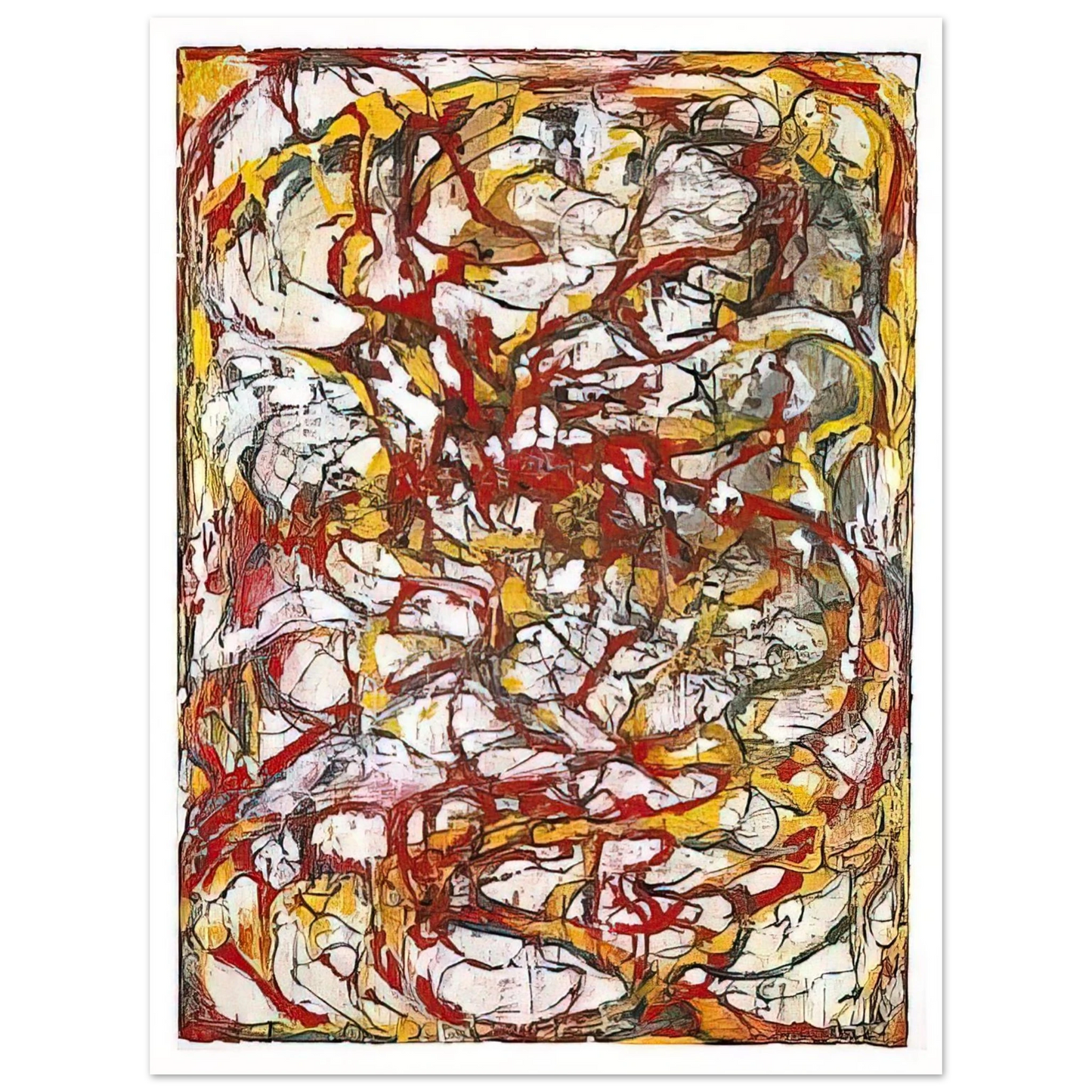
What distinguishes the Dragons (2004) series in Brice Marden's career?
Dragons (2004) represents Marden's mature period, blending American Abstract Expressionism with Chinese calligraphic traditions. These intricate, overlapping lines create a rhythmic spatial depth, moving away from his earlier monochromatic minimalism into a fluid, organic exploration of form and color.
What printing technology and paper quality does RedKalion use?
This reproduction uses our Master's Edition archival paper. It is a 250 gsm (110 lb) museum-quality paper with a thickness of 0.29 mm, ensuring a substantial, premium feel that matches the gravitas of Marden’s contemporary masterpiece.
How does the "Master's Edition" paper affect the visual depth of the artwork?
The matte, uncoated, natural white finish provides a luxurious, non-reflective surface. This specific off-white tone enhances the subtle nuances of Marden's palette, allowing the calligraphic "Dragons" to appear as if they were painted directly onto the textured substrate.
Is the Dragons fine art poster resistant to yellowing over time?
Yes. We use acid-free paper with a pH above 7, which prevents yellowing and degradation. This archival-grade material ensures that the intricate lines and vibrant tones of Brice Marden’s work remain pristine for generations.
How is this large-format 30x40 inch print shipped?
Each print is produced on demand with no minimum order. We use secure, protective packaging designed for fine art, ensuring your 75x100 cm (30x40 inches) poster arrives in gallery-perfect condition, ready for professional framing.
What is the historical influence behind Marden's calligraphic lines?
Marden was deeply influenced by the Couplet from the "Cold Mountain" poems and Han Dynasty calligraphy. Dragons reflects this "Cold Mountain" phase, where the artist utilizes "spirit resonance" (qiyun) to imbue abstract lines with life and motion.
Are RedKalion prints sourced from sustainable materials?
RedKalion is committed to environmental responsibility. We use FSC-certified paper (Forest Stewardship Council), ensuring that your museum-quality reproduction is sourced from responsibly managed forests that provide environmental, social, and economic benefits.