
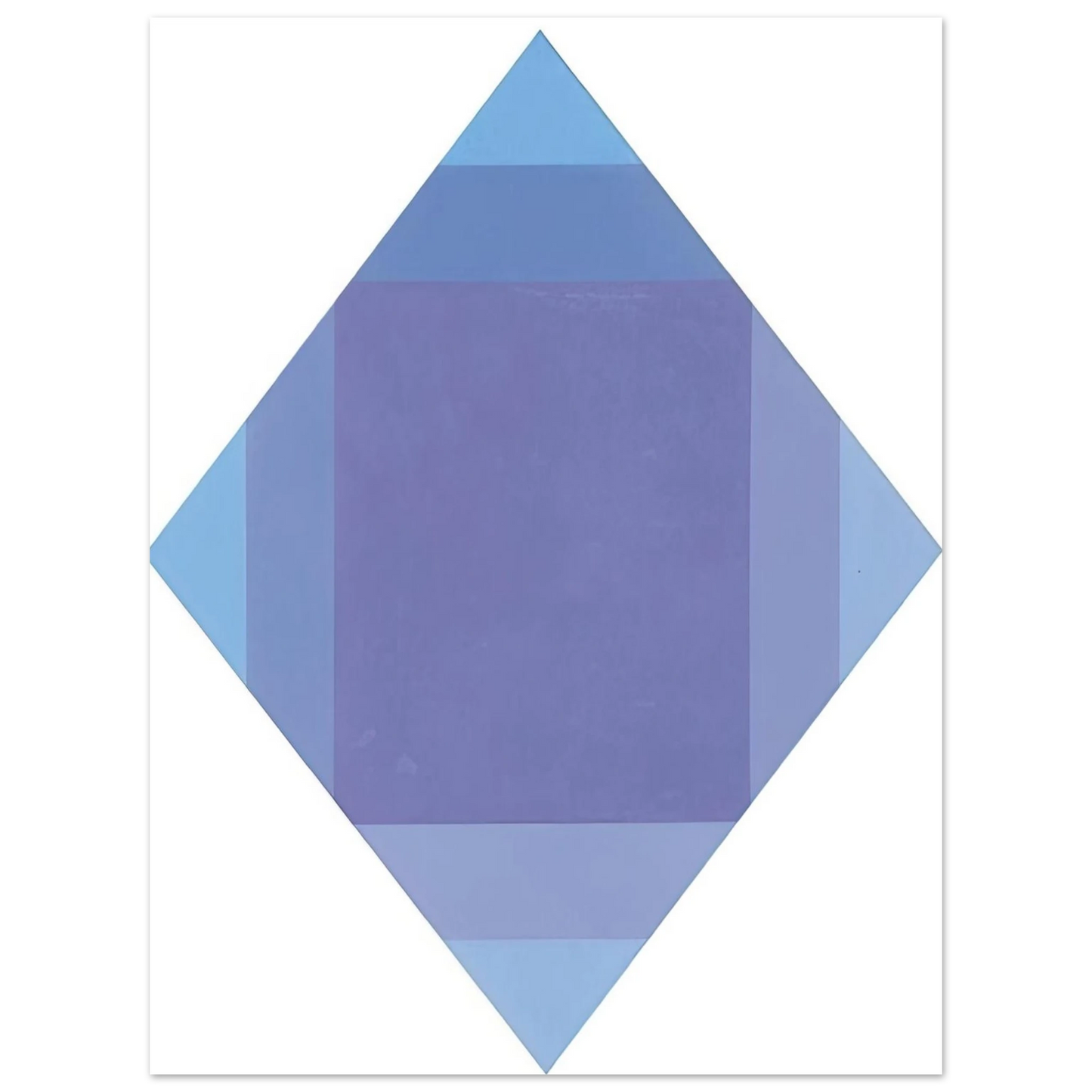
What is the historical significance of Max Bill's "Auflösung von lila" (1972)?
This artwork is a key example of Concrete Art, where Max Bill applied mathematical principles to create abstract compositions, reflecting his Bauhaus training and influence on mid-century design.
How does the geometric design in this print reflect Max Bill's artistic philosophy?
Bill believed art should be based on clear, logical forms; the deconstruction of purple into precise shapes here showcases his commitment to order and visual harmony without symbolic meaning.
What are the specifications of the paper used for this fine art print?
This museum-quality reproduction uses Master's Edition archival paper: matte, uncoated, natural white, 250 gsm weight, 0.29 mm thickness, acid-free for longevity, and FSC-certified for sustainability.
How is the print shipped and are there minimum order requirements?
We print and ship on demand with no minimum orders, ensuring each fine art poster is handled with care and delivered directly to you.
What makes this print archival and resistant to yellowing over time?
The acid-free paper (pH above 7) prevents degradation, making this a durable choice for collectors seeking long-lasting, museum-quality art reproductions.
Can I expect accurate color reproduction in this Max Bill print?
Yes, our premium printing process ensures vibrant, true-to-original colors, capturing the subtle lilac gradients and geometric precision of Bill's 1972 artwork.
Is this print suitable for framing and how does the finish enhance it?
Absolutely; the matte, uncoated finish reduces glare and adds a luxurious texture, making it ideal for framing to showcase this concrete art masterpiece in any setting.