

Discover Unlimited Art Possibilities
At RedKalion, you can find virtually any artwork from any artist, available in a wide range of sizes to perfectly match your space.
If you didn’t find what you’re looking for, contact us at support@redkalion.com . We will source any artwork and produce it in any size and format you need, including art prints, posters, canvas, framed pieces, framed canvas, and more.
For dedicated art enthusiasts, we also offer handcrafted replicas of any artwork, carefully painted by highly skilled artists using traditional techniques.
For custom requests, contact us at support@redkalion.com .
What is the material of this Rene Magritte aluminum print?
This fine art print uses Brushed Silver Aluminum DIBOND® with a metallic finish and horizontal grain for a dynamic, durable look, ideal for museum-quality reproductions.
How thick is the aluminum print, and is it easy to hang?
At 3mm (0.12") thick, it offers a rigid base for durability. A hanging kit is included, with variations based on your fulfillment country for easy installation.
What printing method is used for vivid colors on this Magritte print?
We use direct print on AluDibond to ensure vivid colors and a matte finish, with unprinted white areas revealing a striking metallic silver effect.
Is the finish glare-free for optimal display of this black-and-white artwork?
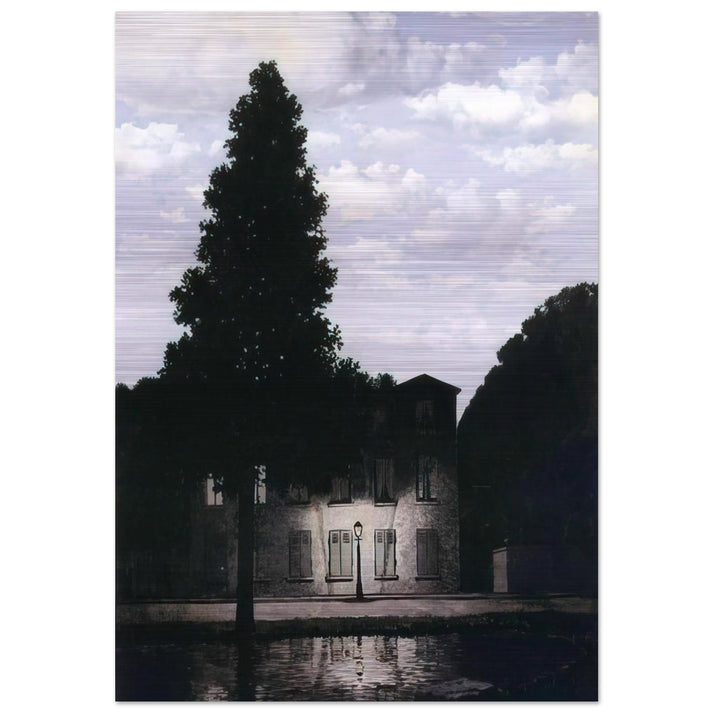
Yes, the matte, glare-free finish is perfect for black-and-white designs like 'The Empire of Lights,' enhancing its surreal visual impact without reflections.
How does RedKalion ensure the archival longevity of this fine art print?
Our archival-grade materials and direct printing on Aluminum DIBOND® provide long-lasting durability, making this a trusted reproduction for art collectors.
What is the historical significance of 'The Empire of Lights' by Rene Magritte?
Created in 1954, this iconic surrealist painting juxtaposes a daytime sky with a nocturnal street scene, exploring themes of reality and illusion in Magritte's signature style.
Why does 'The Empire of Lights' feature contradictory light and dark elements?
Magritte used this contrast to challenge perception and evoke mystery, making it a key example of surrealist art that invites viewer interpretation.