
Discover Unlimited Art Possibilities
At RedKalion, you can find virtually any artwork from any artist, available in a wide range of sizes to perfectly match your space.
If you didn’t find what you’re looking for, contact us at support@redkalion.com . We will source any artwork and produce it in any size and format you need, including art prints, posters, canvas, framed pieces, framed canvas, and more.
For dedicated art enthusiasts, we also offer handcrafted replicas of any artwork, carefully painted by highly skilled artists using traditional techniques.
For custom requests, contact us at support@redkalion.com .
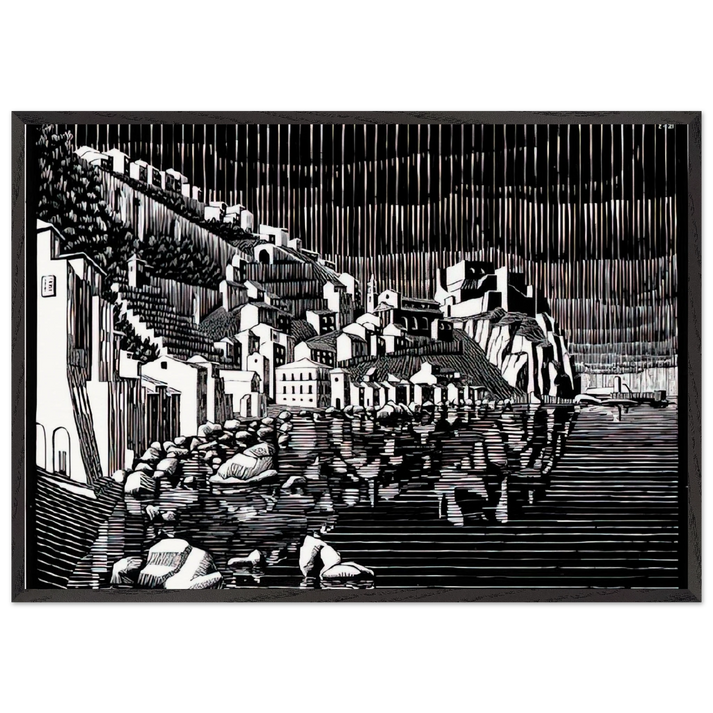
What is the historical significance of Scilla Calabria February 1931 1931 by M.C. Escher?
This 1931 artwork by Maurits Cornelis Escher depicts the Italian coastal town of Scilla in Calabria, showcasing his early exploration of perspective and geometric patterns before his famous tessellations, making it a rare fine art print of his pre-surrealist period.
How does the frame enhance this M.C. Escher print?
The black wooden frame, made from responsibly sourced oak and ash wood and measuring 20mm thick, provides a sturdy, gallery-style border that complements Escher's intricate details in this museum-quality reproduction.
What are the specifications of the paper used for this art print?
This archival print uses 250 gsm (110 lb) matte, uncoated paper with a thickness of 0.29 mm, ensuring durability and vibrant color reproduction for a premium framed art print.
Is this framed print ready to hang upon delivery?
Yes, it includes a hanging kit and is ready-to-hang directly on your wall, making installation simple for this M.C. Escher masterpiece.
How does the plexiglass protect the M.C. Escher reproduction?
Shatterproof plexiglass safeguards the print from dust, UV light, and damage, ensuring long-term preservation of this archival-grade fine art print.
What makes this print an archival-quality reproduction?
It uses FSC-certified, museum-quality paper and archival inks to resist fading, offering a durable M.C. Escher print that maintains its beauty over time.
Can you describe the artistic style in Scilla Calabria February 1931 1931?
Escher employs precise linear perspective and detailed realism in this work, capturing the architectural and natural forms of Scilla with a mathematical clarity that foreshadows his later optical illusions.